Growing adoption brings token economics into focus
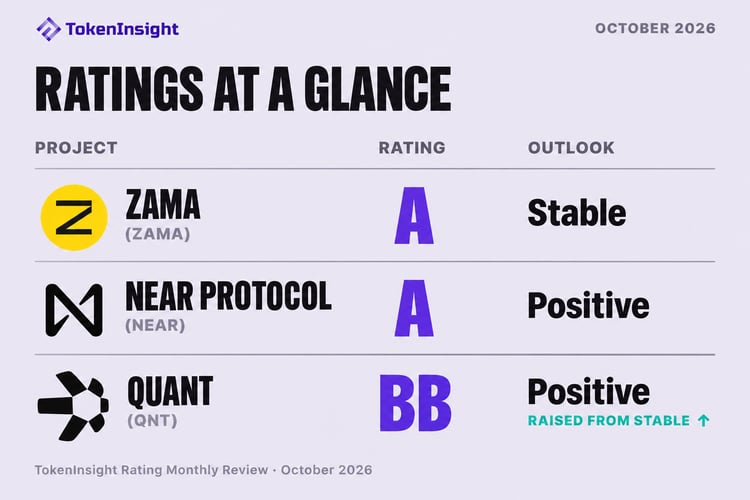
TokenInsight’s latest reviews rate Zama (ZAMA) A / Stable, NEAR Protocol (NEAR) A / Positive, and Quant (QNT) BB / Positive. Quant’s outlook was raised from Stable to Positive.
The three reviews examine different forms of adoption: deposits in confidential DeFi, cross-chain settlement flows, and bank payment infrastructure. They also raise a shared question: how does growing use of a project translate into demand for its token?
Token economics provides a useful comparison across this month’s reviews, alongside the technology, ecosystem development, and execution that inform the broader ratings.
Ratings at a glance
Zama (ZAMA): Growing deposits put fee activity in focus
Rating: A | Outlook: Stable
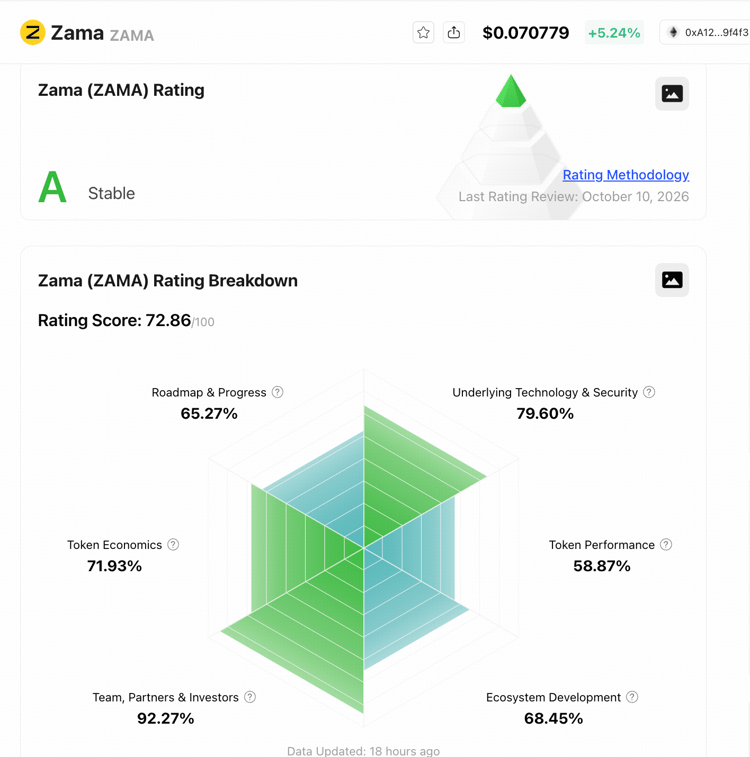
At the time of TokenInsight’s review, Zama’s shielded total value locked (TVL) had reached approximately $114 million, up 37% since September 23. The increase pointed to growing demand for confidential on-chain finance.
The link to ZAMA depends on what users do with those deposits. Zama charges for encrypted-input verification, decryption, and bridging. Fees are denominated in US dollars, paid in ZAMA, and burned in full. Staking rewards are funded through new issuance, with an initial annual inflation rate of 5%.
A larger deposit base creates opportunities for fee-generating activity, but TVL alone does not establish the amount of tokens burned. That depends on the volume and mix of chargeable operations.
This is the unresolved token-economics question behind the Stable outlook. Adoption is progressing, while the scale of usage-driven burns relative to issuance still needs to be demonstrated.
What to watch: recurring protocol fee burns and newly minted staking rewards over the same period.
NEAR Protocol (NEAR): Intents growth strengthens the adoption case
Rating: A | Outlook: Positive
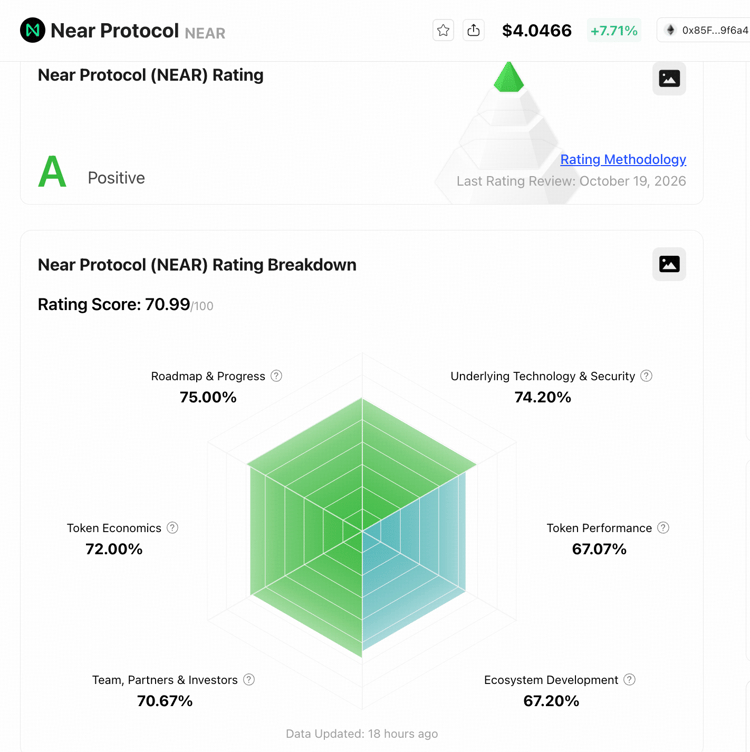
TokenInsight’s review recorded $4.80 billion in NEAR Intents settlement volume in September, almost ten times the level a year earlier. It also recorded more than $2.6 billion in cumulative ZEC settlement through NEAR, highlighting its growing role in privacy-related capital flows.
The Positive outlook reflects this adoption alongside continued protocol development. The review also highlighted support for post-quantum ML-DSA account keys and ongoing improvements to network performance.
The remaining question is how much economic activity reaches NEAR itself. In the review’s measurement window, approximately 4.0 million NEAR flowed into revenue and buyback wallets, while net token supply increased by 20.7 million NEAR.
Transfers to designated wallets should not automatically be treated as completed market buybacks or token burns. The comparison illustrates the importance of tracking execution as well as inflows.
The proposed reduction in annual issuance from 2.5% toward 1.6% is a separate supply-side development. Its contribution depends on implementation, while the demand-side case continues to depend on sustained activity and the revenue it generates.
What to watch: Intents revenue, executed buybacks, net supply growth, and implementation of any approved issuance changes.
Quant (QNT): Bank delivery supports a Positive outlook
Rating: BB | Outlook: Positive, raised from Stable
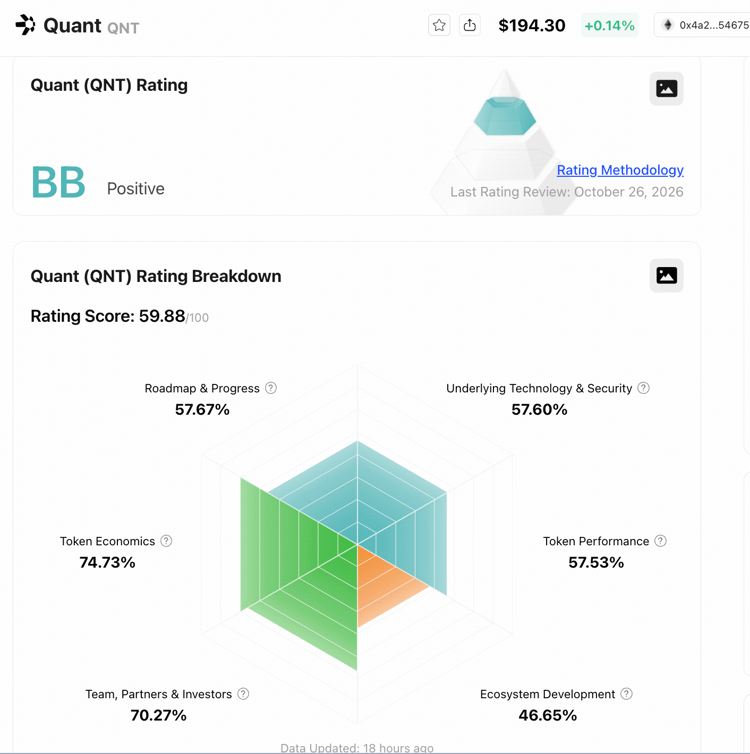
TokenInsight raised Quant’s outlook from Stable to Positive on delivery progress and a more concrete deployment timetable.
The review highlighted live UK customer payments involving Barclays, HSBC, and Lloyds on infrastructure built by Quant. In September, The Clearing House also selected Quant to provide technology for its tokenised-deposit network, expected to become available to participating institutions in the first half of 2027.
Token Economics was Quant’s highest-scoring dimension in the assessment, at 74.73. The review recorded a supply cap of approximately 14.6 million QNT, with about 99.6% already circulating, leaving limited remaining dilution from uncirculated supply.
The BB rating reflects, in part, uncertainty over how directly institutional usage reaches the token. Quant’s platform FAQ permits payment in USD or QNT. That payment choice alone does not establish the token requirements of a specific bank deployment.
At the review date, detailed Fusion staking terms remained an outstanding checkpoint. Clear requirements for staking, locking, or spending QNT would make the relationship between network adoption and token demand easier to assess.
What to watch: Fusion staking terms, named participating banks, and deployment-specific disclosures about QNT usage.
What connects these reviews?
Each project has a different link between adoption and its token. Zama connects chargeable operations to burns. NEAR’s review examines revenue-related flows and buyback execution alongside supply growth. Quant’s institutional progress raises questions about the token requirements of individual deployments.
Following these mechanisms over time will help distinguish business progress from measurable changes in token demand and supply.
Frequently asked questions
- Why does Zama have a Stable outlook despite growing TVL?
Growing TVL supports the adoption case, but it does not establish the scale of recurring fee burns. The review identifies activity-driven burns relative to new issuance as an important unresolved question.
- Does NEAR Intents settlement volume equal NEAR token revenue?
No. Settlement volume measures the value routed through the service. Revenue depends on applicable fees and their allocation. Funds entering buyback wallets, completed purchases, and token burns are also separate measures.
- Does bank adoption of Quant necessarily create demand for QNT?
The connection depends on each deployment’s token requirements. A technology agreement demonstrates adoption of Quant’s infrastructure; assessing QNT demand requires further evidence about payment, staking, locking, or other token uses.
- What is the difference between a rating and an outlook?
A TokenInsight rating expresses the assessment of a project’s and token’s qualifications and risks under its methodology. The outlook indicates the direction of that assessment. A Positive outlook does not guarantee an upgrade or a price increase, and Stable does not mean the token’s price will remain unchanged.
About TokenInsight’s ratings
TokenInsight provides market intelligence through token ratings, research, and data analysis. Our token rating methodology combines quantitative and qualitative assessment across standardized dimensions.
TokenInsight ratings assess a project's and token's qualifications and risks within the blockchain industry. They do not assess investment value and should not be used as the basis for an investment decision. Crypto assets carry substantial risk; readers should conduct their own research and seek professional advice where appropriate.
DeFi
Ethereum
Zero Knowledge Proofs