

EigenLayer's EIGEN Token Analysis

 This article introduces EigenLayer's EIGEN tokenomics and discusses its current price and valuation.

Introduction
EigenLayer is an innovative protocol built on the Ethereum blockchain that introduces the concept of restaking, allowing users to leverage their staked Ethereum (ETH) to provide security for multiple decentralized applications (dApps) simultaneously. This mechanism enhances the security and scalability of Ethereum by enabling stakers to earn additional rewards while optimizing their capital utilization.
EigenLayer acts as a middleware solution, facilitating a marketplace where users can restake their ETH or Liquid Staking Tokens (LSTs) across various applications. This enables protocols to tap into Ethereum's robust security infrastructure without needing to establish their own validator sets, significantly reducing costs and barriers for new projects.
- Restaking Mechanism: Users can opt to restake their staked ETH or LSTs like stETH and rETH, allowing them to extend cryptoeconomic security to various applications on the EigenLayer network. This process is akin to rehypothecation but retains user control over the assets
- Actively Validated Services (AVS): EigenLayer supports AVS, which are services that utilize the pooled security provided by restakers. This creates a dynamic environment where protocols can choose how much yield to offer, and validators can select which services to support based on risk and reward
Token Model
Intersubjective Staking
The EIGEN token, introduced by EigenLayer, serves as a Universal Intersubjective Work Token designed to enhance the security and functionality of decentralized applications (dApps) within the Ethereum ecosystem. The EIGEN token enables a novel concept called intersubjective staking. This allows for penalties (or "slashing") in cases where there is subjective misbehavior that can't be easily identified on-chain. This mechanism helps maintain the integrity of the network by offering intersubjective fault detection without the need to fork Ethereum itself.
In simple terms, "intersubjective" refers to something that is agreed upon or understood by a group of people, rather than something that can be objectively measured by a machine or code. It’s like when two or more people agree on what is fair or what the truth is, even though there isn’t a strict rule or formula to prove it.
In the context of EigenLayer, "intersubjective faults" are behaviors that aren’t explicitly caught by the blockchain’s rules but are still clearly wrong or harmful to the system. When these faults occur, a group of participants (validators or community members) can agree that action should be taken, like penalizing the bad actors. This way, human consensus helps guide decisions that algorithms alone can't make.
- Intersubjective Fault Resolution: EIGEN allows for the resolution of disputes through community consensus, enabling a forking mechanism that can penalize malicious actors by slashing their stakes. This process is termed slashing-by-forking, where a fork is created if a majority of stakers behave maliciously, allowing users to choose which version of the token to support.
- Two-Token Model: EIGEN operates with two distinct tokens:
- EIGEN: This is the primary token used in DeFi applications, which remains unaware of forks, allowing it to be used without complications in long-term positions.
- bEIGEN: This token is used for staking and can be subjected to forking. It governs the canonical state of EigenLayer and manages dispute resolutions across various Active Validated Services (AVS)
Staking Mechanism
EIGEN can be staked to secure various AVS, providing cryptoeconomic security by penalizing operators who commit intersubjective faults. This staking mechanism complements ETH restaking, which primarily addresses objective faults.
AVS Protected by Restaked ETH and Staked EIGEN
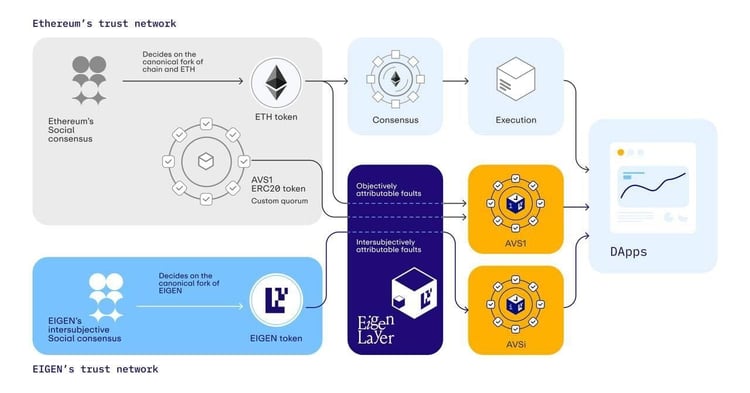
AVS in EigenLayer can be protected by both restaked ETH and staked EIGEN tokens simultaneously. EigenLayer introduces a dual staking model where AVSs like EigenDA (a data availability layer) can utilize both Ethereum's native security through restaked ETH and additional security provided by staked EIGEN tokens.
Restaked ETH comes from Ethereum validators who "reuse" their ETH stake to secure not just Ethereum, but also other protocols on EigenLayer. This pooled security model strengthens AVSs by tapping into Ethereum's robust validator network. On top of that, the EIGEN token brings an added layer of governance and fault-tolerance through intersubjective staking, which allows for penalizing misbehaviors that aren't easily detectable by code.
In essence, by leveraging both restaked ETH and EIGEN, AVSs gain a more comprehensive security mechanism, combining Ethereum's objective slashing with EigenLayer's more nuanced governance and fault-resolution systems.
Token Allocation, Vesting, and Inflation
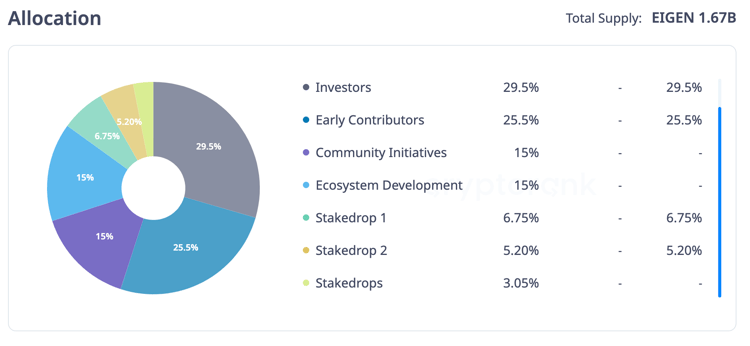
The EIGEN token has an initial total supply of 1.67 billion tokens. However, EIGEN is an inflationary token, meaning this figure does not represent the maximum supply. While the exact inflation rate has not yet been determined, it is expected to be in the low single digits.
At launch, tokens from Statedrop 1 (6.75%) and Statedrop 2 (5.2%) were unlocked, bringing the initial circulating supply to 200 million EIGEN tokens, or approximately 11.95% of the total supply. 3.05% of stakedrops will also be distributed in near future.
Source: cryptorank
Community Allocations (45% Total)
- Stakedrops (15%): This portion rewards stakers who lock up Ethereum (ETH) on EigenLayer.
- Community Initiatives (15%): This allocation is designated for various community-driven projects and initiatives.
- Ecosystem Development (15%): Funds aimed at fostering the broader ecosystem surrounding EigenLayer.
Contributors and Investors (55% Total)
- Early Contributors (25.5%): This group includes developers and early supporters of the protocol.
- Investors (29.5%): Allocated to those who provided funding for the project.
Vesting Schedule
Ecosystem Development
Ecosystem Development has a total allocation of 15% of EIGEN total supply. However, EigenLayer has not disclosed the detailed vesting plan for this category.
Community Initiatives
Community initiatives have been allocated 15% of the total EIGEN token supply. Of this, 4% is designated for Programmatic Incentives v1, which will unlock linearly over one year. The vesting plan for the remaining 11% has not yet been disclosed.
Contributors and Investors
All tokens allocated to investors and core contributors will remain fully locked up for 1 year AFTER the date on which the token first becomes transferrable for the community.
After this date, EIGEN allocated to investors and core contributors will unlock 4% per month. This means EIGEN held by investors and core contributors will not be fully unlocked until 3 years after the date the tokens first become transferable for the community.
Future Infaltion
EigenLayer is designed to have a dynamic token supply similar to Ethereum, with an expected inflationary phase in its early years. The exact emissions schedule has yet to be determined.
According to the project, the inflation design aims to prioritize a balanced ecosystem, distributing EIGEN tokens across various participants such as operators, ETH restakers, and developers. This approach contrasts with typical proof-of-stake systems where rewards predominantly favor existing token holders.
Price and Valuation Analysis
VC Funding Cost
EigenLayer has garnered significant attention in the venture capital space, the project has raised a total of $164.5M in three rounds of fundraising. The last known valuation from Series A is $5 billion, and potentially higher after the Series B investment. The series A funding cost is around $0.3 per EIGEN token. Investors in Series A rounds generally seek returns of 10x to 15x.
SeriesB: $100 Million Investment by Andreessen Horowitz (a16z)
- Announced on February 22, 2024, this investment was made as part of EigenLayer's Series B funding round. a16z was the sole investor in this round
Series A: $50 Million
- Prior to the Series B round, EigenLayer raised $50 million in March 2023, led by Blockchain Capital. This round helped establish a valuation of $5 billion for EigenLayer at that time.
Current Valuation
After its launch on October 1, 2024, the EigenLayer token (EIGEN) experienced significant market activity, starting at an initial price of $3.90 with a fully diluted valuation (FDV) of $6.5 billion. The token's price quickly rose, reaching a high of $4.47 in the first few hours of trading.
The price fluctuated in the days following the launch, largely due to whale activity, such as Tron founder Justin Sun's sale of a large airdrop of EIGEN tokens. Despite these fluctuations, EIGEN's price settled around $3.5 currently, pushing its FDV above $6 billion. The current price is about 10x Series A VC funding cost.
EIGEN is a low float, High FDV token. The relatively large allocation to investors (29.5%) and core contributors (25.5%) making the token face potential significant selling pressure after the 1-year lock-up period.
Related Reading: What is Low Float, High FDV?
The low float, high FDV model has several implications for the market. Initially, it can lead to rapid price appreciation due to the limited supply available for trading. However, as more tokens are unlocked and enter circulation over time, it can create significant selling pressure. This dynamic has raised concerns about the long-term sustainability of such tokens and their potential impact on retail investors. Critics argue that this structure leaves little upside for investors after the token generation event (TGE), as much of the potential value has already been captured by early private investors and venture capitalists.
The future potential of the EIGEN token lies in its demand within the EigenLayer ecosystem. As the circulating supply increases following the one-year lockup period, more Active Validated Services (AVS) will come online, and the EIGEN token will be used in staking to enhance security for these services. These factors are expected to maintain healthy demand for the token and help mitigate selling pressure from token unlocks.
Ethereum
In This Article
Disclaimer

For questions & inquiries
info@tokeninsight.com
For research & editorial
research@tokeninsight.com
2018 – 2026 © TokenInsight Ltd. All rights reserved


Use TokenInsight App All Crypto Insights Are In Your Hands
Open