

zkLink Deep Dive

 zkLink is a Multi-Chain Layer 3 Rollup infrastructure based on zero-knowledge technology that empowers a diverse range of decentralized financial products, including order book DEXs, NFT marketplaces, and more. In this article, we will deep dive into zkLink and its newest advancement, zkLink Nexus.

zkLink is a Multi-Chain Layer 3 Rollup infrastructure based on zero-knowledge technology that empowers a diverse range of decentralized financial products, including order book DEXs, NFT marketplaces, and more.
zkLink functions as a ZK-Rollup infrastructure tailored for DeFi and trading applications, offering a streamlined middleware that connects with both Layer 1 and Layer 2 networks. This connectivity between Layer 1s and Layer 2s makes it a Layer 3 infrastructure where App Rollups can be launched on zkLink that seamlessly integrates with all layers of the blockchain.
zkLink allows developers to easily deploy trading DApps using advanced SDK and APIs. Furthermore, zkLink enhances the trading landscape by aggregating and unifying liquidity from diverse ecosystems. This integration facilitates seamless trading of native DeFi assets across different chains, offering a user-friendly and coherent multi-chain trading experience. This makes zkLink a useful tool for traders and developers alike, fostering the creation of innovative decentralized financial applications.
What Problems Does zkLink Solve?
Layer 2 innovations have made significant headway in increasing Ethereum throughput (scalability), interoperability, and security through the creation of Optimistic and Zero-Knowledge Rollups. However, these networks are still limited in their ability to feasibly and affordably enable high-frequency trading at scale. In addition, they still have not solved the interoperability issues with blockchains beyond Ethereum – and their methods of initiating cross-chain transactions via third-party protocols have introduced security risks and resulted in liquidity fragmentation.
Therefore, the problems zkLink aims to solve include, but are not limited to:
- Interoperability: To address the issue of inadequate infrastructure that facilitates direct crypto token flows across blockchains & different ZK-Rollup Layer 2s
- Scalability: To address the issue of high trading costs for multi-chain assets on Ethereum’s Layer 1 & Layer 2s
- Liquidity Fragmentation: To address the issue of liquidity silos that are isolated on distinct chains
- User Experience/Developer Experience: To address the issue of hampered user adoption & complex user experience of navigating between blockchains
- Self-Sovereignty: To address the issue of traders designating their asset self-custody to CEXs, which impacts decentralization and increases censorship risks
- Security: To address the issue of cross-chain bridging exploits & inter-chain transaction risks
Project Overview
Current State
zkLink Origin
zkLink has already developed and employed its initial hybrid Layer 2/Layer 3 infrastructure protocol called zkLink Origin. zkLink Origin has three pillars: a native multi-chain infrastructure, a one-stop multi-chain asset trading and management solution, and an application-specific multi-chain ZK-Rollup design.
zkLink Origin is a ZK-Rollup-based multi-chain middleware that’s tailored specifically for trading. Its core strength lies in its unified trading layer that integrates multiple Layer 1 blockchains and Layer 2 networks. This integration effectively aggregates and harmonizes liquidity from a variety of ecosystems, thereby facilitating the trading and the composition of native DeFi assets across different chains.
zkLink Origin provides a broad spectrum of liquidity options and showcases its adaptability and compatibility in interfacing with various Layer 1 and Layer 2 blockchains. Thus, applications and users who seek fluid movement of assets and access to a wide array of tokens and trading pairs can benefit from it. zkLink Origin can connect with any chain as long as cross-chain message communication is feasible.
Currently, zkLink Origin supports several prominent Layer 1 chains, such as Ethereum, BNB Smart Chain, Polygon POS, and Avalanche. In addition, it’s compatible with Layer 2 networks including zkSync, Linea, Scroll, StarkNet, Taiko, Linea, Polygon zkEVM, Arbitrum One, and Optimism.
zkLink Nexus
The blockchain industry is witnessing a surge of innovation in the field of zero-knowledge technology, especially with numerous general-purpose ZK-Rollup Layer 2 networks rapidly emerging, with zkEVM frontrunners including Linea, zkSync, Scroll, and Polygon zkEVM, and zkVMs represented by StarkNet. This progress validated zkLink’s original idea from early 2021 to use ZK technology to unify blockchain networks and liquidity across multiple chains and rollups – and resulted in zkLink building a unified Multi-ZK-Rollup infrastructure called zkLink Nexus.
zkLink Nexus is designed to bridge the gap among the ZK-Rollup Layer 2 ecosystems and reduce liquidity fragmentation. In addition, zkLink Nexus enhances performance and brings down the costs for trading DApps, while also making zero security compromises due to it inheriting Ethereum’s security characteristics.
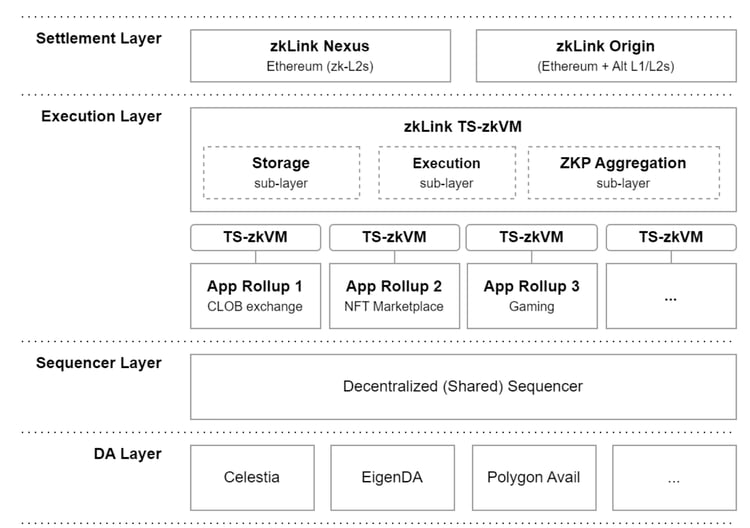
Altogether, the current state of the zkLink protocol includes features such as multi-chain liquidity aggregation, one-stop multi-chain deployment framework, trading-specific zkVM, and more. zkLink is building a secure, scalable, and developer-friendly multi-chain Layer 3 Rollup infrastructure solution aiming to foster a more accessible and inclusive DeFi ecosystem for all crypto users.
Team
zkLink’s team is composed of over 30 individuals and anchored by a globally distributed group of engineers, researchers, and operations specialists. The company's headquarters are in Singapore. zkLink’s team and staff have pursued studies and graduated from renowned institutions including ENSPM Paris, Imperial College London, HIT, Duke University, Johns Hopkins University, Princeton University, Peking University, and Tsinghua University. Their collective expertise, which spans across the academic and professional domains of engineering, economics, finance, cybersecurity, cloud computing, cryptography, smart contracts, and zero-knowledge proofs, provides a solid foundation for zkLink's continued advancement in blockchain technology and the DeFi sector.
Vince Yang – Founder
Vince Yang currently serves as the co-founder and CEO of zkLink, and thereby plays a pivotal role in shaping the overall strategic direction and operations of the company. Yang is an experienced engineer and crypto-tech enthusiast whose entrepreneurial adventure began in the Bitcoin mining business in 2019. Early on, Yang identified the pain point of moving liquidity between networks and the industry’s lack of a reliable cross-chain interoperability bridging function. As a result, Yang immediately put together a development and tech team to work on zero-knowledge bridging technology and distributed computational systems. By leveraging his extensive background in entrepreneurship and product development, Yang brings a wealth of experience to zkLink.
Funding
As of December 19, 2023, zkLink has successfully secured funding through two rounds, amassing a total of $18.5 million.
zkLink accomplished its initial seed round funding on October 22, 2021. The round raised a notable $8.5 million and was led by Republic Crypto. Distinguished participants in this round included Arrington Capital, DeFi Alliance, Huobi Ventures, Ascensive Assets, Morningstar Ventures, GSR, and Marshland Capital.
Additionally, zkLink secured an additional $10 million in funding during a strategic round on May 4, 2023. This round saw participation from notable entities such as Coinbase Ventures, Ascensive Assets, SIG DTI, BigBrain Holdings, and Efficient Frontier, among others. The funds garnered from this strategic round were earmarked to support zkLink's mainnet launch.

Ecosystem
zkLink, as a multi-chain trading infrastructure focused on financial-related protocols and platforms, enables an ecosystem of use cases for DApp developers that include order books, AMMs, NFTs, OFTs, and RWAs, to name a few. The zkLink ecosystem primarily comprises of DeFi products dedicated to trading and other segments, including decentralized exchanges, bridges, NFT marketplaces, and derivatives trading platforms.
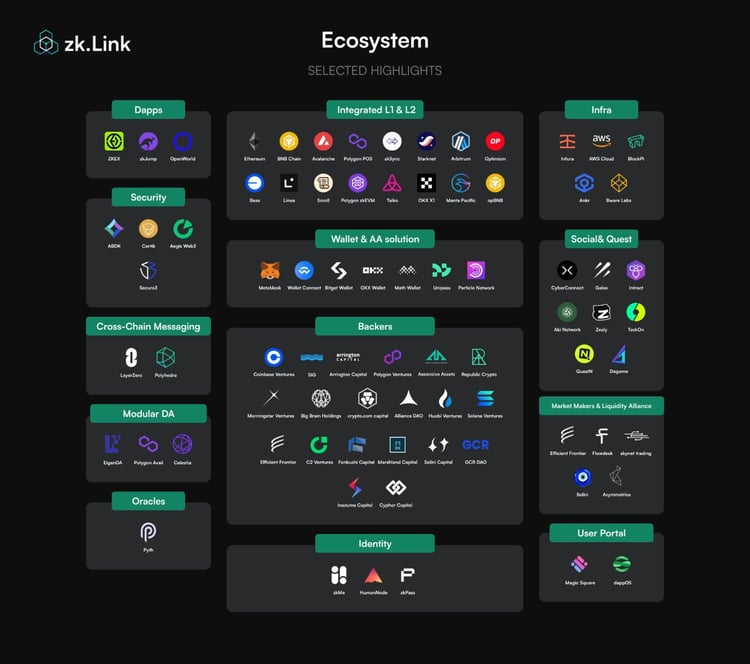
In addition, beyond its ecosystem of already deployed DApps, zkLink has fostered integrations with an ecosystem of 16 connected blockchain networks, multiple infrastructure providers, security partners, modular DA providers, Oracles, cross-chain messaging platforms, wallets, AA solutions, user portals, identity, and zkVM solutions.
As of December 19, 2023, three DApps are deployed on zkLink’s infrastructure that leverages its technology to provide unique trading features. The three DApps are ZKEX, a decentralized multi-chain order book DEX, zkJump, a cross-chain bridge platform, and OpenWorld, a decentralized derivatives exchange.
- ZKEX: Multi-Chain Order Book DEX
ZKEX is a multi-chain order book DEX that harnesses zkLink's technology to facilitate seamless and secure multi-chain trading through an order book model. It represents a crucial component within the zkLink ecosystem, offering users a platform for decentralized trading with a CEX-like user experience. ZKEX is the first DApp to launch on zkLink.
- zkJump: Cross-Chain Bridge
zkJump is the primary cross-chain bridge within the zkLink ecosystem. Leveraging zkLink's technology, zkJump facilitates interoperability by enabling the transfer of assets and data across different blockchain networks. It addresses the need for enhanced connectivity within the broader blockchain ecosystem.
- OpenWorld: Decentralized Derivative Exchange
OpenWorld is a decentralized derivative exchange deployed on zkLink that provides users with the ability to engage in decentralized trading of derivative products. Through zkLink's technology, OpenWorld contributes to expanding the ecosystem by offering a platform for users interested in decentralized derivatives trading.
Moving forward, it is widely anticipated that the zkLink ecosystem will continue to grow with the introduction of additional DApps that concentrate on decentralized trading and other financial protocols.

Partnerships
zkLink has strategically forged trusted partnerships with several prominent entities within the blockchain industry and has established a network of collaborations with many well-known Web3 companies. Notable partners include LayerZero, CyberConnect, and GALXE.

Recent Achievements
- zkLink Nexus Alpha Mainnet Playground Launch
At the end of December 2023, zkLink launched the zkLink Nexus Alpha Mainnet Playground, where users can finally enter zkLink’s Multi-Rollup Layer 3 environment and directly engage with the zkLink protocol by experiencing with the protocol’s non-custodial Layer 3 account, bridging funds from L2 Rollups, and interacting with zkLink’s diverse ecosystem of DApps. The Layer 3 Alpha Mainnet Playground allows users to use their favorite L2 ZK-Rollup and experience Nexus’s L3 environment of gasless transactions, aggregated assets, and bridgeless fees.
Community
The primary channels through which zkLink connects with its community include Twitter, Telegram, Discord, and Medium. Each of these channels serves as a hub for disseminating updates, sharing information, and engaging in discussions with the zkLink community.
Featured below are zkLink's community platforms and follower statistics on its main channels. From the numbers, it’s evident that zkLink’s community presence is relatively strong.
| Social Platform | Followers |
| 350,000 | |
| Discord | 280,000 |
| Medium | 22,000 |
| Telegram | 17,000 |
In addition, the platform's community performance is notably active, evident in its substantial follower count, post status, and frequent user interactions.
Taking Twitter as an example, zkLink's posts typically involve three major categories: recent technology/ecosystem/partnership updates, diverse campaigns, and perspective sharing (such as Twitter Spaces and AMAs). The average number of views is approximately 10,000 to 20,000, and posts are accompanied by a substantial number of likes, often reaching well into the hundreds.

Campaigns
zkLink has been actively conducting various campaigns throughout its development to enhance the overall zkLink brand, community, and ecosystem. Notable campaigns from zkLink's official blog include:
- Dunkirk Test (May 11, 2023)
This campaign targeted asset security, emphasizing the importance of ensuring a secure environment for users' assets. The Dunkirk Test involved testing and validating the security measures implemented within the zkLink ecosystem to fortify user confidence in the platform.
- Summer Tour (Aug 23, 2023)
The Summer Tour campaign focused on reward incentives. It introduced various incentives to encourage users to engage and participate. This campaign included diverse reward mechanisms to incentivize users to actively interact with zkLink's ecosystem.
- Liquidity Alliance Program (Ongoing)
The zkLink Liquidity Alliance Program aims to elevate the trading experience within the zkLink ecosystem. This program encourages market makers to provide liquidity and stimulate trading activities among users.
The program involves pairing market makers with eligible DApps within the zkLink ecosystem, offering liquidity solutions upon request. To support this, zkLink chose to collaborate with key industry players, including Skynet, Asymmetries, EF, Keyrock, Wintermute, Selini, and Flowdesk.

Tokenomics
In the future, zkLink is poised to launch its native utility and governance token, ZKL, which will play a crucial role in the zkLink protocol.
ZKL is the native utility token and governance token for the zkLink protocol. ZKL helps developers unlock access to the zkLink rollup infrastructure service, including the ZK-proof markets. It is also the governance token of the zkLink DAO, which governs the development of the protocol. ZKL will be a standard ERC20 token issued on the Ethereum Mainnet. The total supply of ZKL is capped at 1 billion and is non-inflationary. ZKL will also be made available on its connected chains. In summary, ZKL will be used to:
- Unlock zkLink rollup infra services
- Pay for zero-knowledge proof computational resources
- Govern zkLink's development through the zkLink DAO
zkLink Nexus: Ethereum’s First Multi-ZK-Rollup Layer 3 Trading Layer
zkLink Nexus represents a crucial advancement in zkLink's technological portfolio, introducing a Multi-Chain, Multi-ZK-Rollup Layer 3 trading layer tailored to empower financial-centered DApps.
In contrast to existing Layer 3 solutions, such as zkSync's Hyperchain, Starknet's Madara, and Arbitrum Orbit, which are confined to their respective Layer 2 networks, Nexus distinguishes itself by being built atop multiple Layer 2s. This innovative approach brings forth several advantages for DApp developers, including unified liquidity, enhanced scalability, reduced gas costs, and heightened app-specific customizability.
Precisely, Nexus can exclusively interface with various Layer 2 zkEVMs, providing a comprehensive suite of customized Application Programming Interfaces (APIs) tailored for DApps. This unique feature suite empowers developers to seamlessly deploy highly customizable trading-focused DApps, granting them access to aggregated liquidity across multiple Layer 2 environments.
Architecture
The architectural framework of zkLink Nexus is strategically crafted to address a critical security challenge prevalent in the current multi-rollup/multi-chain blockchain environment, specifically on mitigating Deposit Fraud.
Inherent to different Layer 2s is a certain level of information isolation, preventing direct connections for the verification of transaction accuracy. Typically, these Layer 2s rely on external third-party relays to transfer transaction information, which introduces a heightened security risk during transfers, with Deposit Fraud being at the forefront.
zkLink Nexus, positioned as a unified Multi-ZK-Rollup Layer 3 connecting with multiple Layer 2s, adeptly solves this challenge. By consolidating all pertinent transfer information within its network, Nexus can independently verify each transaction.
To achieve transaction verification, the protocol commits zk-proofs to the connected Layer 2s, such as zkSync and Starknet zkEVM. Subsequently, these Layer 2s transmit the proofs to the Ethereum mainnet, where contracts verify the consistency of the proofs and relay the results back to the Layer 2s, facilitating the final confirmation and execution of transactions.
Therefore, this process can be perceived as inheriting the security of Ethereum, which greatly improves the security during transactions. However, it is crucial to acknowledge that zkLink Nexus can not claim a 100% replication of Ethereum's security at the current stage. Presently, the Layer 2 ecosystem is not fully mature, and security may experience a certain degree of compromise during the transmission of transaction information to Layer 2s.
Nevertheless, zkLink Nexus effectively addresses the primary security concern within the multi-rollup/multi-chain landscape, contributing to an enhanced level of transaction security across diverse networks.

Summary
The zkLink Nexus Architecture Workflow can be succinctly summarized in three key steps:
- Nexus gathers all pertinent transfer information, conducts verification on its network, and subsequently commits zk-proofs to the associated Layer 2s.
- Layer 2s transmit these proofs to the Ethereum mainnet.
- Contracts on Ethereum assess the consistency of the proofs, relay the results back to the Layer 2s, and execute the transactions accordingly.
Features
zkLink Nexus boasts five prominent features as a Multi-Chain, Multi-ZK-Rollup trading infrastructure: Ethereum-level Security, Unified Liquidity, Developer-Friendly Experience, Enhanced Transaction Performance, and Reduced Trading Costs.
Ethereum-level Security
Regarding security, zkLink Nexus takes a pivotal approach by collecting and verifying transfer information within its network and eliminating the need for third-party involvement. This intrinsic capability mitigates trust risks from external entities and directly inherits the robust security framework of Ethereum.
Furthermore, by leveraging zk-SNARK protocol and ZKP technology, Nexus establishes connections with various general-purpose ZK-Rollup Layer 2s, ensuring adherence to Ethereum's security through ZKPs without compromising on security principles.
Unified Liquidity
zkLink's ultimate vision is to deliver a user experience akin to centralized exchanges. To realize this vision, zkLink Nexus introduced the Native Asset Aggregation function to address liquidity fragmentation issues arising from the proliferation and isolation of Layer 1 networks and Layer 2 solutions.
- The Problem – Liquidity Fragmentation
The growing number of Layer 2s has resulted in liquidity fragmentation, where liquidity from different Layer 2s lack interoperability, leading to diminished capital efficiency.
- The Solution – Liquidity Aggregation and Unification
zkLink Nexus tackles this challenge through the implementation of Liquidity Asset Aggregation and Unification. Under this principle, tokens issued by the same entity across different blockchains and rollups (e.g., USDC on Ethereum, zkSync, StarkNet, Linea) can be consolidated into a single category, such as USDC, and utilized seamlessly on the zkLink platform. This approach simplifies transactions and trading processes within the network while amalgamating fragmented liquidity of the same asset across diverse chains. Token merge not only streamlines user interactions but also enhances liquidity, promoting higher capital efficiency. Most importantly, it eliminates the need for bridges or intermediary systems typically required for cross-chain interactions.

Beyond token merge, zkLink Nexus introduces another noteworthy feature for fulfilling asset aggregation — a unified wallet. Users gain the ability to manage their portfolios and execute transfers across multiple chains using a single wallet. This innovation not only enhances user convenience but also contributes to a more cohesive and streamlined multi-chain trading experience on the zkLink platform.
Developer-Friendly Experience
In its role as a trading-centric infrastructure, zkLink is committed to offering comprehensive tool packages for DApp builders, thereby simplifying their development and deployment workflows. The primary objective of zkLink Nexus is to handle complex programming tasks on the backend, enabling DApp developers to concentrate on front-end development and creating more user-centered features, such as a trading metrics dashboard for example. This is achieved through the implementation of four key functions:
- Native ZK Social Login
zkLink Nexus introduces Native ZK Social Login, a feature designed to minimize reliance on third-party trust assumptions and enhance trading security. By providing a secure and native social login solution, it ensures a streamlined and secure authentication process, reinforcing user trust in the DApp.
- ZK Oracle Hub
The ZK Oracle Hub emerges as a critical component, offering high-frequency price feeds in trading scenarios. This functionality reduces the cost of transfer verification on order book exchanges by aggregating proofs and sending them on-chain. This approach alleviates the need for validators to verify transactions individually during high-frequency transfer occurrences, enhancing the efficiency of the trading process.
- Adaptive Liquidity Rebalancing
To address liquidity fragmentation for different multi-chain Layer 2 assets such as the USDC stablecoin, zkLink Nexus incorporates the Adaptive Liquidity Rebalancing tool. This tool facilitates the seamless transfer of funds from one Layer 2 to another, ensuring efficient management and optimization of liquidity across different chains.
- Liquidity Broker Service
The Liquidity Broker Service SDK offers fast withdrawal times for users. This feature eliminates the waiting time for proof verifications on Layer 2s, providing a swift and responsive experience for users looking to withdraw funds. The Liquidity Broker Service contributes to an enhanced user experience by reducing wait times and ensuring efficient transaction processing.

zkLink Nexus also stands out by offering tailored modular DA solutions and customizable network collections, providing developers with a high degree of flexibility and autonomy in their development endeavors.
- Customizable DA Solutions
Developers have the freedom to choose from various DA solutions based on their specific requirements. For example, they can opt for an on-chain Layer 2 DA solution or leverage external off-chain DA solutions provided by third-party entities such as Celestia. This flexibility empowers developers to align their chosen DA solution with the unique needs of their projects, enhancing adaptability and customization in the development process.
- Customizable Network Collections
zkLink Nexus introduces customizable network collections, allowing developers to autonomously define their target network collection based on their specific project’s requirements. This includes options such as the Ethereum mainnet, Validium Layer 2s, IPFS, and more. This customization capability enables developers to tailor their network configurations according to their project's specific needs, fostering a more personalized and efficient development environment.
- Developer-Friendly Trading-Specific DSL
In terms of programming language, zkLink Nexus goes a step further by introducing a developer-friendly, trading-specific Domain-Specific Language (DSL). This language is secured by Zero-Knowledge Proof (ZKP) technology, offering a balance between reduced complexity and increased flexibility. The introduction of this DSL aims to enhance development efficiency, allowing developers to build features more seamlessly and with greater ease.
Enhanced Transaction Performance
zkLink Nexus elevates trading performance through four key enhancements, each contributing to a faster and more efficient transaction experience:
- Poseidon Hash Adoption
The incorporation of Poseidon Hash brings about swift hash computations, resulting in expedited trading process times. This not only accelerates transaction execution but also fortifies the security of transactions, ensuring a robust and efficient trading environment.
- Circuit Executors Refactoring
zkLink Nexus undergoes extensive optimization and refactoring of its Circuit Executors. This process enhances the capabilities of transaction executors, leading to an overall improvement in the efficiency of trading execution.
Notably, Nexus adopts mid-size circuits, requiring fewer circuits to build compared to other ZK-based protocols. For example, while the circuits of typical ZK-Rollup EVMs number around 100, zkLink only needs approximately 10 to 20 circuits.
- Parallel Processing
The introduction of Parallel Processing allows users to perform multiple operations simultaneously. This capability is especially valuable during periods of high transaction volumes, ensuring sustained trading efficiency. By enabling parallel processing, zkLink Nexus enhances the platform's responsiveness to varying workloads, resulting in a smoother transaction experience.
- Effective Proof System
zkLink Nexus innovates with an Effective Proof System, creating a rapid and cost-effective solution for transactions. This system operates independently, eliminating the need for reliance on external third-party trust entities. By providing a secure and efficient proof generation mechanism, zkLink Nexus ensures that transactions are not only swift but also cost-effective, further contributing to enhanced overall trading performance.
Reduced Trading Costs
zkLink Nexus incorporates Multi-Application Recursive Proof Verification (MARPV) technology to effectively diminish the costs associated with transaction verification.
Normally, transaction costs comprise three primary components: Proof Generation, Proof Verification, and DA. Notably, Proof Generation typically accounts for 20-30% of the total transaction cost, while Proof Verification and DA, collectively referred to as ‘on-chain cost’, constitute the remaining 70-80% of the total cost.
MARPV specifically targets the Proof Verification stage of transaction processing. The Recursive ZK Verify Contract within MARPV strategically reduces the number of on-chain verifications and the overall verification time. This reduction translates to lower verification costs, optimizing the efficiency of the transaction verification process.
Moreover, MARPV plays a crucial role in ensuring the accuracy and integrity of off-chain states in cross-rollup transactions, thereby facilitating seamless and secure multi-chain transactions. The technology contributes to a more cost-effective and streamlined verification process, addressing a crucial aspect of transaction processing.

Closing Thoughts
zkLink is a Multi-Chain Layer 3 Rollup infrastructure based on zero-knowledge technology that aims to solve the problem of liquidity fragmentation and lack of interoperability through a trustless and decentralized approach. It enables the aggregation and unification of isolated liquidity from each chain silo to a unified Layer 2 ecosystem, providing multi-chain use cases for DApp developers, including order books, AMMs, NFTs, OFTs, and RWAs. In addition, zk-SNARKs compress zkLink transactions, guarantee the correctness of transaction execution, and optimize the multi-chain state synchronization process. As a result, this design encompasses built-in checks and balances ensuring that no single party controls asset security and significantly decreasing the likelihood of being compromised.
Beyond technological advancements, zkLink's substantial social media impact, expanding partner network, and varied campaigns play pivotal roles in bolstering the continual evolution of its protocol and brand. As it extends its ecosystem, zkLink strategically leverages ZKP technology to make significant contributions to the DeFi world and the broader blockchain infrastructure ecosystem, thereby spearheading the road toward a ZK-powered Layer 3 infrastructure and better multi-chain future.
Zero Knowledge Proofs
Layer 2
Rollups
Disclaimer

For questions & inquiries
info@tokeninsight.com
For research & editorial
research@tokeninsight.com
2018 – 2026 © TokenInsight Ltd. All rights reserved


Use TokenInsight App All Crypto Insights Are In Your Hands
Open