

TokenInsight TradFi Weekly #003: What Are Your Stocks Worth When the Market Is Closed?

 The U.S. stock market was closed for three days last week.
But prices for names like NVDA, TSLA, and AMD didn’t really stop moving. On the other side of the market, perpetual contracts tied to these stocks kept trading around the clock.
By Sunday night, some were trading nearly 8% away from their Friday closes.
Even more interesting: the biggest moves were concentrated in one sector…
The U.S. stock market was closed for three days last week.
But prices for names like NVDA, TSLA, and AMD didn’t really stop moving. On the other side of the market, perpetual contracts tied to these stocks kept trading around the clock.
By Sunday night, some were trading nearly 8% away from their Friday closes.
Even more interesting: the biggest moves were concentrated in one sector…

Our data comes directly from the official APIs of 19 exchanges and covers Sep. 7–13. Market-wide figures cover the full TradFi perp universe, while single-asset volume and performance rankings are based on the 20 most actively traded TradFi perps.
How big is the TradFi perp market now?
TradFi perps generated $151.4B in volume across 19 exchanges last week, accounting for 18.3% of all futures volume. Gold alone, through XAU perps, traded $25.8B, or roughly 17% of the entire TradFi perp market.
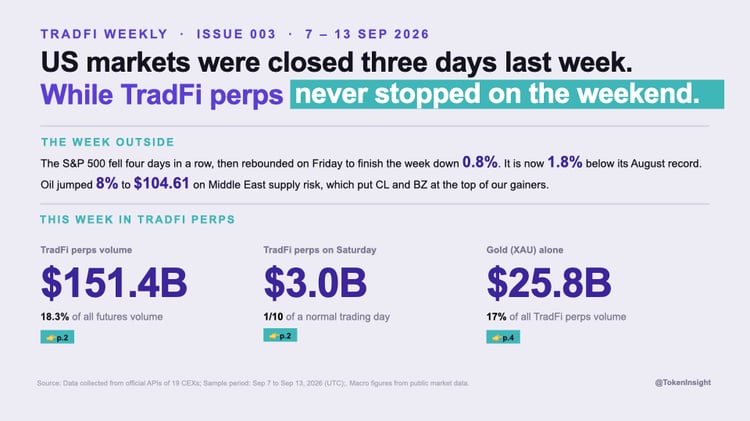
TradFi perps are no longer a niche corner of the derivatives market. Nearly $1 out of every $5 traded in futures last week went through them. But $151.4B is a weekly total.
If this is truly a 24/7 market, there’s a more important question: Is the liquidity there 24/7 too?
No.
The perps trade 24/7. The money doesn’t.
On a normal trading day, TradFi perps do roughly $32B in daily volume.
But when U.S. equities are closed:
Labor Day: $12.7B, or 11.6% of all futures volume
Saturday: $3.0B, or just 5.8% of all futures volume
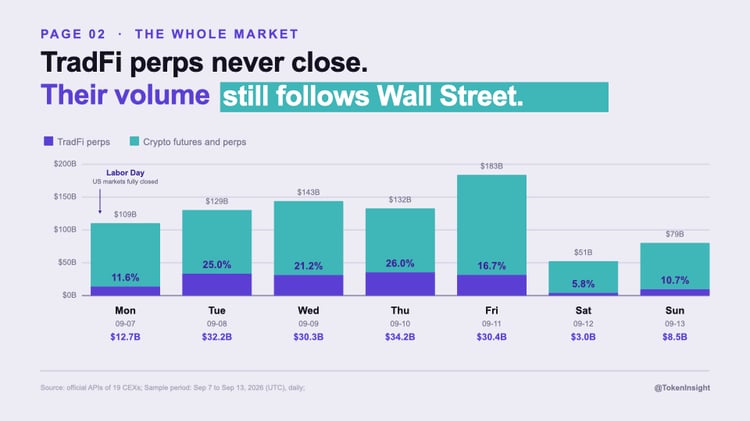
By Saturday, volume had fallen to roughly 1/10 of a normal weekday.
In other words, these perps may trade around the clock, but activity still largely follows the rhythm of the U.S. stock market.
So there are really two sides to “24/7”: You can trade 24 hours a day. That doesn’t mean there’s deep liquidity 24 hours a day.
If a stock perp suddenly moves 5% over the weekend, the move itself isn’t enough. You also need to know how much liquidity was behind that price.
Which brings us to the next question: Where is all that money actually trading?
What is the money trading?
These were the six most-traded TradFi perp contracts of the week: The top two alone accounted for roughly 30% of total volume.
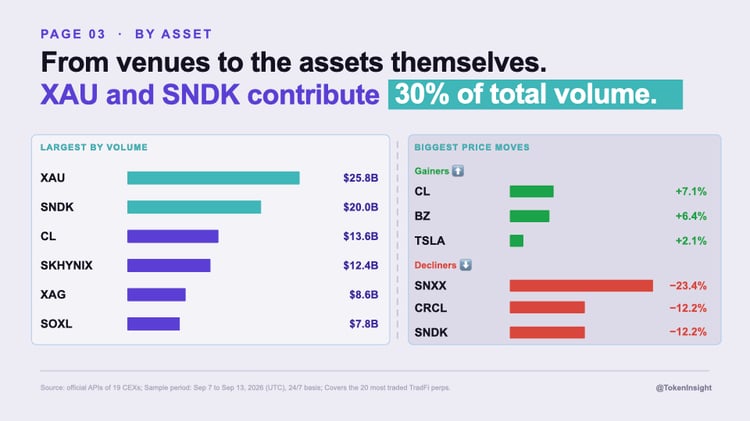
Crude oil was also among the week’s biggest gainers, rising nearly 8% as Middle East supply risks pushed oil prices higher.
On the other side, the three biggest losers among the tracked contracts were:
SNXX −23.4%, CRCL −12.2%, SNDK −12.2%.
SNDK is worth watching. It was both the second-most-traded contract and one of the three worst performers of the week. The most heavily traded names aren’t necessarily the best-performing ones.
And this becomes even more interesting over the weekend.
Because that’s when the stock market itself stops giving you a price.
So what are perps pricing when the stock market is closed?
From Friday at 4:00 PM to Sunday at 8:00 PM ET, U.S. equities were closed.
Stock prices were frozen at Friday’s close. Their perps kept trading.
By Sunday night, here’s where they stood relative to Friday’s equity close:
SPY: −0.4%
GOOGL: −0.9%
QQQ: −1.1%
AMD: −3.0%
MU: −4.0%
SOXL: −7.9%
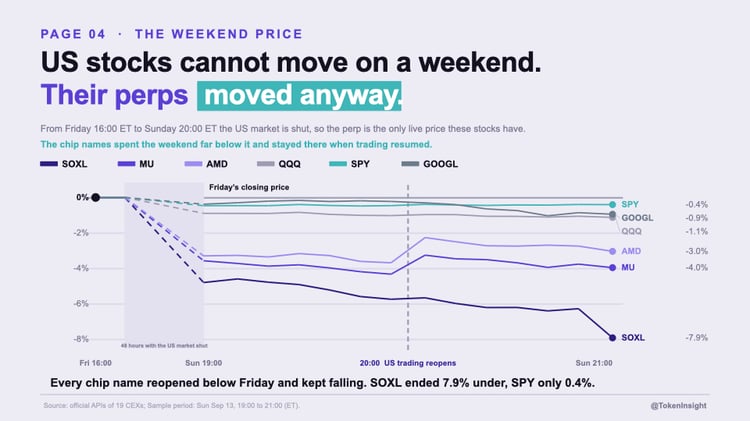
The five deepest declines were all tied to semiconductors. Meanwhile, SPY barely moved, trading just 0.4% below its Friday close.
So this wasn’t the perp market pricing a broad U.S. equity risk-off move.
The selling pressure was concentrated in semiconductors.
Here’s what makes it worth watching further: When U.S. overnight equity trading reopened at 8:00 PM ET on Sunday, these perps didn’t immediately retrace their weekend declines.
That makes TradFi perps a potentially useful price window to watch the next time U.S. Equities are closed for the weekend.
Then the Fed hiked.
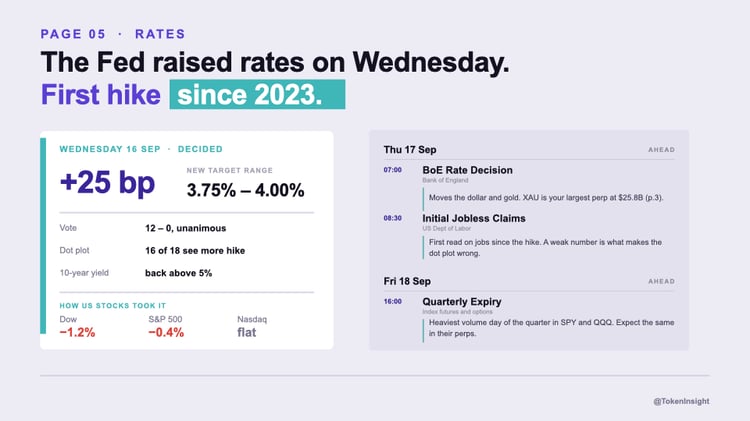
On Wednesday, the Fed raised rates by 25 bps, taking the federal funds target range to 3.75%–4.00% in a 12–0 vote.
In the dot plot, 16 of 18 participants saw another rate hike before year-end, while the 10-year Treasury yield moved back above 5%.
Here’s how markets traded that day:
Which leaves us with a very direct question: After the rate hike, how will TradFi perps price the next window when U.S. equities are closed?
Next week, we’re following two things.
First: What happens to these TradFi perps after the rate hike?
Second: When exactly do prices start moving during those 48 hours when U.S. equities are closed?
If you hold U.S. stocks or trade equity perps, this is TokenInsight’s weekly dataset built for that gap.
TradFi Weekly, updated every week.
Full data and previous issues: tokeninsight.com
DeFi
Disclaimer

For questions & inquiries
info@tokeninsight.com
For research & editorial
research@tokeninsight.com
2018 – 2026 © TokenInsight Ltd. All rights reserved


Use TokenInsight App All Crypto Insights Are In Your Hands
Open