

TokenInsight TradFi Weekly #006: Perps vs Stocks at the Reopen — How Far Apart?
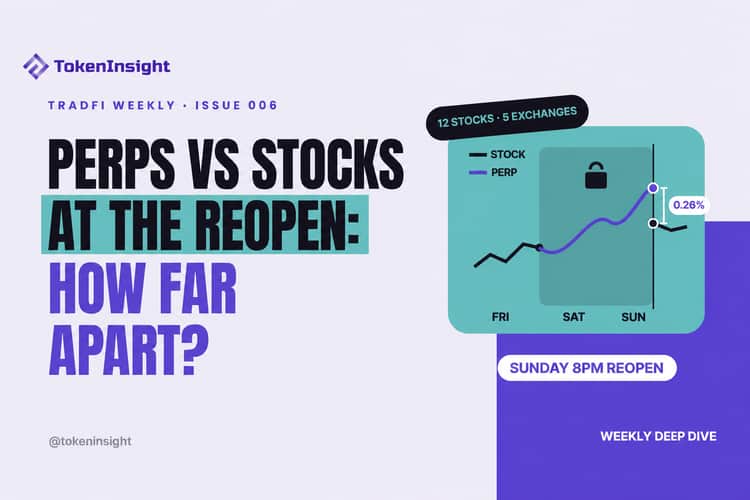
 Last issue, we compared how 10 stocks and ETFs moved on perps over the weekend with how the stocks gapped when overnight trading resumed. The direction matched for all 10; the size did not always match.
This time we ask a more direct question: at the exact moment US overnight trading reopened on Sunday evening, how far apart were perp prices and stock prices? And did it matter which exchange you traded on?
The short answer: 10 of 12 perps sat slightly above the stock, with a median gap of just 0.26%. And on any given stock, the exchanges quoted almost the same price.
Last issue, we compared how 10 stocks and ETFs moved on perps over the weekend with how the stocks gapped when overnight trading resumed. The direction matched for all 10; the size did not always match.
This time we ask a more direct question: at the exact moment US overnight trading reopened on Sunday evening, how far apart were perp prices and stock prices? And did it matter which exchange you traded on?
The short answer: 10 of 12 perps sat slightly above the stock, with a median gap of just 0.26%. And on any given stock, the exchanges quoted almost the same price.

First, what is the “overnight reopen”? On weekdays, the regular US stock session closes at 4pm ET. After-hours trading runs until 8pm, and an overnight session runs from 8pm to 4am. From Friday 8pm to Sunday 8pm, though, US stocks don’t trade at all for 48 hours. TradFi perps on crypto exchanges keep trading around the clock. When the overnight session opens at 8pm ET on Sunday, that is the stock’s first price after the weekend.
1) Chip stocks sank; gold still led volume
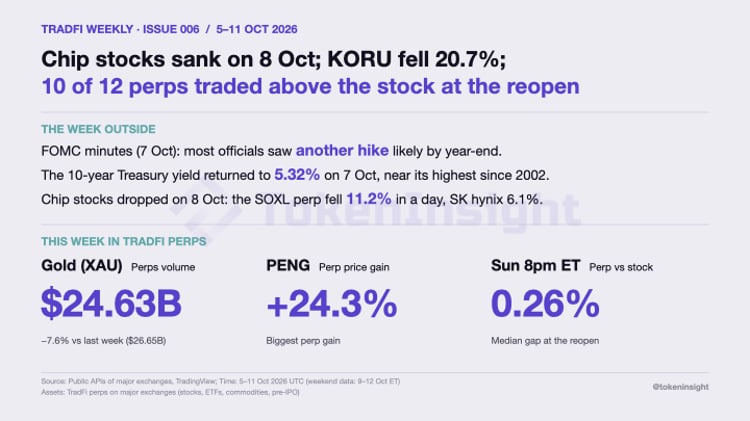
Start with the backdrop. The September FOMC minutes, released October 7, showed most officials thought another rate hike by year-end was “likely appropriate.” The 10-year Treasury yield returned to 5.32% that day, near its highest since 2002.
Under that rate pressure, chip stocks sold off on October 8. The SOXL perp, a 3× semiconductor ETF, fell 11.2% in a single day, and SK hynix dropped 6.1%. KORU, a 3× Korea ETF, lost 20.7% over the week.
On volume, gold (XAU) perps traded $24.63B this week. That was down 7.6% from $26.65B, but still the most of any TradFi perp.
2) Movers: PENG led, SHAZ fell the most
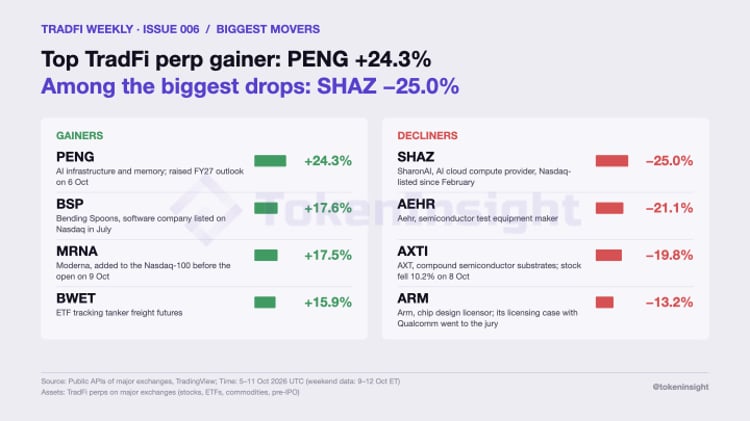
We looked at every TradFi perp on OKX, kept only contracts with at least $1M in weekly volume, and excluded leveraged and inverse ETFs. Otherwise 3× products like KORU would crowd the list. That left 110 assets.
Top gainers:
Penguin Solutions (PENG, +24.3%), an AI infrastructure and memory company, raised its FY2027 outlook in its October 6 earnings.
Bending Spoons (BSP, +17.6%) is a software company that listed on Nasdaq in July.
Moderna (MRNA, +17.5%) joined the Nasdaq-100 before the open on October 9.
BWET (+15.9%) is an ETF that tracks tanker freight futures.
Biggest decliners:
SharonAI (SHAZ, −25.0%) is an AI cloud compute provider that listed on Nasdaq in February.
Aehr (AEHR, −21.1%) makes semiconductor test equipment.
AXT (AXTI, −19.8%) supplies compound semiconductor substrates; its stock fell 10.2% on October 8.
Arm (ARM, −13.2%), the chip design licensor, saw its licensing case with Qualcomm go to the jury this week.
Three of the four decliners are chip-related, in line with the October 8 sell-off.
3) At the reopen: 10 of 12 perps sat slightly above the stock
This is the core question of this issue. At the Sunday 8pm ET reopen, we compared the Binance perp price at that moment with the stock’s opening price (the open of the TradingView 8pm one-hour bar).
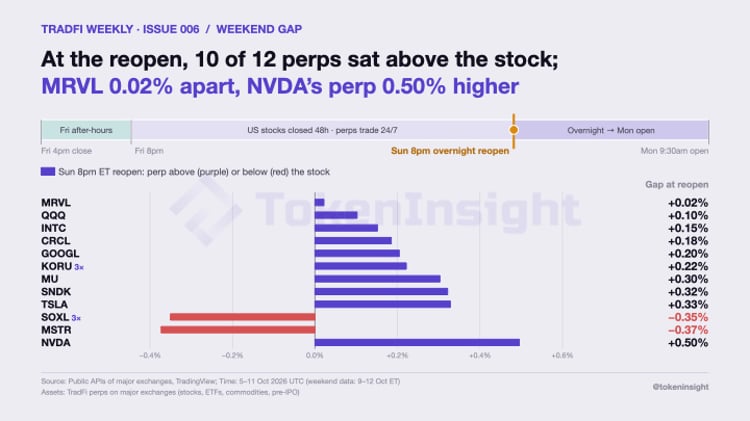
The results:
10 of 12 stocks and ETFs had perps priced slightly above the stock, with a median gap of 0.26%.
MRVL was almost exact, just 0.02% apart.
NVDA was furthest, with its perp 0.50% higher.
Only SOXL (−0.35%) and MSTR (−0.37%) had perps below the stock.
Put simply: if you had bought NVDA on a perp just before 8pm Sunday, the stock opened about 0.5% below your price. For MRVL, there was almost no difference. After 48 hours with stocks closed, most perps were within 0.5% of the stock when trading resumed.
This is still one weekend of data. It doesn’t show that perps are always priced above stocks; we’ll keep tracking it week by week.
4) A different angle: does the exchange matter?
Slide 3 looks at the gap stock by stock. Slide 4 looks at it exchange by exchange. For SNDK, SOXL and MU, we compared each of five exchanges’ perp opening prices at Sunday 8pm with the stock’s opening price.
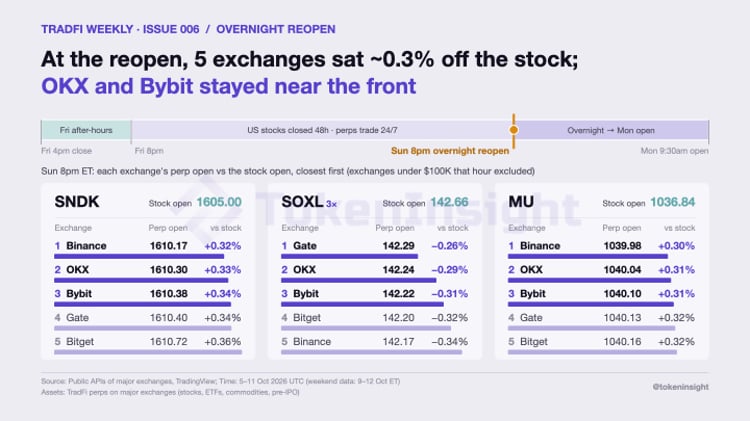
The picture was consistent:
All five exchanges were about 0.3% away from the stock. SNDK and MU perps were above it; SOXL was below.
OKX and Bybit ranked in the top three on all three stocks. Binance was closest on SNDK and MU, and Gate was closest on SOXL.
The differences were tiny. The closest and furthest exchanges were only 0.02–0.08 percentage points apart. On SNDK, for example, Binance quoted 1610.17 and Bitget 1610.72, against a stock open of 1605.00.
In other words, the gap at the reopen came mostly from the stock itself, not from where you traded it. For everyday traders, liquidity and fees matter more than price differences at that moment.
(Note: exchanges that traded less than $100K in that hour were left out, because their prices may not reflect live trading.)
5) Hour by hour: a quiet weekend, then a jump at the reopen
Finally, how did TradFi perp trading spread across those 48 hours? We tracked hourly volume for 15 stock perps on OKX:
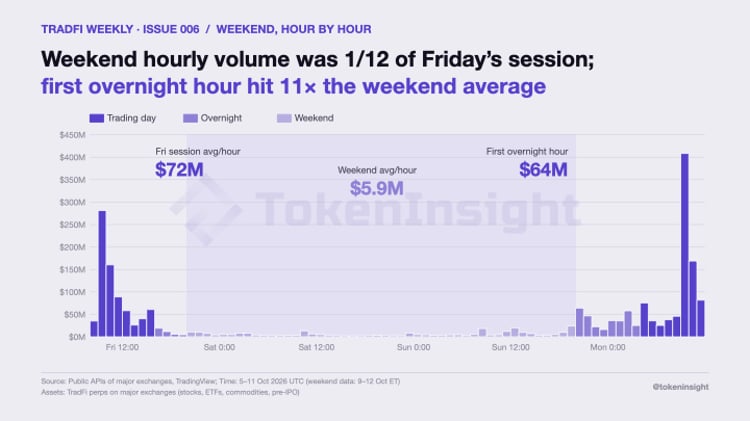
Friday’s regular session (10am–4pm) averaged $72M per hour.
The 48-hour weekend averaged just $5.9M per hour, about 1/12 of Friday’s pace.
The first hour after the Sunday 8pm reopen jumped to $64M, 11 times the weekend average.
This fits what slides 3 and 4 showed. Perps traded all weekend, but thinly. As soon as stocks resumed, money flowed back in, and that is the moment perp and stock prices lined up again.
6) Next week: earnings, PMI, and an election on a weekend
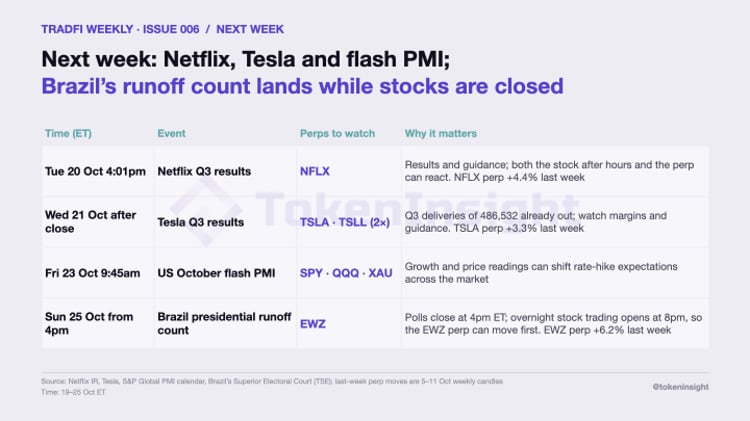
Tue, October 20, 4:01pm: Netflix reports Q3 results. The stock after hours and the perp can both react right away. The NFLX perp rose 4.4% last week.
Wed, October 21, after the close: Tesla reports Q3 results. Q3 deliveries of 486,532 are already out, so the focus is margins and guidance. The TSLA perp rose 3.3% last week; TSLL, the 2× version, is worth watching too.
Fri, October 23, 9:45am: US October flash PMI. Its growth and price readings could shift rate-hike expectations, moving SPY, QQQ and gold.
Sun, October 25, from 4pm: Brazil’s presidential runoff count. Polls close at 4pm ET and counting starts while US stocks are closed. Overnight trading doesn’t open until 8pm, so the EWZ (Brazil ETF) perp can react first. The EWZ perp rose 6.2% last week.
Brazil’s count lands right inside the weekend window this issue focuses on, which makes it another live test of “perps move first, stocks follow.”
TokenInsight TradFi Weekly, updated every week.
DeFi
Exchanges
Disclaimer

For questions & inquiries
info@tokeninsight.com
For research & editorial
research@tokeninsight.com
2018 – 2026 © TokenInsight Ltd. All rights reserved


Use TokenInsight App All Crypto Insights Are In Your Hands
Open