

TokenInsight TradFi Weekly #007: Chips Crashed. Who Kept Buying the Dip?

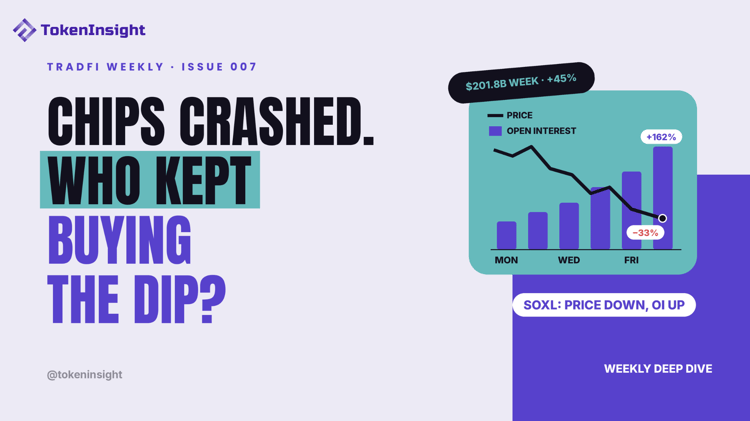
 Chip stocks fell eight days in a row, and SOXL, the 3× semiconductor ETF, lost a third of its value in a week. Normally, that is when traders head for the exit.
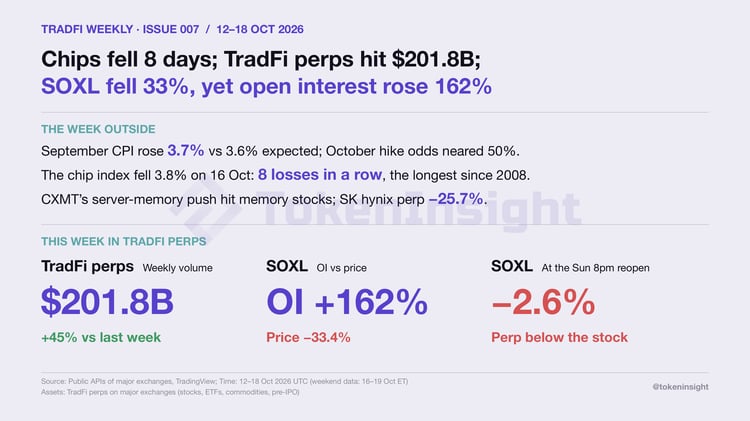
Perp data says the opposite. Open interest in SOXL rose 162%, and its funding rate flipped from near zero to mostly positive. TradFi perps traded $201.8B on the week, up 45% and nearly $50B more than any week we have tracked before.
This issue answers three questions: where did the money go, who was adding positions, and what happened at Sunday's overnight reopen?

1) Three things moved markets: inflation, chips and CXMT
- Inflation ran hot. September CPI, released October 14, rose 3.7% year over year versus 3.6% expected. Odds of another Fed hike in October climbed from under 25% to roughly a coin flip.
- Chips kept falling. The Philadelphia Semiconductor Index fell 3.8% on October 16, its eighth straight loss and the longest streak since 2008.
- Memory stocks led the drop. China's CXMT said it is pushing denser server memory, raising fears for memory makers' margins. The SK hynix perp fell 25.7% on the week.
2) Movers: fewer than 15% of TradFi perps rose
Among OKX TradFi perps with at least $1M in weekly volume (excluding leveraged and inverse ETFs), fewer than 15% finished the week higher.
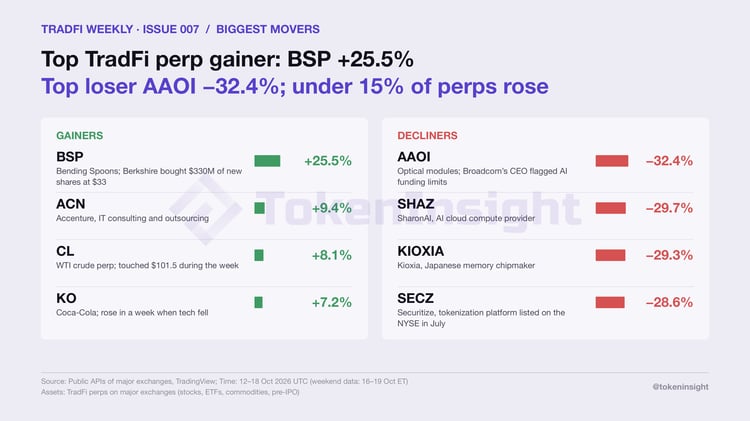
Top gainer: Bending Spoons (BSP, +25.5%). Berkshire Hathaway disclosed on October 14 that it is buying $330M of new shares at $33 each.
Crude oil (CL, +8.1%) and Coca-Cola (KO, +7.2%) also rose. Some defensive assets gained even as tech fell.
Top loser: Applied Optoelectronics (AAOI, −32.4%). Broadcom's CEO warned that funding limits could slow AI infrastructure spending, and optical component makers sold off. Memory names such as Kioxia (KIOXIA, −29.3%) were also near the bottom.
3) The deeper the drop, the more positions piled in
This was the strangest part of the week.
Two quick definitions:
Open interest (OI): the total number of perp contracts still open, a rough gauge of how much money stays in the market.
Funding rate: a fee settled every few hours between longs and shorts. When it is positive, longs pay shorts.
The numbers:
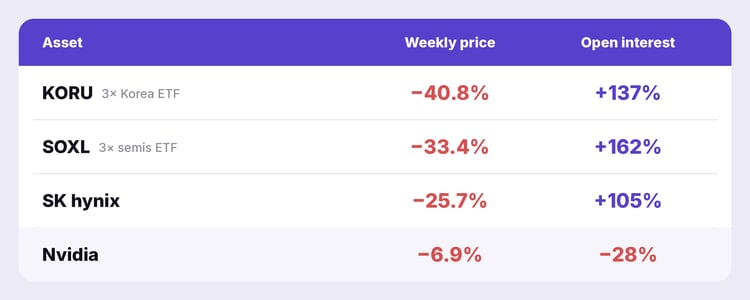
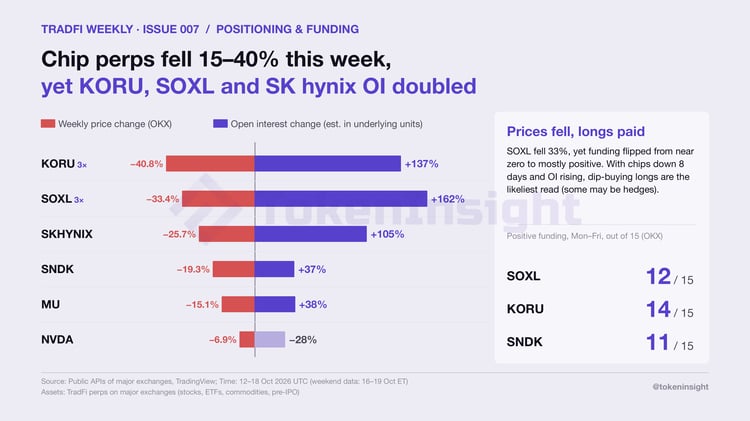
Prices fell 30–40%, yet open interest more than doubled. SOXL's funding was positive in 12 of 15 weekday settlements, up from zero the week before; KORU was positive 14 times and SanDisk 11 times.
With chips down eight days straight, the likeliest reading is that some traders bought the dip, and did it with 3× leveraged products. New positions may also include shorts and hedges, though, so these two measures alone cannot tell how many traders were long or short.
Nvidia shows the flip side: it fell the least, and its open interest dropped 28%. Money piled into the hardest-hit names and left the most resilient one.
4) Where the volume went
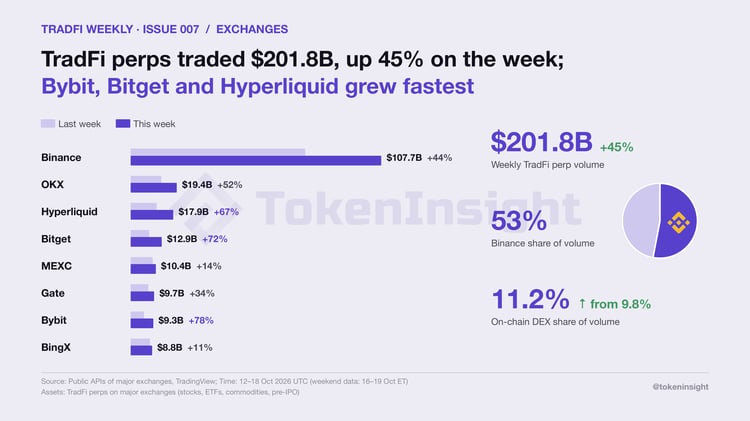
TradFi perps traded $201.8B, up 45% on the week.
Binance took 53% and remains the dominant venue.
The fastest growth came from Bybit (+78%), Bitget (+72%) and Hyperliquid (+67%).
On-chain DEXs grew their share from 9.8% to 11.2%. The more volatile the market, the bigger the slice on-chain venues captured.
5) Weekend gap: this time the stocks moved first
For the third week in a row, we compared perp and stock prices at the moment US overnight trading reopened, 8pm ET on Sunday.
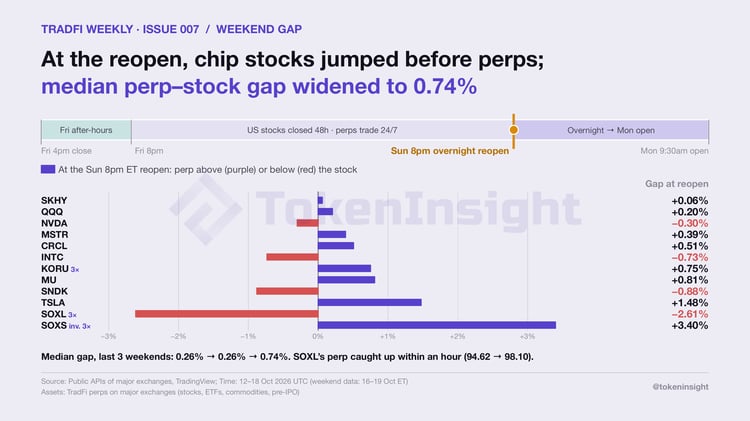
In the previous two weekends, perps had already priced in the stocks' reopening levels, with a median gap of just 0.26%. This weekend was different:
Chip stocks jumped at the reopen. SOXL opened at 97.16.
At that moment, the SOXL perp was still at 94.62, 2.6% below the stock. Within an hour it rose to 98.10 and caught up.
The median gap across 12 stocks widened to 0.74%.
Weekend perps do not always lead. When news hits right at the reopen, the stocks can move first.
6) Next week
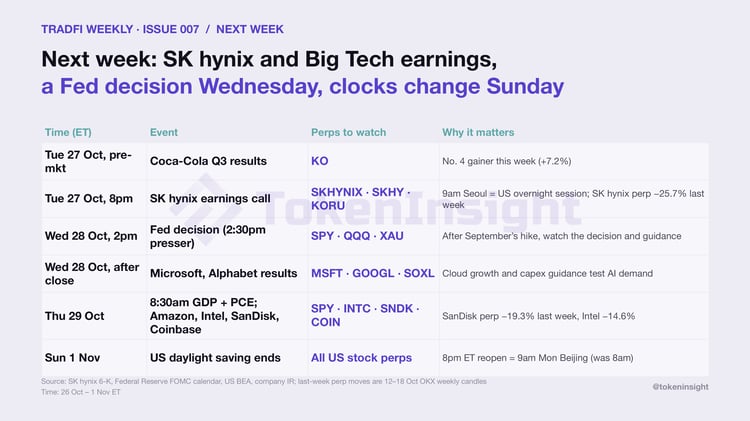
- Tue, Oct 27: Coca-Cola reports before the open. SK hynix holds its earnings call at 8pm ET, during US overnight trading.
- Wed, Oct 28: Fed decision at 2pm ET, press conference at 2:30pm. Microsoft and Alphabet report after the close; their capex guidance will test AI spending.
- Thu, Oct 29: Q3 GDP and September PCE at 8:30am ET. Amazon, Intel, SanDisk and Coinbase report after the close.
- Sun, Nov 1: US daylight saving time ends. The overnight reopen stays at 8pm ET, which becomes 9am Monday in Beijing.
This week's chip sell-off came from doubts about the payoff from AI spending. Next week's Big Tech earnings will offer the first answers.
TokenInsight TradFi Weekly, updated every week.
DeFi
Exchanges
Data
Disclaimer

For questions & inquiries
info@tokeninsight.com
For research & editorial
research@tokeninsight.com
2018 – 2026 © TokenInsight Ltd. All rights reserved


Use TokenInsight App All Crypto Insights Are In Your Hands
Open