

Crypto Exchange Liquidity Report - Sep 2026
 August–September 2026 has been defined by the sharpest risk rally of the year running headlong into a tightening central bank. Bitcoin gained roughly ~25% in August, its best month of the year, as U.S. spot ETFs absorbed about $3.5 billion in net inflows, while gold rose ~10% and silver ~15% over the same period. September then delivered a dense run of headwinds — the CLARITY Act's failure in the Senate procedural vote, the Fed's first rate hike since 2023, and a BOJ increase to its highest policy rate in 31 years — briefly pushing BTC below $75,000. The recovery was swift: BTC reclaimed $80,000 on September 18 and pushed above $87,000 by September 21, its highest level since late January. With positioning rebuilding this quickly under tightening policy, the question of where executable liquidity actually resides has become central to how institutional flow is routed. This report examines how nine major exchanges performed under these conditions, measuring order book depth, slippage, and bid-ask spreads across BTC, ETH, XAU, and XAG to assess where liquidity is genuinely concentrated.

Executive Summary
This report examines the liquidity landscape across nine major exchanges, using order book depth, slippage, and bid-ask spread as core metrics. The analysis covers BTC and ETH in both spot and futures markets, as well as XAU (Gold) and XAG (Silver) futures, based on order book snapshots collected from Aug 16 to Sep 14, 2026.
BTC & ETH Spot: Binance and MEXC are effectively tied at the near-touch 0.01% band at roughly $1.35–1.36M in combined depth, with Binance extending to $4.35M at 0.03%. On slippage, Binance posts a near-zero BTC $100K median and the lowest P90 at 0.007%, MEXC records the lowest BTC $500K median at 0.005%, and KuCoin, OKX and Bitget keep their $100K medians at or below 0.005%; ETH shows wider dispersion, with Binance leading at both sizes. Spreads remain highly compressed, with the tightest BTC group at 0.001 bps and ETH quotes clustered between 0.040 and 0.041 bps.
BTC & ETH Futures: MEXC records the deepest near-touch book at 0.03% with $21.03M, while Bitget ranks first at the wider 0.05% band with $41.60M, indicating a larger share of its liquidity sits further from the mid-price. On slippage, Binance, MEXC, Bitget, Hyperliquid and OKX all post 0.001% BTC medians at $500K, with Binance offering the greatest execution certainty at a 0.004% P90, while MEXC and OKX lead ETH at both sizes. CEX spreads are uniform at 0.013 bps for BTC and 0.041 bps for ETH, with Hyperliquid an order of magnitude wider at 0.127 (BTC) and 0.402 bps (ETH).
XAU & XAG Futures: Binance leads combined metals depth at the tight 0.01% band with $2.41M, narrowly ahead of MEXC at $2.39M, while Bitget takes first place at 0.03% with $7.21M; at the asset level, Binance and Bitget anchor gold and MEXC leads silver in order book depth. Slippage follows a similar split, with Binance posting the lowest XAU $300K median at 0.001% and MEXC the lowest XAG $300K median at 0.002%, though Binance holds the tighter tail in both metals. Spreads are consistent in gold at 0.023 bps among the leading venues but far more dispersed in silver, where Hyperliquid leads at 0.155 bps against a 1.505 bps cohort and HTX sits well outside at 7.522 bps.
Methodology
The Crypto Exchange Liquidity Report evaluated four assets, including: BTC, ETH, XAU and XAG. Nine exchanges were selected for comparison, including: Binance, OKX, Bybit, Bitget, KuCoin, MEXC, Gate, HTX and Hyperliquid. Coverage may vary by market segment depending on pair availability and API accessibility.
Liquidity in this report is evaluated using three complementary dimensions: Order Book Depth (median), Slippage (median, P90) and Spread (median).
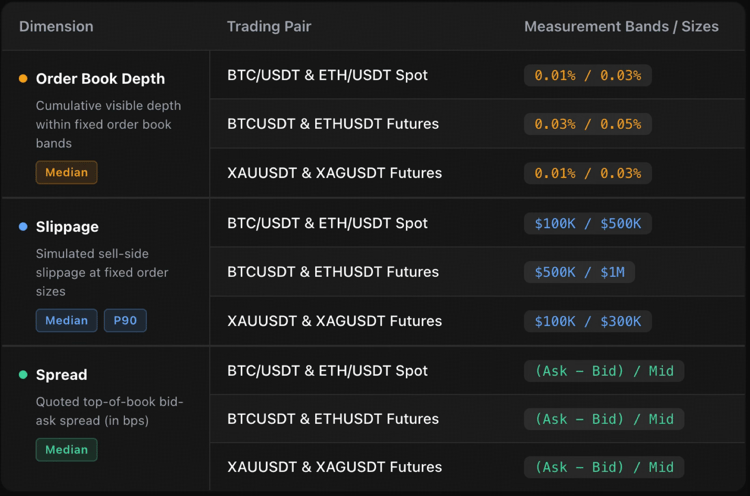
P90 slippage represents the 90th percentile outcome, meaning that 90% of simulated executions experienced slippage at or below this level. This helps assess not only average execution quality, but also the potential downside risk under less favorable liquidity conditions. Data is sampled once every 30 minutes. Results are based on data collected from the official APIs of selected CEXs during the sample period from Aug 16, 2026, 00:00 to Sep 14, 2026, 23:30 (UTC+8).
BTC & ETH Spot Depth
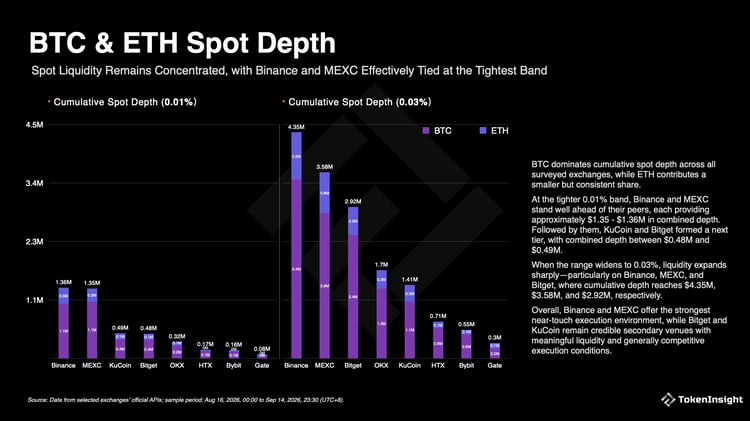
Spot Liquidity Remains Concentrated, with Binance and MEXC Effectively Tied at the Tightest Band
BTC dominates cumulative spot depth across all surveyed exchanges, while ETH contributes a smaller but consistent share.
At the tighter 0.01% band, Binance and MEXC stand well ahead of their peers, each providing approximately $1.35 - $1.36M in combined depth. Followed by them, KuCoin and Bitget formed a next tier, with combined depth between $0.48M and $0.49M.
When the range widens to 0.03%, liquidity expands sharply—particularly on Binance, MEXC, and Bitget, where cumulative depth reaches $4.35M, $3.58M, and $2.92M, respectively.
Overall, Binance and MEXC offer the strongest near-touch execution environment, while Bitget and KuCoin remain credible secondary venues with meaningful liquidity and generally competitive execution conditions.
BTC & ETH Spot Slippage
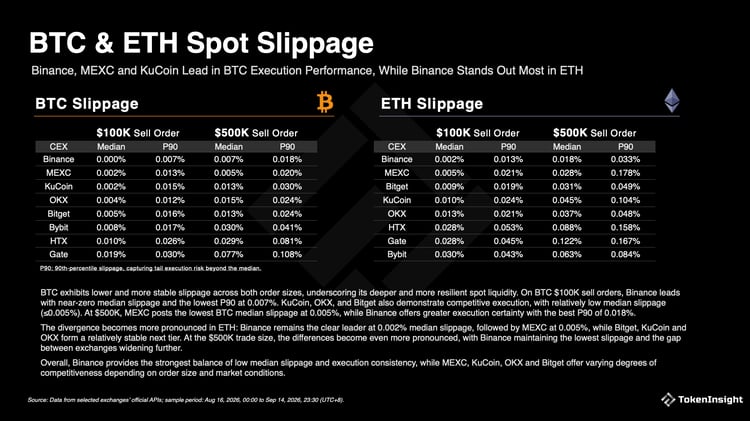
Binance, MEXC and KuCoin Lead in BTC Execution Performance, While Binance Stands Out Most in ETH
BTC exhibits lower and more stable slippage across both order sizes, underscoring its deeper and more resilient spot liquidity. On BTC $100K sell orders, Binance leads with near-zero median slippage and the lowest P90 at 0.007%. KuCoin, OKX, and Bitget also demonstrate competitive execution, with relatively low median slippage (≤0.005%). At $500K, MEXC posts the lowest BTC median slippage at 0.005%, while Binance offers greater execution certainty with the best P90 of 0.018%.
The divergence becomes more pronounced in ETH: Binance remains the clear leader at 0.002% median slippage, followed by MEXC at 0.005%, while Bitget, KuCoin and OKX form a relatively stable next tier. At the $500K trade size, the differences become even more pronounced, with Binance maintaining the lowest slippage and the gap between exchanges widening further.
Overall, Binance provides the strongest balance of low median slippage and execution consistency, while MEXC, KuCoin, OKX and Bitget offer varying degrees of competitiveness depending on order size and market conditions.
BTC & ETH Spot Bid-Ask Spread
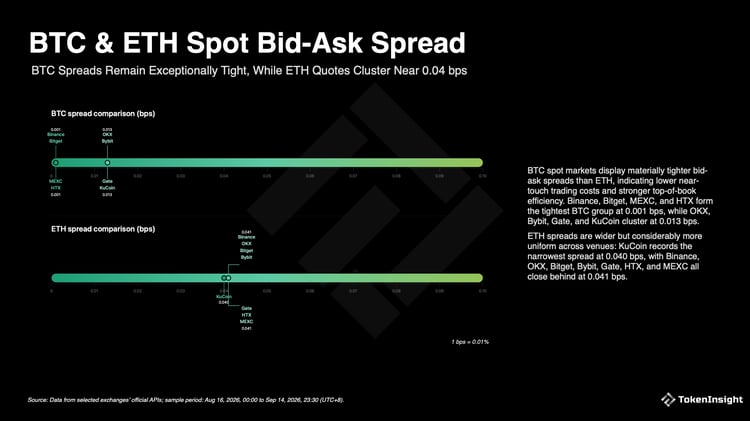
BTC Spreads Remain Exceptionally Tight, While ETH Quotes Cluster Near 0.04 bps
BTC spot markets display materially tighter bid-ask spreads than ETH, indicating lower near-touch trading costs and stronger top-of-book efficiency. Binance, Bitget, MEXC, and HTX form the tightest BTC group at 0.001 bps, while OKX, Bybit, Gate, and KuCoin cluster at 0.013 bps.
ETH spreads are wider but considerably more uniform across venues: KuCoin records the narrowest spread at 0.040 bps, with Binance, OKX, Bitget, Bybit, Gate, HTX, and MEXC all close behind at 0.041 bps.
BTC & ETH Futures Depth
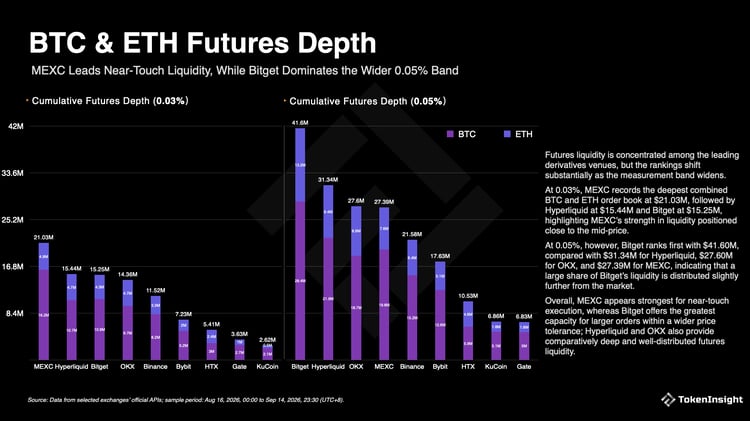
MEXC Leads Near-Touch Liquidity, While Bitget Dominates the Wider 0.05% Band
Futures liquidity is concentrated among the leading derivatives venues, but the rankings shift substantially as the measurement band widens.
At 0.03%, MEXC records the deepest combined BTC and ETH order book at $21.03M, followed by Hyperliquid at $15.44M and Bitget at $15.25M, highlighting MEXC’s strength in liquidity positioned close to the mid-price.
At 0.05%, however, Bitget ranks first with $41.60M, compared with $31.34M for Hyperliquid, $27.60M for OKX, and $27.39M for MEXC, indicating that a large share of Bitget’s liquidity is distributed slightly further from the market.
Overall, MEXC appears strongest for near-touch execution, whereas Bitget offers the greatest capacity for larger orders within a wider price tolerance; Hyperliquid and OKX also provide comparatively deep and well-distributed futures liquidity.
BTC & ETH Futures Slippage
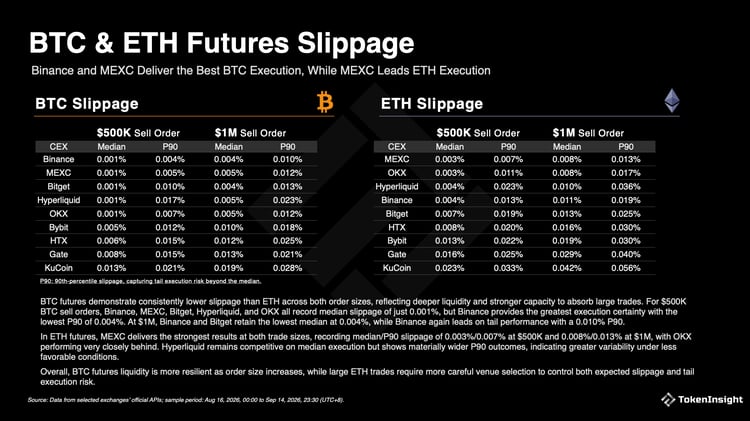
Binance and MEXC Deliver the Best BTC Execution, While MEXC Leads ETH Execution
BTC futures demonstrate consistently lower slippage than ETH across both order sizes, reflecting deeper liquidity and stronger capacity to absorb large trades. For $500K BTC sell orders, Binance, MEXC, Bitget, Hyperliquid, and OKX all record median slippage of just 0.001%, but Binance provides the greatest execution certainty with the lowest P90 of 0.004%. At $1M, Binance and Bitget retain the lowest median at 0.004%, while Binance again leads on tail performance with a 0.010% P90.
In ETH futures, MEXC delivers the strongest results at both trade sizes, recording median/P90 slippage of 0.003%/0.007% at $500K and 0.008%/0.013% at $1M, with OKX performing very closely behind. Hyperliquid remains competitive on median execution but shows materially wider P90 outcomes, indicating greater variability under less favorable conditions.
Overall, BTC futures liquidity is more resilient as order size increases, while large ETH trades require more careful venue selection to control both expected slippage and tail execution risk.
BTC & ETH Futures Bid-Ask Spread
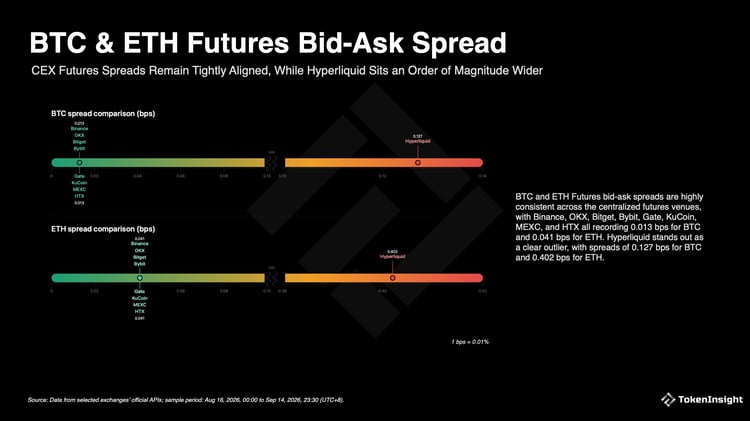
CEX Futures Spreads Remain Tightly Aligned, While Hyperliquid Sits an Order of Magnitude Wider
BTC and ETH Futures bid-ask spreads are highly consistent across the centralized futures venues, with Binance, OKX, Bitget, Bybit, Gate, KuCoin, MEXC, and HTX all recording 0.013 bps for BTC and 0.041 bps for ETH. Hyperliquid stands out as a clear outlier, with spreads of 0.127 bps for BTC and 0.402 bps for ETH.
XAU & XAG
XAU & XAG Futures Depth
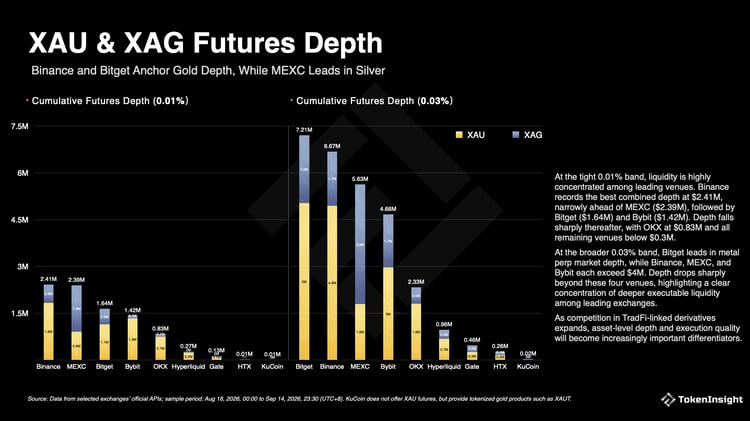
Binance and Bitget Anchor Gold Depth, While MEXC Leads in Silver
At the tight 0.01% band, liquidity is highly concentrated among leading venues. Binance records the best combined depth at $2.41M, narrowly ahead of MEXC ($2.39M), followed by Bitget ($1.64M) and Bybit ($1.42M). Depth falls sharply thereafter, with OKX at $0.83M and all remaining venues below $0.3M.
At the broader 0.03% band, Bitget leads in metal perp market depth, while Binance, MEXC, and Bybit each exceed $4M. Depth drops sharply beyond these four venues, highlighting a clear concentration of deeper executable liquidity among leading exchanges.
As competition in TradFi-linked derivatives expands, asset-level depth and execution quality will become increasingly important differentiators.
XAU & XAG Futures Slippage
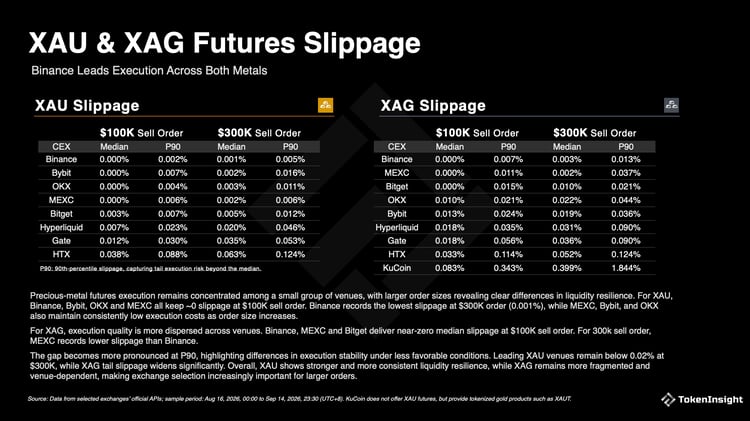
Binance Leads Execution Across Both Metals
Precious-metal futures execution remains concentrated among a small group of venues, with larger order sizes revealing clear differences in liquidity resilience. For XAU, Binance, Bybit, OKX and MEXC all keep ~0 slippage at $100K sell order. Binance records the lowest slippage at $300K order (0.001%), while MEXC, Bybit, and OKX also maintain consistently low execution costs as order size increases.
For XAG, execution quality is more dispersed across venues. Binance, MEXC and Bitget deliver near-zero median slippage at $100K sell order. For 300k sell order, MEXC records lower slippage than Binance.
The gap becomes more pronounced at P90, highlighting differences in execution stability under less favorable conditions. Leading XAU venues remain below 0.02% at $300K, while XAG tail slippage widens significantly. Overall, XAU shows stronger and more consistent liquidity resilience, while XAG remains more fragmented and venue-dependent, making exchange selection increasingly important for larger orders.
XAU & XAG Futures Bid-Ask Spread
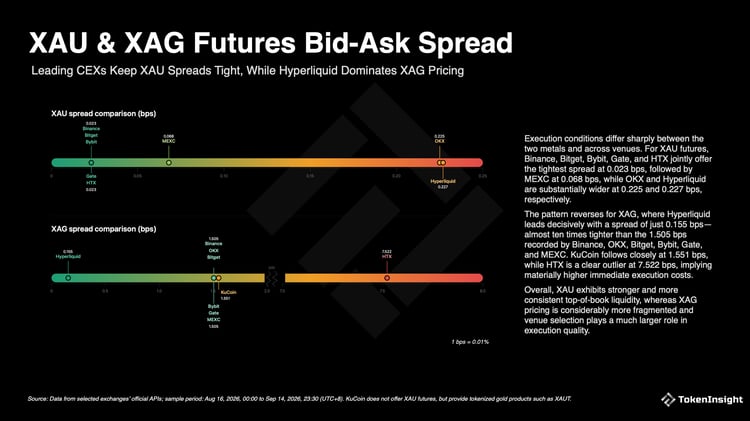
Leading CEXs Keep XAU Spreads Tight, While Hyperliquid Dominates XAG Pricing
Execution conditions differ sharply between the two metals and across venues. For XAU futures, Binance, Bitget, Bybit, Gate, and HTX jointly offer the tightest spread at 0.023 bps, followed by MEXC at 0.068 bps, while OKX and Hyperliquid are substantially wider at 0.225 and 0.227 bps, respectively.
The pattern reverses for XAG, where Hyperliquid leads decisively with a spread of just 0.155 bps—almost ten times tighter than the 1.505 bps recorded by Binance, OKX, Bitget, Bybit, Gate, and MEXC. KuCoin follows closely at 1.551 bps, while HTX is a clear outlier at 7.522 bps, implying materially higher immediate execution costs.
Overall, XAU exhibits stronger and more consistent top-of-book liquidity, whereas XAG pricing is considerably more fragmented and venue selection plays a much larger role in execution quality.
FAQ
Q1: Which exchange had the deepest combined BTC and ETH spot order book?
A1: In our Aug 16–Sep 14, 2026 sample, Binance ($1.36M) and MEXC ($1.35M) were effectively tied for combined BTC and ETH spot depth within 0.01% of the mid-price. At the wider 0.03% band, Binance led with $4.35M.
Q2: Which exchange has the lowest slippage for large BTC futures orders?
A2: For a simulated $500K sell order, Binance, MEXC, Bitget, Hyperliquid and OKX all recorded 0.001% median slippage. Binance had the lowest P90 slippage at 0.004%.
Q3: Can you trade gold and silver futures on crypto exchanges?
A3:Yes, though product coverage differs by exchange. In our sample, Binance led combined XAU and XAG futures depth at the 0.01% band with $2.41M, narrowly ahead of MEXC at $2.39M. At 0.03%, Bitget led with $7.21M. KuCoin was included for XAG futures, but not XAU futures; its XAUT perpetual is a separate contract linked to tokenized gold.
Exchanges
Download
Disclaimer

For questions & inquiries
info@tokeninsight.com
For research & editorial
research@tokeninsight.com
2018 – 2026 © TokenInsight Ltd. All rights reserved


Use TokenInsight App All Crypto Insights Are In Your Hands
Open