

Equity Perpetuals Market Report - How Large Has the Equity Perpetual Market Become?

 Equity perpetuals have moved from a niche listing to a material category on crypto exchanges. Across Binance, Bybit, Bitget, MEXC, and OKX, they averaged $17.6 billion in daily volume during our sample period, close behind ETH at $18.2 billion and BTC at $24.0 billion. On weekdays alone, the figure rises to roughly $23.5 billion, ahead of ETH on any day the underlying cash market is open. Yet weekend volume falls to 9.9% of weekday levels, against 44.4% for BTC, showing the category remains anchored to traditional trading hours. This report examines how large the equity perpetuals market has become and how the five venues compare on product coverage, position limits, order-book depth, and execution quality.

Executive Summary
Equity perpetuals are emerging as a meaningful second growth pillar within the perpetual market. Across the selected centralized exchanges (Binance, Bybit, Bitget, MEXC and OKX), equity perpetuals averaged $17.6 billion in daily trading volume, compared with $24.0 billion for BTC and $18.2 billion for ETH. More importantly, average equity perpetual volume rises to approximately $23.5 billion per weekday, approaching BTC and moving ahead of ETH. This indicates that demand for leveraged equity exposure on crypto-native venues has moved beyond a niche use case and is becoming a material component of derivatives trading.
However, the liquidity profile of equity perpetuals remains fundamentally different from that of crypto assets. Weekend equity perpetual volume falls to only $2.3 billion per day, equivalent to 9.9% of weekday levels ($23.5B), compared with 44.4% for BTC and 53.7% for ETH. This sharp decline suggests that, despite being 24/7 tradable in product design, equity perpetuals remain strongly anchored to the trading hours, information flow, and price discovery of their underlying cash markets.
Competition among exchanges is increasingly taking place across two dimensions: first, product breadth and trading capacity; and second, liquidity and execution quality. In the first area, as of July 29, 2026, MEXC offers the broadest equity perpetual coverage with 310 equity perpetuals, followed by Bitget with 235, while Binance and Bybit list 148 and 147 respectively, and OKX remains considerably more selective with 42. MEXC also adopts relatively aggressive leverage and position-limit structures. It is the only venue among the selected exchanges that consistently supports meaningful position sizes at 100x leverage across the selected perpetuals.
In the second area, liquidity and execution are assessed on weekday observations of five selected equity perpetuals (SOXLUSDT, SPCXUSDT, INTCUSDT, SNDKUSDT and SKHYNIXUSDT). Order-book depth shows that exchange leadership varies depending on how close liquidity sits to the traded price. At the tighter 0.01% band, MEXC moves into first place with $0.52M, ahead of Bybit at $0.43M and Bitget at $0.33M. At the wider 0.05% and 0.10% depth bands, Bitget leads the five selected equity perpetuals in cumulative depth, followed by MEXC and Binance. This suggests that Bitget provides stronger broad-band resting liquidity, while MEXC concentrates more liquidity close to the touch.
Slippage data also demonstrates the execution quality across five selected exchanges for representative equity perpetuals. At a $10K sell-order size, all five exchanges maintain median slippage below 0.02% across the selected perpetuals, indicating generally healthy execution conditions. MEXC records the lowest median slippage on three of the five perpetuals, while Binance leads SNDKUSDT and Bitget leads INTCUSDT. At $100K, differences between venues become more pronounced. MEXC continues to lead SKHYNIXUSDT, SOXLUSDT and SPCXUSDT, with median slippage of 0.0170%, 0.0130%, and 0.0112%, respectively, while Binance remains strongest on SNDKUSDT and Bitget on INTCUSDT. Tail execution risk also increases materially at the larger order size, highlighting the growing importance of order-book depth and liquidity resilience for larger traders.
In our view, equity perpetuals are no longer simply an extension of crypto exchanges’ derivatives catalogs. Their weekday trading activity has already reached a scale comparable with major crypto perpetuals, but their pronounced dependence on traditional market hours shows that the category has not yet developed an independent 24/7 liquidity structure. The next stage of market development will therefore be determined less by how many equity contracts exchanges can list, and more by whether they can build resilient off-hours liquidity, efficient price discovery, and institutional-grade execution at scale.
Data Coverage
This report analyzes the perpetual market across Binance, Bybit, Bitget, MEXC and OKX using data collected from their official APIs. Aggregate perpetual trading volume across these five exchanges covers July 1 to August 5, 2026, while equity perpetual product coverage and position limits are based on exchange-level snapshots collected on July 29, 2026.
Liquidity and execution analysis covers five selected trading pairs, SOXLUSDT, SPCXUSDT, INTCUSDT, SNDKUSDT and SKHYNIXUSDT, from July 29 to August 6, 2026, excluding weekends (data is sampled once every 30 minutes.). Order-book depth (median) is measured within 0.01%, 0.05%, and 0.10% of the prevailing market price, while slippage is assessed using simulated $10K and $100K sell orders.
Perpetual Trading Volume
Crypto Still Leads Perpetual Trading, While Equities Show Rising Trading Momentum
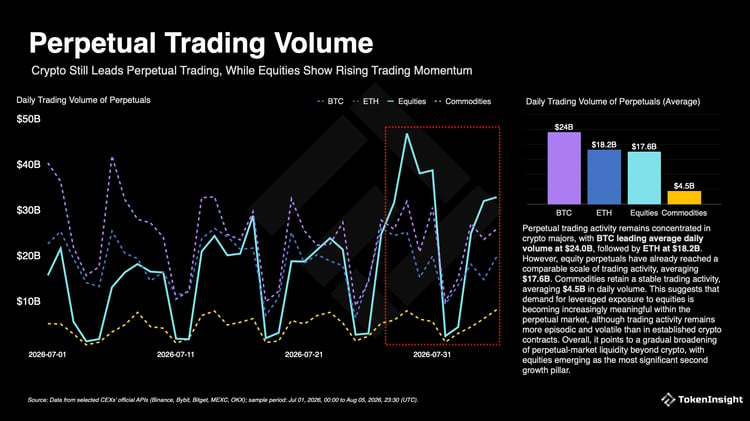
Perpetual trading activity remains concentrated in crypto majors, with BTC leading average daily volume at $24.0B, followed by ETH at $18.2B. However, equity perpetuals have already reached a comparable scale of trading activity, averaging $17.6B. Commodities retain a stable trading activity, averaging $4.5B in daily volume. This suggests that demand for leveraged exposure to equities is becoming increasingly meaningful within the perpetual market, although trading activity remains more episodic and volatile than in established crypto contracts. Overall, it points to a gradual broadening of perpetual-market liquidity beyond crypto, with equities emerging as the most significant second growth pillar.
Weekend & Weekday Trading Volume
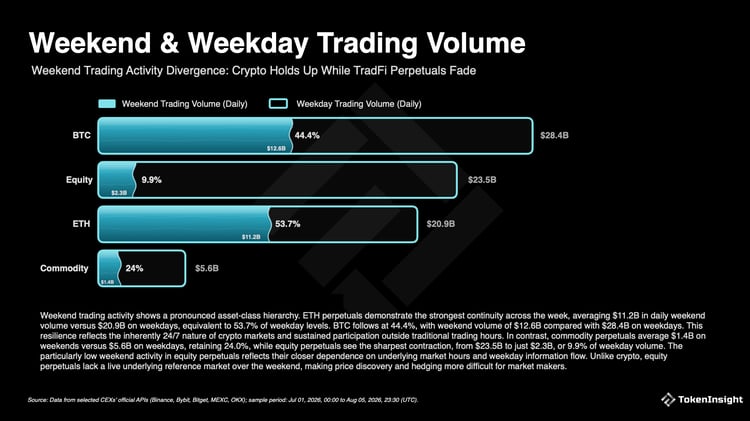
Weekend Trading Activity Divergence: Crypto Holds Up While TradFi Perpetuals Fade
Weekend trading activity shows a pronounced asset-class hierarchy. ETH perpetuals demonstrate the strongest continuity across the week, averaging $11.2B in daily weekend volume versus $20.9B on weekdays, equivalent to 53.7% of weekday levels. BTC follows at 44.4%, with weekend volume of $12.6B compared with $28.4B on weekdays. This resilience reflects the inherently 24/7 nature of crypto markets and sustained participation outside traditional trading hours. In contrast, commodity perpetuals average $1.4B on weekends versus $5.6B on weekdays, retaining 24.0%, while equity perpetuals see the sharpest contraction, from $23.5B to just $2.3B, or 9.9% of weekday volume. The particularly low weekend activity in equity perpetuals reflects their closer dependence on underlying market hours and weekday information flow. Unlike crypto, equity perpetuals lack a live underlying reference market over the weekend, making price discovery and hedging more difficult for market makers.
Equity Perpetuals Coverage
MEXC Offers the Broadest Equity Perpetuals; OKX Has Adopted the Most Cautious Strategy
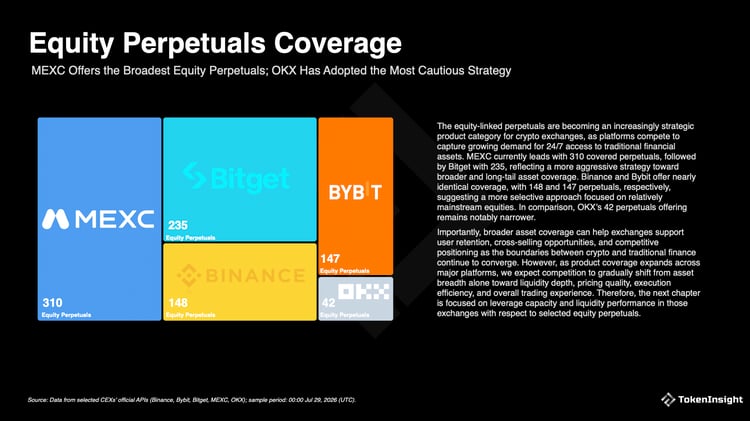
The equity-linked perpetuals are becoming an increasingly strategic product category for crypto exchanges, as platforms compete to capture growing demand for 24/7 access to traditional financial assets. MEXC currently leads with 310 covered perpetuals, followed by Bitget with 235, reflecting a more aggressive strategy toward broader and long-tail asset coverage. Binance and Bybit offer nearly identical coverage, with 148 and 147 perpetuals, respectively, suggesting a more selective approach focused on relatively mainstream equities. In comparison, OKX’s 42 perpetuals offering remains notably narrower.
Importantly, broader asset coverage can help exchanges support user retention, cross-selling opportunities, and competitive positioning as the boundaries between crypto and traditional finance continue to converge. However, as product coverage expands across major platforms, we expect competition to gradually shift from asset breadth alone toward liquidity depth, pricing quality, execution efficiency, and overall trading experience. Therefore, the next chapter is focused on leverage capacity and liquidity performance in those exchanges with respect to selected equity perpetuals.
Equity Perpetuals Position Limit
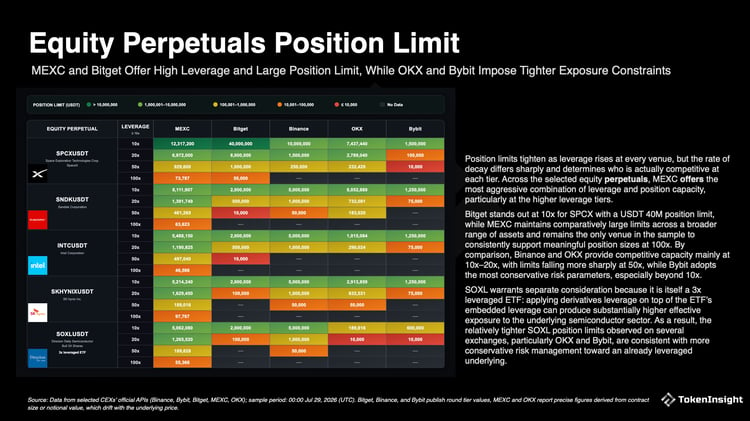
MEXC and Bitget Offer High Leverage and Large Position Limit, While OKX and Bybit Impose Tighter Exposure Constraints
Position limits tighten as leverage rises at every venue, but the rate of decay differs sharply and determines who is actually competitive at each tier. Across the selected equity perpetuals, MEXC offers the most aggressive combination of leverage and position capacity, particularly at the higher leverage tiers.
Bitget stands out at 10x for SPCX with a USDT 40M position limit, while MEXC maintains comparatively large limits across a broader range of assets and remains the only venue in the sample to consistently support meaningful position sizes at 100x. By comparison, Binance and OKX provide competitive capacity mainly at 10x–20x, with limits falling more sharply at 50x, while Bybit adopts the most conservative risk parameters, especially beyond 10x.
SOXL warrants separate consideration because it is itself a 3x leveraged ETF: applying derivatives leverage on top of the ETF’s embedded leverage can produce substantially higher effective exposure to the underlying semiconductor sector. As a result, the relatively tighter SOXL position limits observed on several exchanges, particularly OKX and Bybit, are consistent with more conservative risk management toward an already leveraged underlying.
Equity Perpetuals Order Book Depth
Bitget and MEXC Lead Depth at the Wider Bands, While MEXC Tops the Near-Touch 0.01% Band
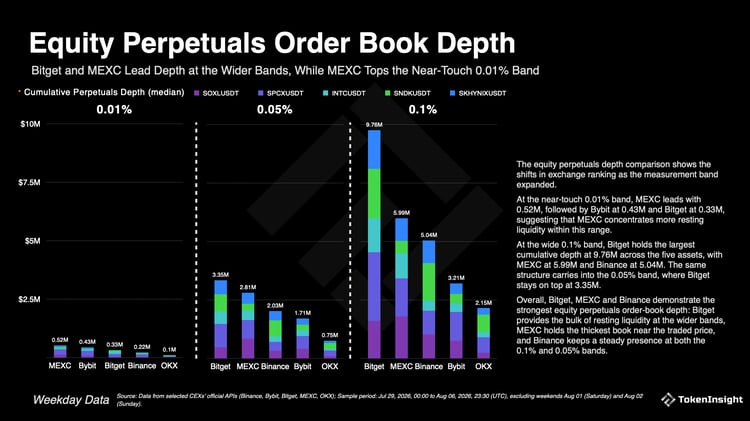
The equity perpetuals depth comparison shows the shifts in exchange ranking as the measurement band narrows.
At the near-touch 0.01% band, MEXC leads with 0.52M, followed by Bybit at 0.43M and Bitget at 0.33M, suggesting that MEXC concentrates more resting liquidity within the near-touch 0.01% band.
At the wide 0.1% band, Bitget holds the largest cumulative depth at 9.76M across the five assets, with MEXC at 5.99M and Binance at 5.04M. The same structure carries into the 0.05% band, where Bitget stays on top at 3.35M.
Overall, Bitget, MEXC and Binance demonstrate the strongest equity perpetuals order-book depth: Bitget provides the bulk of resting liquidity at the wider bands, MEXC holds the thickest book near the traded price, and Binance keeps a steady presence at both the 0.1% and 0.05% bands.
Equity Perpetuals Slippage - $10K Sell Order
MEXC Leads Three of Five Perpetuals in Slippage Performance, While All Venues Hold Median Slippage Below 0.02%
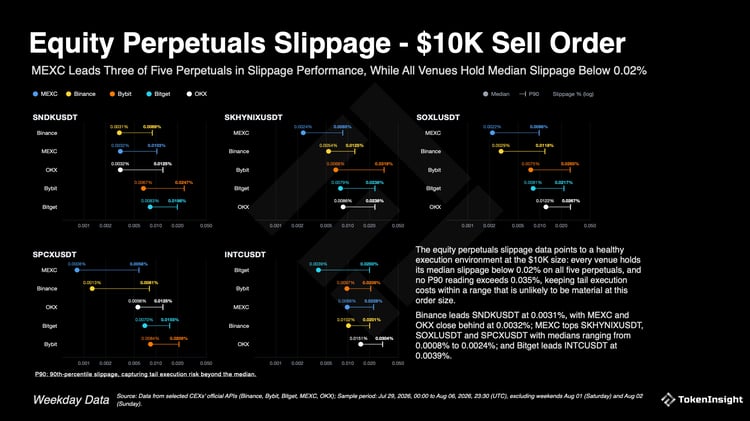
The equity perpetuals slippage data points to a healthy execution environment at the $10K size: every venue holds its median slippage below 0.02% on all five perpetuals, and no P90 reading exceeds 0.035%, keeping tail execution costs within a range that is unlikely to be material at this order size.
Binance leads SNDKUSDT at 0.0031%, with MEXC and OKX close behind at 0.0032%; MEXC tops SKHYNIXUSDT, SOXLUSDT and SPCXUSDT with medians ranging from 0.0008% to 0.0024%; and Bitget leads INTCUSDT at 0.0039%.
Equity Perpetuals Slippage - $100K Sell Order
MEXC and Bitget Deliver the Tightest Equity Perpetuals Slippage at $100K
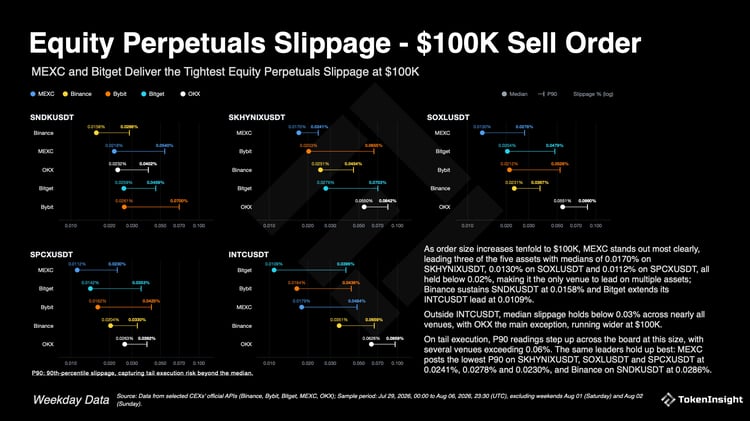
As order size increases tenfold to $100K, MEXC stands out most clearly, leading three of the five assets with medians of 0.0170% on SKHYNIXUSDT, 0.0130% on SOXLUSDT and 0.0112% on SPCXUSDT, all held below 0.02%, making it the only venue to lead on multiple assets; Binance sustains SNDKUSDT at 0.0158% and Bitget extends its INTCUSDT lead at 0.0109%.
Outside INTCUSDT, median slippage holds below 0.03% across nearly all venues, with OKX the main exception, running wider at $100K.
On tail execution, P90 readings step up across the board at this size, with several venues exceeding 0.06%. The same leaders hold up best: MEXC posts the lowest P90 on SKHYNIXUSDT, SOXLUSDT and SPCXUSDT at 0.0241%, 0.0278% and 0.0230%, and Binance on SNDKUSDT at 0.0286%.
FAQ
Q1: How big is the equity perpetuals market in 2026?
Equity perpetuals average $17.6 billion in daily trading volume across five major crypto exchanges (Jul 1 – Aug 5, 2026), rising to $23.5 billion on weekdays, ahead of ETH perpetuals and approaching BTC.
Q2:Can you trade equity perpetuals on weekends?
Yes, equity perpetuals are tradable 24/7 by design. In practice, weekend volume falls to 9.9% of weekday levels because the underlying stock markets are closed, making pricing and hedging harder for market makers.
Q3: Which exchange lists the most equity perpetuals?
As of July 29, 2026: MEXC (310), Bitget (235), Binance (148), Bybit (147), OKX (42).
Q4: Which exchange has the best execution for equity perpetuals?
At $10K orders, all five venues keep median slippage below 0.02%. At $100K, leadership varies by ticker, the full per-ticker rankings are in the report.[link]
Exchanges
Stock
Download
Disclaimer

For questions & inquiries
info@tokeninsight.com
For research & editorial
research@tokeninsight.com
2018 – 2026 © TokenInsight Ltd. All rights reserved


Use TokenInsight App All Crypto Insights Are In Your Hands
Open