

Stablecoins After GENIUS: Circle’s Strategy, Risks, and the Arc Blockchain
 2025 marks a turning point for regulated dollar stablecoins. This article examines how the GENIUS Act reshapes the landscape, why USDC is structurally advantaged, where Circle’s yield-dependent revenue model is exposed to rate cuts, and how Arc blockchain and the Circle Payments Network aim to turn USDC into core financial infrastructure.

2025 marks a structural transition for U.S. dollar stablecoins: from a lightly regulated grey zone to a formally recognized part of the financial system. GENIUS Act has established a clear federal regulatory framework for payment stablecoins in the United States. This approach is further supported by the Anti-CBDC Surveillance State Act, which prioritizes privately issued stablecoins while prohibiting the Federal Reserve and other federal agencies from issuing or promoting a retail central bank digital currency (CBDC). It signals that U.S. policymakers are deliberately pushing dollar-based crypto innovation toward privately issued, market-driven digital dollars rather than a centrally managed CBDC. In practice, this gives regulated stablecoin issuers a clearer runway to become core infrastructure for payments, DeFi, and cross-border settlement, while constraining the role of the Fed to oversight instead of direct retail issuance.
The GENIUS Act gives compliant issuers a clear legal perimeter and effectively elevates USDC. As the largest fully regulated stablecoin globally, it is backed by high-quality, transparent liquid reserves and has earned strong institutional confidence. Other regulated stablecoins, involving PYUSD (PayPal), BUIDL (BlackRock), and the Trump-linked USD1, have attracted attention as potential rivals and shown impressive growth in adoption and ecosystem integration following the GENIUS Act's enactment. However, their current market shares remain significantly smaller and insufficient to displace USDC's leading position in the near term.
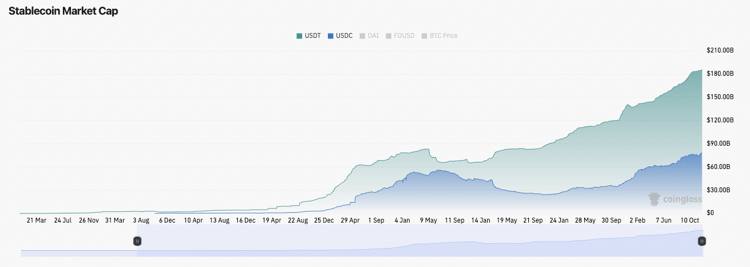
What differentiates USDC from other stablecoins is its liquidity depth, integration with both enterprises and on-chain DeFi protocols, and established distribution networks created a scale-driven moat. These entrenched strengths position USDC to largely benefit from the expected surge in stablecoin demand as broader adoption accelerates in the years ahead.
Market Cap of USDT and USDC (2017-2025)
Source: https://www.coinglass.com/pro/stablecoin
Circle's Revenue Outlook
Circle currently relies heavily on a single revenue stream, with interest earned on USDC reserves accounting for approximately 96% of its total revenue, as highlighted in analyses of its Q3 2025 earnings. This concentration makes the company's profitability highly sensitive to fluctuations in interest rates, a vulnerability often cited as a core risk in its business model.
The bulk of Circle's earnings stems from yields on the assets backing USDC, which are predominantly invested in short-term U.S. Treasuries and similar high-quality, liquid instruments. With markets anticipating further Federal Reserve rate cuts following the December 2025 reduction (bringing the federal funds rate to 3.5%–3.75%), pressure on these yields is expected to intensify, potentially compressing reserve income. Proponents counter this concern by pointing out that robust growth in USDC circulation could offset declining yields. This offsetting effect relies on continued substantial expansion in USDC supply, allowing a larger reserve base to generate sufficient income even at lower rates per dollar.
Management and industry forecasts align on strong growth prospects, suggesting a 40–60% annual growth in USDC supply. Under this outlook, Circle's overall revenue is poised to rise even in an environment of moderately declining or stabilizing interest rates.
Arc Blockchain
Circle is actively working to expand USDC’s footprint and create new sources of demand. In April 2025, the company launched the Circle Payments Network (CPN), designed to connect a wide range of financial institutions — including banks, neobanks, payment service providers, virtual asset service providers, and digital wallets. In August 2025, Circle introduced Arc, a blockchain purpose-built for stablecoin-centric financial activity. To understand why Arc matters, it’s important to first recognize USDC’s leading role in the on-chain economy.
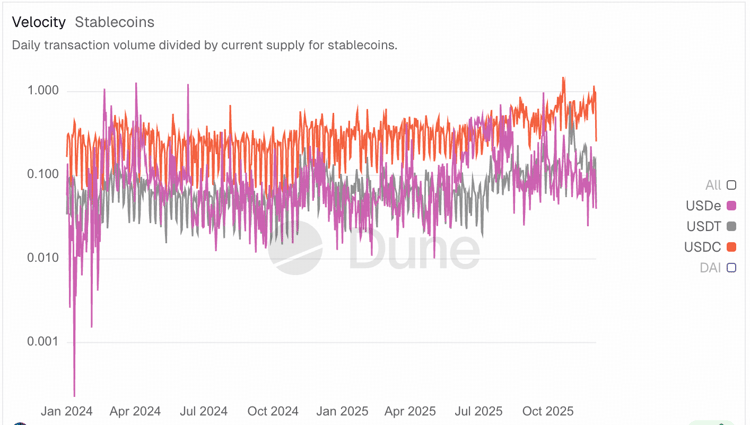
Although USDT remains the largest stablecoin by market capitalization, USDC is the clear leader in on-chain usage. One way to see this is through the concept of velocity — how frequently a unit of currency changes hands. Applied to stablecoins, velocity measures how often each token is transacted rather than sitting idle. A higher velocity indicates more active economic use.
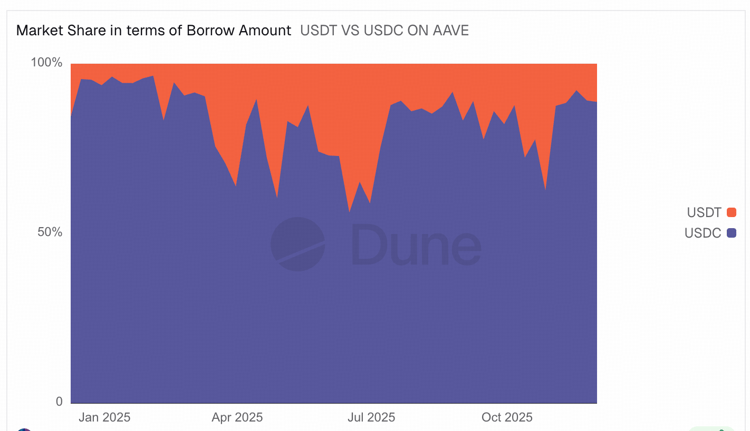
Charts below show that USDC consistently exhibits higher velocity than USDT, meaning it is more heavily used in real on-chain activities such as payments, trading, and DeFi. A concrete example is Aave, one of the largest lending protocols, where USDC represents the majority of both deposits and borrowing, while USDT plays a much smaller role.
Source: Dune Dashboard (https://dune.com/blofinresearch/main-stablecoins)
Source: Dune Dashboard (https://dune.com/blofinresearch/usdt-vs-usdc)
Currently, every transaction involving USDC on external networks like Ethereum or Solana requires users to pay a transaction fee (gas fee) using the native currency of that chain (ETH or SOL). Arc's pivotal innovation is allowing users to pay gas fees on its network directly with USDC itself. If Arc successfully attracts a substantial portion of USDC activity, it could redirect a share of the transaction fees back into the Circle ecosystem. In this way, Arc offers Circle a mechanism to participate more directly in the economic value generated by USDC transactions that currently flows to external blockchains.
In the near term, however, Arc should be viewed less as an immediate profit center and more as a strategic asset: a USDC-centric moat and enterprise infrastructure layer that lowers frictions for developers and institutional users, standardizes compliance, and deepens USDC’s role as settlement rail. Any meaningful, revenue contribution from Arc will depend on: expanding TVL in the ecosystem, enhancing the necessity of USDC, and therefore driving other fee-generating services (payment networks, FX, custody, developer services).
The main challenge is that the ecosystems Arc aims to intermediate already exhibit deep protocol network effects—Aave, Uniswap, Pendle, Perp and other leading DeFi protocols are heavily entrenched on Ethereum or Solana. For Arc to move beyond being primarily a strategic USDC platform and become a significant standalone revenue driver, it will need not only technical robustness, but also a compelling reason for liquidity, applications, and users to migrate or build natively on its rails.
Conclusion
Circle today remains a highly rate-sensitive, reserve-yield–driven model. Under favorable conditions, growth in USDC circulation can offset part of the revenue pressure from lower short-term interest rates. While whether it can fully neutralize that pressure depends on two curves: the speed and depth of rate cuts, and the sustainable growth rate of USDC in a market where multiple regulated dollar tokens are vying for share. It means that revenue diversification and the expansion of fee-based services is a structural necessity rather than a nice-to-have.
Arc's main role is to deepen USDC’s moat and provide an enterprise-grade settlement and compliance layer that lowers friction for institutions and developers. Only when meaningful TVL and transaction volume are achieved, Arc then evolves into a visibly material revenue contributor.
Stablecoins
Circle
Policy and Regulation
Disclaimer

For questions & inquiries
info@tokeninsight.com
For research & editorial
research@tokeninsight.com
2018 – 2026 © TokenInsight Ltd. All rights reserved


Use TokenInsight App All Crypto Insights Are In Your Hands
Open