

Unveiling the World of Privacy Crypto
 Crypto is pseudonymous and transparent. Privacy coins like Zcash, Monero and Tornado Cash use cryptography to restore true financial confidentiality. This article analyzes their mechanisms and the intense regulatory landscape surrounding crypto privacy.

The Myth of Anonymity
Many people assume that cryptocurrencies like Bitcoin and Ethereum are anonymous since everyone can see the public ledger of transactions (blockchain) and wallet addresses. However, these transactions are actually pseudonymous. Every public transaction is permanently saved in the record books (ledger) for all to see. While you do not have your name located on the blockchain, an individual with the proper training can follow the flow of your funds back to the first time it came onto the system (on-ramp) by using exchanges where you must provide identification and from there to connect the address to your true identity. Therefore, in many ways, using bitcoin to make a purchase is less private than cash transactions. It is similar to making a purchase in a large open area where many people can witness the transaction and take notes on it.
Privacy coins were created to solve this issue. With the help of advanced cryptography, privacy coins will allow the sender, receiver, amount of money and other sensitive information being sent to remain confidential (private) just like cash transactions are done in the real world. In this article, we will look into three of the most popular privacy coins available today—Zcash, Monero and Tornado Cash—and how they operate within this complex regulatory framework.
Zcash (ZEC): The "Opt-In" Approach
Zcash is a cryptocurrency, launched in 2016 as a fork of Bitcoin, and it has become the largest privacy coin by market capitalization. Zcash offers customers the option of either privacy or transparency; privacy can be selected at the user's discretion. The main technological advancement that Zcash employs is zk-SNARKs (Zero-Knowledge Succinct Non-Interactive Arguments of Knowledge), which enhance user anonymity by allowing the network to verify a transaction's validity without ever revealing the underlying data.
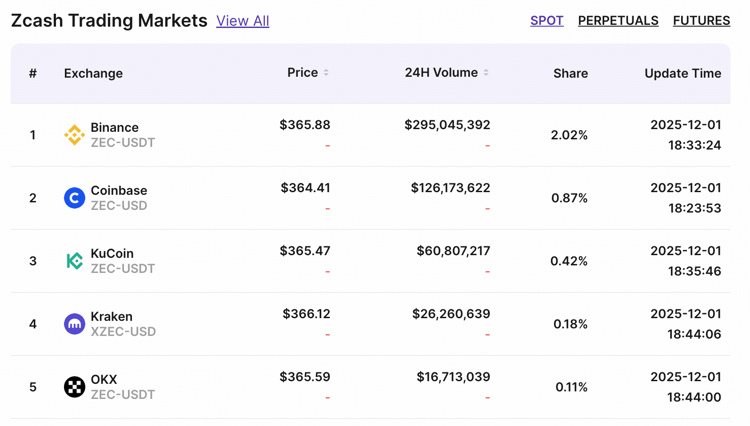
Users of Zcash may use either a "transparent address" (which works like Bitcoin's, displaying all transaction data) or a "shielded address" (which encrypts transaction data). What sets Zcash apart from other cryptocurrencies is the ability to use 'view keys' to allow third parties such as auditors or government regulators access to specific transactional information without exposing the user's entire financial record. Because of the ability to maintain the balance between privacy and the ability to audit transactions, Zcash continues to be available on mainstream exchanges, including Coinbase and Binance. However, the mainstream adoption of Zcash's privacy features is still at its early stages; as of now, it is estimated that 70% of the ZEC circulating supply is still being held in transparent addresses.
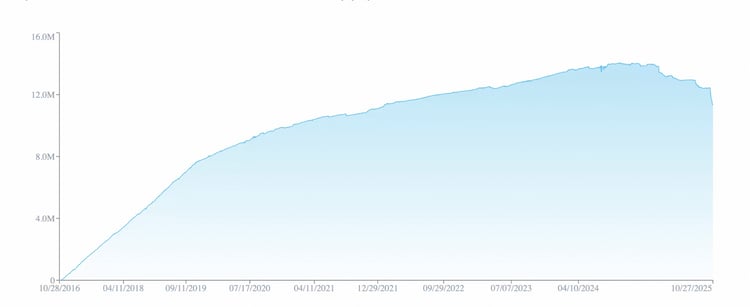
Source: Galaxy Research
Monero (XMR): Privacy by Default
In stark contrast to Zcash, Monero (launched in 2014) operates on a philosophy of confidential transactions. There is no option to send a transparent transaction; every movement of funds is opaque by default.
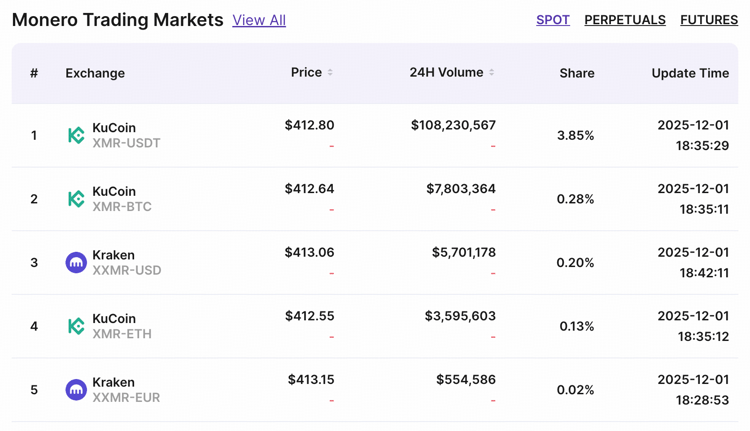
Monero achieves this through a suite of cryptographic tools: Stealth Addresses create unique, one-time destinations for every payment; Ring Signatures mix a user's transaction with "decoy" outputs from other users; and RingCT hides the transaction amount. This makes tracing a Monero transaction mathematically indistinguishable from others in the network. While this presents a promising way for anonymity and privacy, it has drawn significant ire from regulators. Agencies like the U.S. DOJ and Europol view Monero as a facilitator of illicit finance, leading to its delisting from major centralized exchanges.
Tornado Cash: The Ethereum Mixer
Unlike Zcash and Monero, which are standalone blockchains, Tornado Cash is a privacy protocol (a smart contract) built on top of Ethereum. It functions as a digital "mixer." Users deposit Ether into a shared pool, where it is jumbled together with funds from other users using zero-knowledge proofs. When the user withdraws funds to a new address, the link between the deposit and the withdrawal is severed, effectively "cleaning" the transaction details and history.
Tornado Cash has recently been at the center of a historic legal battle. In 2022, the U.S. Treasury (OFAC) sanctioned the protocol due to its use by hackers for money laundering. However, in late 2024, a U.S. appellate court overturned these sanctions in the landmark Van Loon v. Treasury case, ruling that immutable smart contracts are software code—not property or persons—and cannot be sanctioned. Following this ruling, the Treasury lifted the sanctions in March 2025. This legal clarity has revitalized the protocol, with its Total Value Locked (TVL) recently surging to new all-time highs.
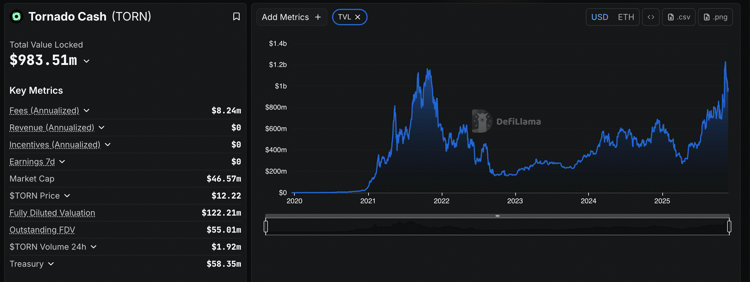
Source: DefiLlama
The Regulatory Horizon and Future of Privacy Coins
The privacy sector exists in a state of constant tension between individual rights and public safety. Regulators argue that total anonymity undermines global efforts to stop money laundering and terrorism financing. This has led to the enforcement of the "Travel Rule" by bodies like the FATF, requiring exchanges to share user data—a requirement that privacy coins inherently complicate. As early as 2018, Japan began to prohibit its exchanges from listing the privacy coins Monero, Zcash and Dash. South Korea and Australia have implemented similar laws limiting their licensed exchanges from dealing in privacy coins, resulting in the removal of these coins from all exchanges— XMR, ZEC, DASH, and others. Recently, in 2023, Dubai (United Arab Emirates) began moving to prohibit trading in privacy coins; the European Union is now developing legislation to prohibit regulated entities from using anonymous cryptocurrencies.
Meanwhile, law enforcement agencies and blockchain analytics firms like Chainalysis continue to develop sophisticated tools to trace these assets, claiming that “nothing is completely anonymous”. As the technology evolves, the industry is likely moving toward a middle ground: systems that offer selective disclosure, allowing individuals to protect their data from the public while retaining the ability to prove compliance to authorities when necessary.
Privacy
Policy and Regulation
Zero Knowledge Proofs
Disclaimer

For questions & inquiries
info@tokeninsight.com
For research & editorial
research@tokeninsight.com
2018 – 2026 © TokenInsight Ltd. All rights reserved


Use TokenInsight App All Crypto Insights Are In Your Hands
Open