

Crypto Exchange Report Q1 2026
 Q1 2026 forced the crypto exchange industry into a phase of structural recalibration. Bitcoin ground from ~$95K to ~$68K, average open interest slipped to a four-quarter low, and total trading volume fell 32% QoQ to $17.9 trillion. The contraction reflected compounding macro headwinds: a hawkish Fed, Middle East tensions, and the lingering damage from October 2025's $19B liquidation cascade. In an environment where capital is rotating defensively but the competitive landscape is actively being restructured, this report examines 20 major exchanges — with 11 as primary venues — across trading volume, market share, open interest, turnover rate, and the emerging equity perpetuals segment.

Executive Summary
Q1 2026 marked a decisive cooldown for the crypto exchange industry. Total trading volume fell to $17.9 trillion, down 32% quarter-over-quarter and 42% from Q3 2025's cycle peak of $31.0 trillion. The contraction was driven by persistent macro headwinds — a hawkish Fed, elevated geopolitical risk, and the lingering structural damage from October 2025's tariff-driven $19 billion liquidation cascade — which collectively pushed BTC from approximately $95K to $68K over the quarter. Both derivatives ($14.6T) and spot ($3.3T) volume hit multi-quarter lows, while average open interest declined to $0.09 trillion, its lowest level in four quarters, as the market continued a broad deleveraging cycle.
The top five exchanges — Binance (32.77%), OKX (13.27%), Bybit (9.55%), Gate (8.88%), and Bitget (7.70%) — collectively commanded 72.17% of total volume. OKX was the quarter's standout gainer (+1.25 pp), widening its lead over Bybit. Derivatives accounted for 82% of total market volume (+1.4 pp QoQ), with exchange-level ratios ranging from 40% to 93%, underscoring divergent platform profiles.
The spot and derivatives markets told structurally different stories. In spot, Binance led at 30.83%. MEXC (7.88%) and KuCoin (6.69%) rounded out the top three. In derivatives, the landscape was far more concentrated: Binance led at 33.27%, OKX held a firm second at 15.11%, and Bybit followed at 10.31%. The top three collectively controlled approximately 59% of derivatives volume.
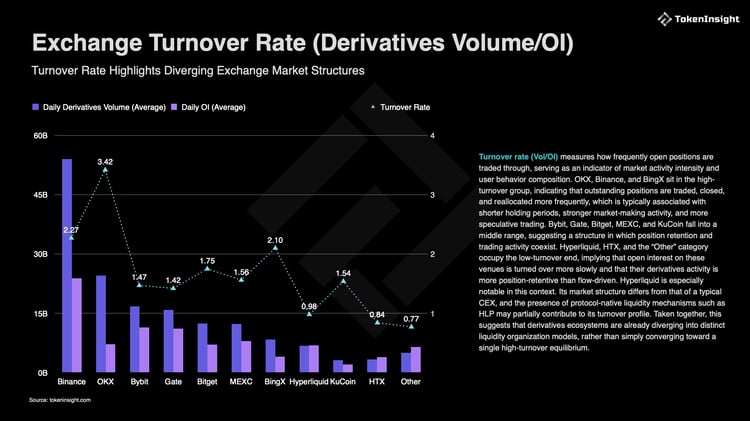
The open interest landscape revealed a different competitive hierarchy. Binance led at 25.95%, but Bybit (12.43%) and Gate (12.12%) held near-parity in the next tier. Due to the high trading activities of commodities on Hyperliquid, its OI share rose to 7.49%, approaching OKX (7.71%) and representing a significant milestone for on-chain derivatives adoption. Turnover rate analysis further differentiated exchange ecosystems: OKX (3.42x), Binance (2.27x), and BingX (2.10x) exhibited high-frequency trading intensity, while Hyperliquid (0.98x) and HTX (0.84x) operated with more position-retentive profiles — suggesting structural divergence in liquidity models rather than convergence toward a single equilibrium.
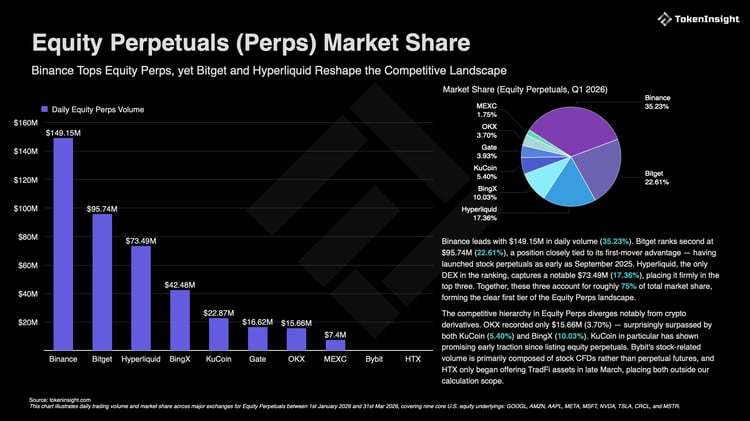
Beyond crypto-native trading, Q1 2026 saw the rapid emergence of Equity Perpetuals as a new competitive frontier. Bitget's early entry in September 2025 gave it a structural head start, while Hyperliquid demonstrated that on-chain infrastructure could compete directly with centralized venues. Binance led at 35.23%, but Bitget (22.61%) and Hyperliquid (17.36%) captured second and third. The segment remains early-stage at approximately $423M in daily volume, yet its rapid adoption signals that TradFi derivatives expansion is becoming a meaningful axis of platform differentiation.
The Q1 2026 data points to a market in post-leverage-purge recalibration and participants await clarity on rates, regulation, and geopolitical resolution before re-risking.
Data Coverage
This report examines the crypto exchange industry in Q1 2026, drawing on trading volume, open interest and turnover rate data across 20 exchanges: Binance, OKX, Bybit, Bitget, Hyperliquid (Futures Only), MEXC, Gate, KuCoin, Coinbase (Spot Only), BingX, Crypto.com, HTX, Kraken, Bullish, Upbit (Spot Only), Deribit (Futures Only), Bitfinex, Bitstamp (Spot Only), Hashkey Exchange (Spot Only), and Gemini. Based on market share, trading volume, and open interest, 11 exchanges — Binance, OKX, Bybit, Bitget, Hyperliquid (Futures), MEXC, Gate, KuCoin, Coinbase (Spot), BingX, and HTX — were selected as primary subjects of analysis. The remaining exchanges are aggregated under “Other.”
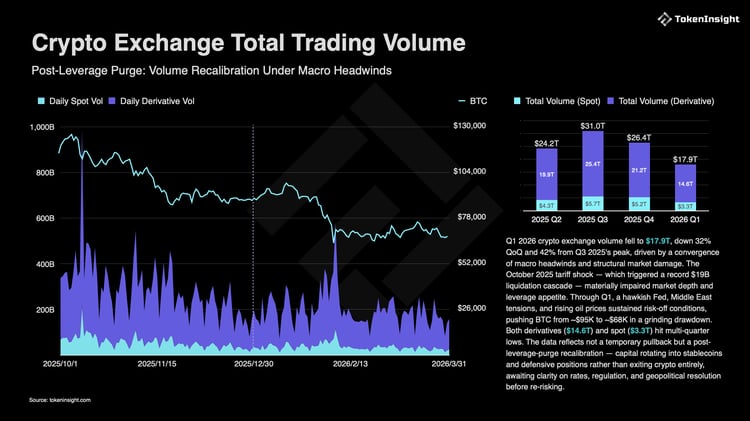
Crypto Exchange Total Trading Volume
Post-Leverage Purge: Volume Recalibration Under Macro Headwinds
Q1 2026 crypto exchange volume fell to $17.9T, down 32% QoQ and 42% from Q3 2025's peak, driven by a convergence of macro headwinds and structural market damage. The October 2025 tariff shock — which triggered a record $19B liquidation cascade — materially impaired market depth and leverage appetite. Through Q1, a hawkish Fed, Middle East tensions, and rising oil prices sustained risk-off conditions, pushing BTC from ~$95K to ~$68K in a grinding drawdown. Both derivatives ($14.6T) and spot ($3.3T) hit multi-quarter lows. The data reflects not a temporary pullback but a post-leverage-purge recalibration — capital rotating into stablecoins and defensive positions rather than exiting crypto entirely, awaiting clarity on rates, regulation, and geopolitical resolution before re-risking.
Crypto Exchange Market Share
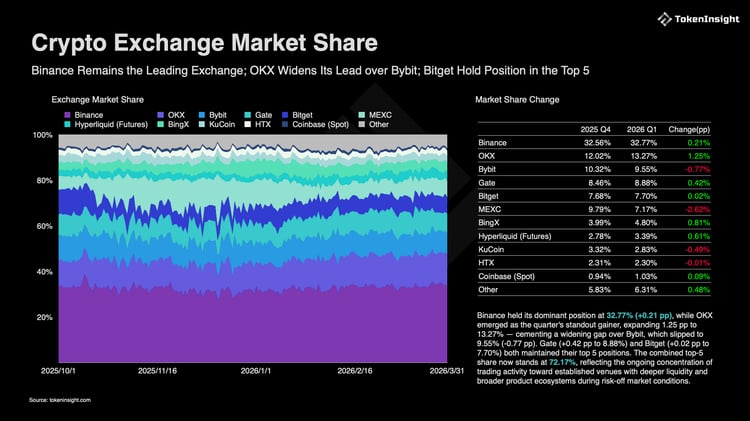
Binance Remains the Leading Exchange; OKX Widens Its Lead over Bybit; Bitget Holds Position in the Top 5
Binance held its dominant position at 32.77% (+0.21 pp), while OKX emerged as the quarter's standout gainer, expanding 1.25 pp to 13.27% — cementing a widening gap over Bybit, which slipped to 9.55% (-0.77 pp). Gate (+0.42 pp to 8.88%) and Bitget (+0.02 pp to 7.70%) both maintained their top 5 positions. The combined top-5 share now stands at 72.17%, reflecting the ongoing concentration of trading activity toward established venues with deeper liquidity and broader product ecosystems during risk-off market conditions.
Derivatives vs Spot Volume Split
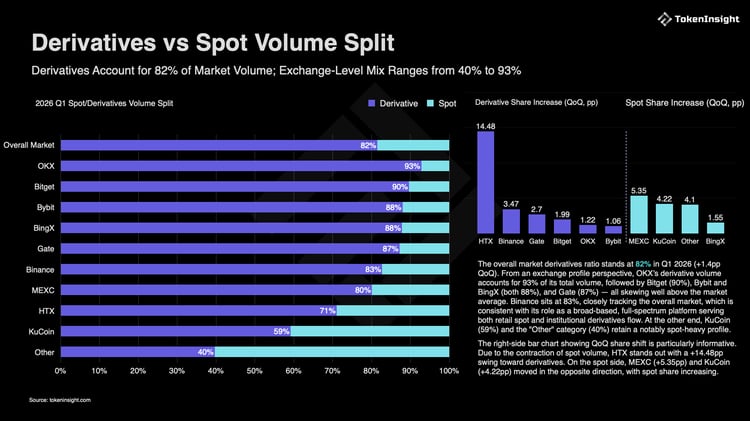
Derivatives Account for 82% of Market Volume; Exchange-Level Mix Ranges from 40% to 93%
The overall market derivatives ratio stands at 82% in Q1 2026 (+1.4pp QoQ). From an exchange profile perspective, OKX’s derivative volume accounts for 93% of its total volume, followed by Bitget (90%), Bybit and BingX (both 88%), and Gate (87%) — all skewing well above the market average. Binance sits at 83%, closely tracking the overall market, which is consistent with its role as a broad-based, full-spectrum platform serving both retail spot and institutional derivatives flow. At the other end, KuCoin (59%) and the "Other" category (40%) retain a notably spot-heavy profile.
The right-side bar chart showing QoQ share shift is particularly informative. Due to the contraction of spot volume, HTX stands out with a +14.48pp swing toward derivatives. On the spot side, MEXC (+5.35pp) and KuCoin (+4.22pp) moved in the opposite direction, with spot share increasing.
Spot Market Share
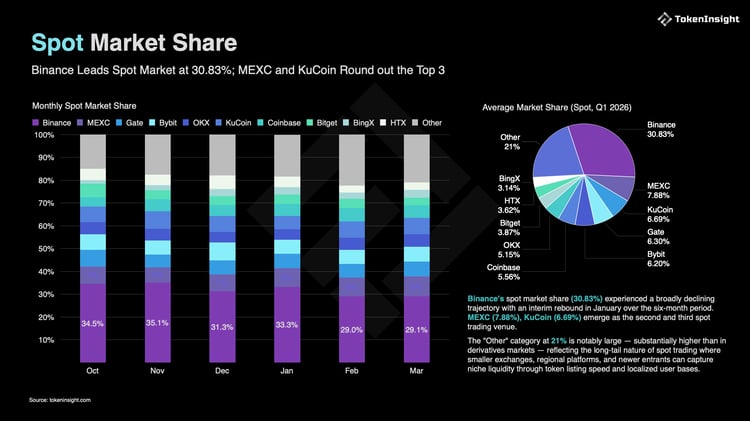
Binance Leads Spot Market at 30.83%; MEXC and KuCoin Round out the Top 3
Binance's spot market share (30.83%) experienced a broadly declining trajectory with an interim rebound in January over the six-month period. MEXC (7.88%), KuCoin (6.69%) emerge as the second and third spot trading venue.
The "Other" category at 21% is notably large — substantially higher than in derivatives markets — reflecting the long-tail nature of spot trading where smaller exchanges, regional platforms, and newer entrants can capture niche liquidity through token listing speed and localized user bases.
Derivatives Market Share
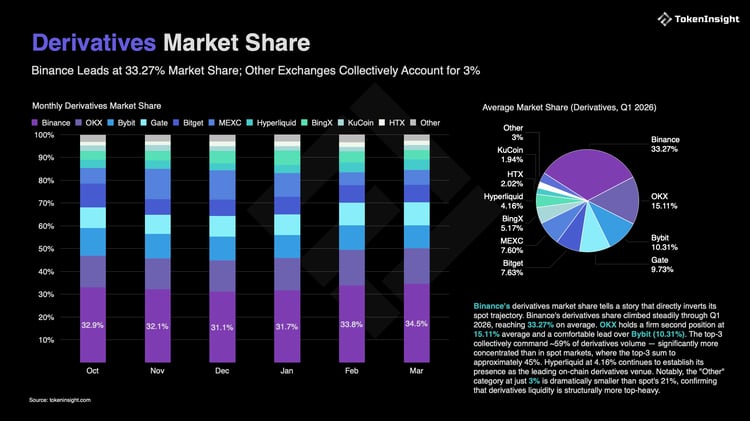
Binance Leads at 33.27% Market Share; Other Exchanges Collectively Account for 3%
Binance's derivatives market share tells a story that directly inverts its spot trajectory. Binance's derivatives share climbed steadily through Q1 2026, reaching 33.27% on average. OKX holds a firm second position at 15.11% average and a comfortable lead over Bybit (10.31%). The top-3 collectively command ~59% of derivatives volume — significantly more concentrated than in spot markets, where the top-3 sum to approximately 45%. Hyperliquid at 4.16% continues to establish its presence as the leading on-chain derivatives venue. Notably, the "Other" category at just 3% is dramatically smaller than spot's 21%, confirming that derivatives liquidity is structurally more top-heavy.
Open Interest (OI) Volume
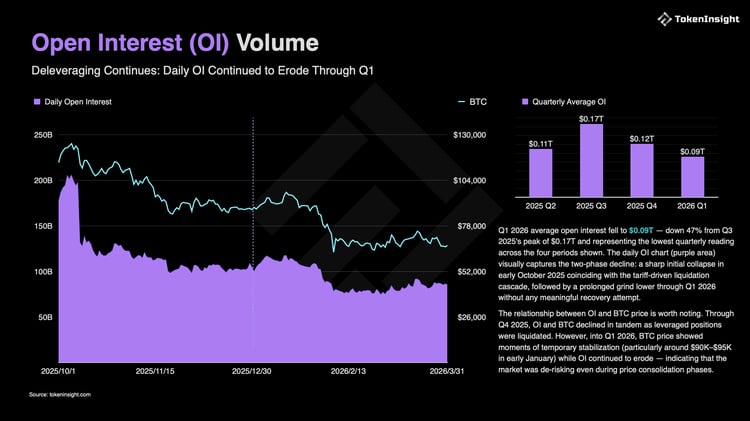
Deleveraging Continues: Daily OI Continued to Erode Through Q1
Q1 2026 average open interest fell to $0.09T — down 47% from Q3 2025's peak of $0.17T and representing the lowest quarterly reading across the four periods shown. The daily OI chart (purple area) visually captures the two-phase decline: a sharp initial collapse in early October 2025 coinciding with the tariff-driven liquidation cascade, followed by a prolonged grind lower through Q1 2026 without any meaningful recovery attempt.
The relationship between OI and BTC price is worth noting. Through Q4 2025, OI and BTC declined in tandem as leveraged positions were liquidated. However, into Q1 2026, BTC price showed moments of temporary stabilization (particularly around $90K–$95K in early January) while OI continued to erode — indicating that the market was de-risking even during price consolidation phases.
Open Interest Market Share
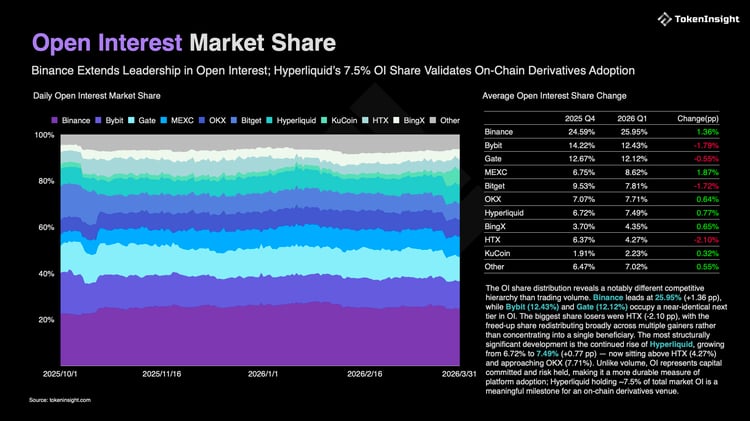
Binance Extends Leadership in Open Interest; Hyperliquid’s 7.5% OI Share Validates On-Chain Derivatives Adoption
The OI share distribution reveals a notably different competitive hierarchy than trading volume. Binance leads at 25.95% (+1.36 pp), while Bybit (12.43%) and Gate (12.12%) occupy a near-identical next tier in OI. The biggest share losers were HTX (-2.10 pp), with the freed-up share redistributing broadly across multiple gainers rather than concentrating into a single beneficiary. The most structurally significant development is the continued rise of Hyperliquid, growing from 6.72% to 7.49% (+0.77 pp) — now sitting above HTX (4.27%) and approaching OKX (7.71%). Unlike volume, OI represents capital committed and risk held, making it a more durable measure of platform adoption; Hyperliquid holding ~7.5% of total market OI is a meaningful milestone for an on-chain derivatives venue.
Exchange Turnover Rate (Derivatives Volume/OI)
Turnover Rate Highlights Diverging Exchange Market Structures
Turnover rate (Vol/OI) measures how frequently open positions are traded through, serving as an indicator of market activity intensity and user behavior composition. OKX, Binance, and BingX sit in the high-turnover group, indicating that outstanding positions are traded, closed, and reallocated more frequently, which is typically associated with shorter holding periods, stronger market-making activity, and more speculative trading. Bybit, Gate, Bitget, MEXC, and KuCoin fall into a middle range, suggesting a structure in which position retention and trading activity coexist. Hyperliquid, HTX, and the “Other” category occupy the low-turnover end, implying that open interest on these venues is turned over more slowly and that their derivatives activity is more position-retentive than flow-driven. Hyperliquid is especially notable in this context. Its market structure differs from that of a typical CEX, and the presence of protocol-native liquidity mechanisms such as HLP may partially contribute to its turnover profile. Taken together, this suggests that derivatives ecosystems are already diverging into distinct liquidity organization models, rather than simply converging toward a single high-turnover equilibrium.
Equity Perpetuals (Perps) Market Share
Binance Tops Equity Perps, yet Bitget and Hyperliquid Reshape the Competitive Landscape
Binance leads with $149.15M in daily volume (35.23%). Bitget ranks second at $95.74M (22.61%), a position closely tied to its first-mover advantage — having launched stock perpetuals as early as September 2025. Hyperliquid, the only DEX in the ranking, captures a notable $73.49M (17.36%), placing it firmly in the top three. Together, these three account for roughly 75% of total market share, forming the clear first tier of the Equity Perps landscape.
The competitive hierarchy in Equity Perps diverges notably from crypto derivatives. OKX recorded only $15.66M (3.70%) — surprisingly surpassed by both KuCoin (5.40%) and BingX (10.03%). KuCoin in particular has shown promising early traction since listing equity perpetuals. Bybit's stock-related volume is primarily composed of stock CFDs rather than perpetual futures, and HTX only began offering TradFi assets in late March, placing both outside our calculation scope.
Thesis & Outlook
Q1 2026 was not simply a quarter of contraction; it was a quarter in which the shape of competition began to shift. Aggregate volume compressed, leverage continued to unwind, and capital rotated into defensive postures. Beneath that surface, however, market share reshuffled, on-chain derivatives reached a credible scale, and TradFi-related products emerged as a genuine battleground.
Looking into Q2 2026, three developments warrant close attention. First, whether the equity segment graduates from an early-adopter niche into a mainstream product line. Second, whether Hyperliquid's open interest share continues to climb, testing how far on-chain venues can advance against centralized incumbents under sustained risk-off conditions. Third, whether turnover-rate divergence across exchanges persists, confirming that derivatives liquidity is organizing around structurally distinct models rather than converging. The quarter closed with market share highly concentrated, but not fixed. New product launches from incumbents and mounting competitive pressure from perp DEXs leave the industry map open to meaningful redrawing in the quarters ahead.
For more details, please download the entire report
Exchanges
Download
Disclaimer

For questions & inquiries
info@tokeninsight.com
For research & editorial
research@tokeninsight.com
2018 – 2026 © TokenInsight Ltd. All rights reserved


Use TokenInsight App All Crypto Insights Are In Your Hands
Open