Railgun is a set of privacy contracts deployed on Ethereum mainnet. This article will briefly introduce the mechanism and token information of the protocol.
Imagine how we will interact with Web3 on-chain ecosystem in the next 5 years? How much information are you willing to disclose for every contract-interaction? Imagine, if it is still such a wallet- directly-connected-to-project contract model, our personal on-chain information will be collected and utilized for free, which adds a lot of data security risks. Therefore, the privacy on chain has always been a topic that cannot be avoided.
In the current market, privacy projects are numerous and have different perspectives. Such as privacy computing layer (Phala Network, Suterusu, NuCypher), public chain or parachian (Manta, Platon, Secret Network), middleware (Tornado Cash, Raze Network), etc.
Recently, the trending project Railgun is one of these middleware solutions. We first discovered this project in the Defiant Youtube video. The founder, Emmanuel Goldstein, has many years of experience in cybersecurity and understands DeFi privacy quite well. This article provides a brief introduction to what Railgun really is and why we are optimistic about its model.
Railgun is a set of privacy contracts deployed on Ethereum mainnet. By using Railgun, users can transfer money, trade, act as LPs, or interact with any other contract on the Ethereum mainnet while hiding their address untraceable. Railgun primarily uses zk-SNARKs zero-knowledge proof technology to ensure that the information that is hidden is verifiable.
In brief, Railgun has the following features.
Three steps: ADD, SPLIT, and REMOVE.
Two pools: Live Pool, Dead Pool
One note: zero knowledge note (not NFT or tokens)
Specifically, the core of the Railgun protocol is a JoinSplit transaction, which operates on the (U)TXO – that is (Unspent) Transaction Output, model. Details: https://assets.railgun.org/docs/whitepaper/Railgun%20Project%20Whitepaper%20-%20July%202021.pdf
In short, Railgun creates an anonymous pool of money (the pool is operated by Relyar) and all of the user's private operations are operated by Railgun's anonymous pool of assets.
The core advantage of Railgun is that it has a lower barrier to user participation and is easier to use. To make anonymous transactions, you don't need to learn how to use some new software, you just need to tap on other items. It's like when you open an app and the question pops up: Do you share data with Apple? You choose no. It's that simple. Of course the reality may be, do you use Railgun for anonymous transactions before trading on Uniswap? If you choose yes, an additional confirmation of a fee is paid and that's it, no matter what tokens you're trading and how much it is. If Railgun enhances the product experience with additional treats, users can easily buy in. Other current solutions like mixers are lack in functionality and ease of use. For example, they don’t allow for internal shielded transactions, can’t interact with smart contracts, and users may have to operate in fixed denominations. These solutions do not allow for simple, efficient use of protocols while anonymity is maintained... In a word, they are not good to use.
A shielded transaction is essentially a transaction that is between two shielded addresses. Details: https://coinmarketcap.com/alexandria/glossary/shielded-transaction
High middleware adaptability and low development cost. Building, running and maintaining a huge decentralized network of independent nodes is very difficult for any project. Especially in a bear market, the network operation and maintenance costs become very high for each node and their opportunity costs can be high. Therefore the attractiveness of a small network will be extremely poor. Compared to developing a brand new public chain ecosystem or parallel chain, the difficulty of writing a set of contracts using zero knowledge proof is relatively small. There is also no need to spend money to attract projects to support your own public chain ecosystem. Since Railgun has developed Adapt module, it is widely used in various DeFi contracts to help expand its user base at low cost.
The product logic of Railgun is simple, and there are many ways to expand as long as the core functions do not go wrong. For example, you can use Railgun for dark pool trading to ensure that your portfolio is not copied, and other project parties can even use Railgun as a base to build a UI for dark pool services to push to their users, and Whales can avoid having their transactions monitored by nansen, zerion, etc. In short, such a middleware product we think has the combinability of Lego and therefore has a lot of imagination for both users and developers.
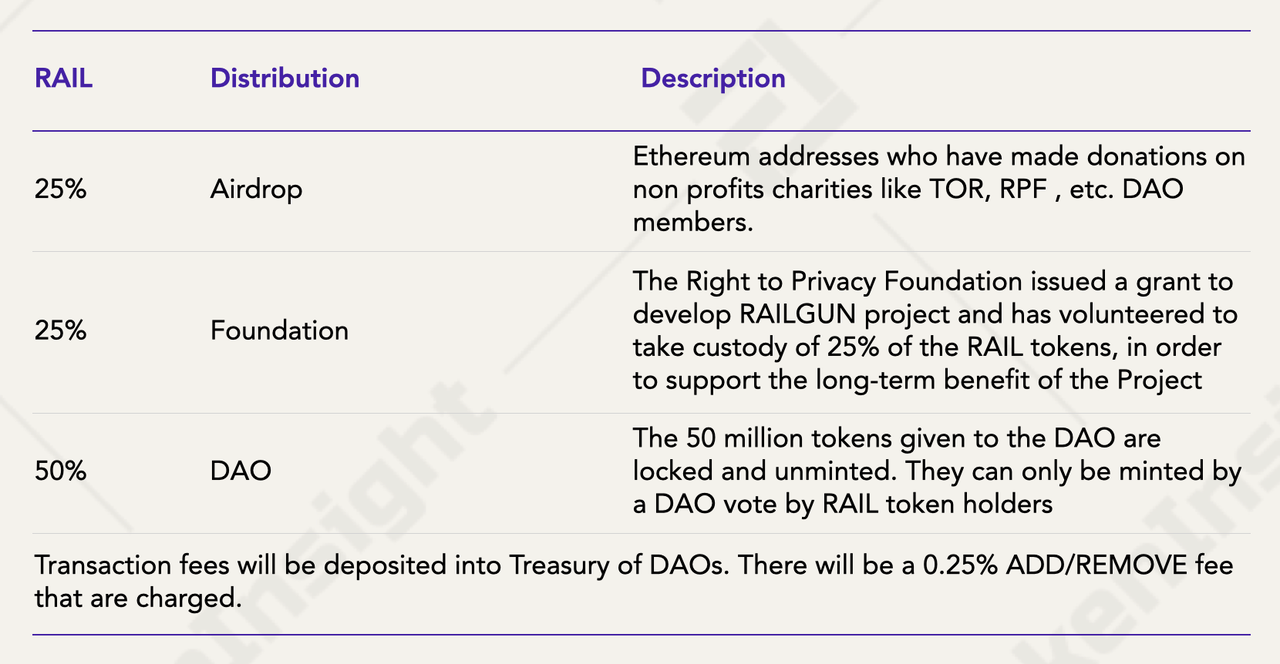
The protocol will be deployed to BSC, Polygon, and later to Solana and Polkadot, each chain with its own new token minted. Currently, there are already token airdrops for staked users on different chains (except Polkadot).
The team is relatively solid, except for the less clear information disclosure about the founders, who are all Ivy League educated and have experience in traditional and crypto industries. No clear cooperation experience can be found, but a high proportion of the same Oxford graduates are obvious.
The advisors are also strong background: all have academic backgrounds in the top 3 of the UK, and the main roles are: academic advisors, legal advisors, and marketing media advisors.
Emmanuel Goldstein is the founder. He has experience developing DeFi, being a long term DeFi project LP, and has 10 years experience developing mobile games and game economy. He alsohas experience in cybersecurity work in former government departments.
Andrey Kravchenko, Project Manager. He is a PhD, lecturer and MBA in Computer Science at Oxford University, Deep Learning research direction. He had self-made mobile app and web development company Vitruvian Man, and he also has CTO experience.
Kieran Mesquita, Chief Scientist. As an early bitcoin advocator, he started mining BTC in 2010 with his own codes. He has at least 3 years of experience in entrepreneurship, management, and has rich experience in consensus algorithm development, mining, contract development and cross-chain development. He is also the CTO at a UnityChain in Taiwan (2019).
Token Information: Railgun (RAIL)
 APP
APP