Ink Finance provides a highly scalable and customizable framework for on-chain collaborative financial operations, enabling organizations to create compliant, blockchain-based structures with advanced risk management and transparency. In this article, we will deep dive into Ink Finance and its native token QUILL.
With the development of blockchain technology, a new form of organization has emerged in recent years: the on-chain organization. From the well-known Decentralized Autonomous Organizations (DAOs) to the innovative concept of Network States proposed by Balaji Srinivasan, these on-chain entities are transforming how people can collaborate together.
Ink Finance provides a highly scalable and customizable framework for on-chain collaborative financial operations, enabling organizations to create compliant, blockchain-based structures with advanced risk management and transparency. Ink empowers organizations to transition seamlessly from traditional Web2 organizations to Web3 entities through a holistic solution. The platform integrates features such as DAO creation, treasury operations, investment and funding management, and community economic governance. With its InkEnvelope functionality, Ink Finance also supports real-world asset (RWA) underwriting, enabling the transformation of various asset types into tokenized formats.
The platform not only supports the creation and management of on-chain organizations but also empowers them to embrace decentralized structures tailored to specific needs. For instance, a Decentralized Science (DeSci) community could leverage Ink Finance to raise funds for research initiatives, manage treasury operations democratically, and tokenize intellectual property (IP) assets, fostering transparency and collaboration.
While decentralized organizations like DAOs have become a foundational structure for many crypto projects, they face significant challenges in managing complex and multifaceted operations. The primary issue confronting DAOs in the current market is the lack of a unified and cohesive management platform that integrates essential components such as governance, task management, financial execution, and compliance into a single, efficient system.
Fragmentation of DAO Tools
The current landscape of DAO management tools is highly fragmented. Various platforms address specific needs — such as governance (e.g., Snapshot), financial management (e.g., Gnosis Safe), or social verification (e.g., CollabLand) — but no single solution provides a unified platform that seamlessly integrates these functionalities. As a result, DAOs are forced to rely on a patchwork of tools, which leads to operational inefficiencies and disconnected workflows.
Disconnection Between Decision-Making and Execution
Another critical issue for DAOs is the disconnect between decision-making processes and on-chain execution. While tools like Snapshot facilitate proposal-based governance and voting, efficiently executing these decisions on-chain remains a significant challenge. This separation introduces procedural bottlenecks and hinders seamless operations.
Lack of Effective Organizational Structures
Traditional enterprises achieve operational efficiency through clear divisions, hierarchies, and subsidiaries. DAOs, however, struggle to replicate these structures in an on-chain environment. The relationships between parent DAOs and sub-DAOs often lack clarity and technical implementation, making it difficult to establish interconnected and scalable functional units.
Insufficient Financial Management and Compliance Tools
Comprehensive financial management is vital for effective organizational operations, yet most DAOs lack integrated tools for payments, audits, risk control, and compliance. These gaps undermine their ability to handle fiscal operations efficiently and securely.
These limitations hinder DAOs from evolving into more complex organizational structures and achieving larger business objectives. To overcome these challenges, DAOs require a cohesive, all-encompassing management platform that integrates governance, organizational structures, task management, financial execution, and compliance into a single framework. Such a solution would enable DAOs to operate efficiently, scale effectively, and meet their ambitious goals.
Ink Finance provides a powerful, all-in-one treasury management solution for decentralized organizations to address their complex financial needs, offering features such as manager identity verification, multi-asset treasury vaults, payment and transfer control, income and revenue audits, and much more.
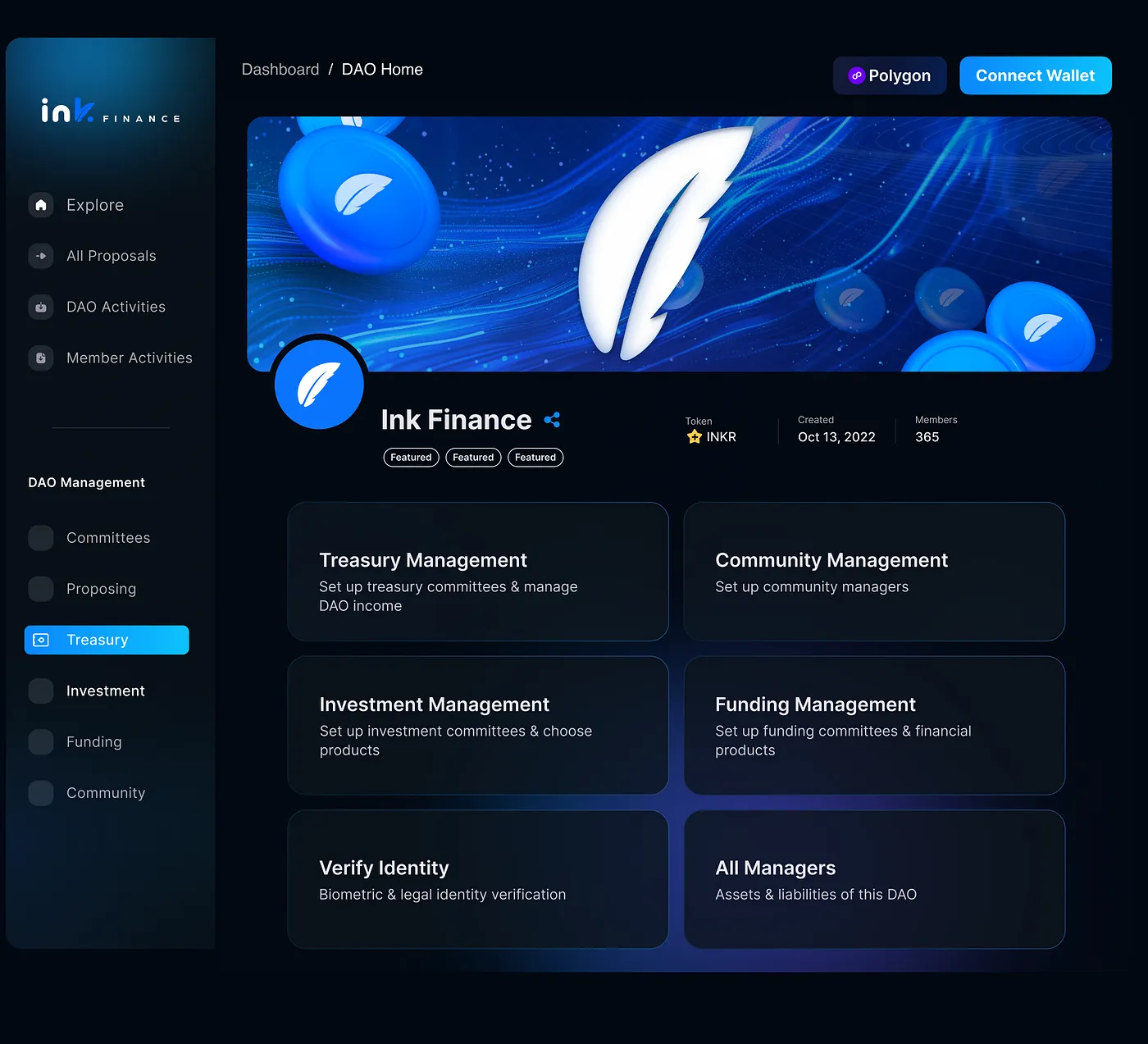
Ink Finance simplifies treasury creation through customizable modules that can be configured by board members or treasury managers. Board members can propose the appointment of verified manager wallets to the Treasury Committee, assigning specific responsibility to them. Governance token holders can vote on these proposals, and upon reaching a resolution, Ink Finance’s factory system executes these decisions on-chain, creating a secure, multi-asset treasury vault managed by approved individuals.
At the heart of Ink Finance’s treasury management solution is the Universal Custodian Vault (UCV), a smart contract based vault that ensure security and autonomy. Ink Finance itself holds no operational authority over these vaults. All treasury operations, such as transaction setup and approval, are decided and controlled exclusively by governance-voted resolutions.
Treasury managers are subject to rigorous identity verification standards, including options like social media bound verification, humanode biometric verification, and Astra regulatory compliance verification, ensuring both security and regulatory alignment.
The platform supports streamlined financial operations such as periodic payrolls, one-off payments, and vault-to-vault transfers. It also resolves the common opaque financial reporting problem facing decentralized organizations by classifying income and revenue categories for detailed on-chain audits.
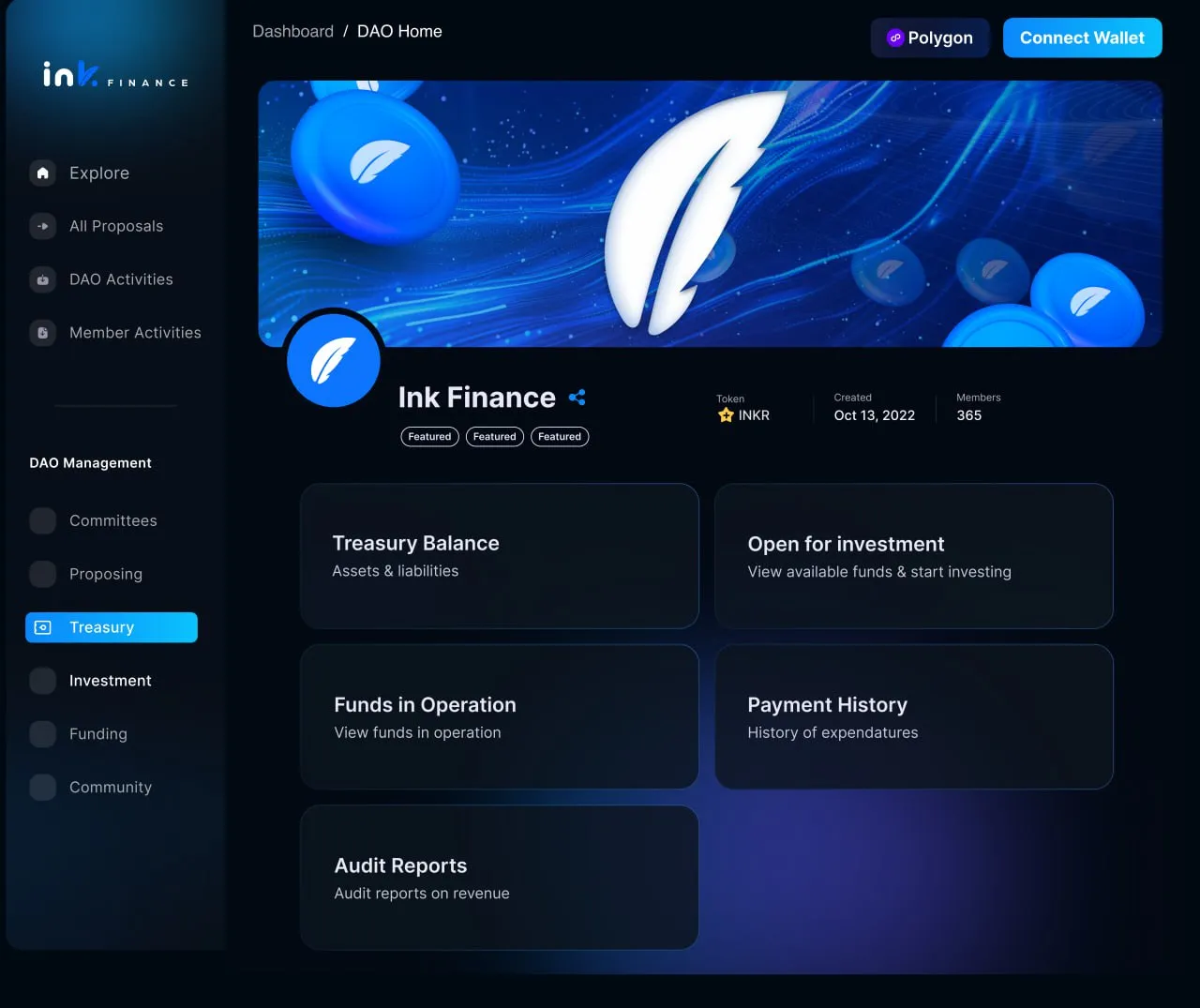
DAO members, contributors, and protocol investors can access real-time information about their treasury’s balance and activities within their organizations. All outgoing expenditures are trackable and viewable through payment history dashboard, while all incoming transactions can be reviewed via audit reports. This transparency promotes accountability and ensures stakeholders can monitor the organization’s financial health.
Real-World Assets (RWA) has become a major sector in the crypto market and U.S. Treasuries have become the leading asset class in this emerging field. There has been over $2.4 billion tokenized treasuries on-chain. Due to their simplicity, standardization, and global prominence, tokenized treasuries are the most accessible financial instrument for blockchain integration.
U.S. Treasuries are highly standardized financial instruments with predictable features like fixed maturities and coupon payment. This uniformity makes them easy to be tokenized, as they can be easily represented on blockchain through smart contracts that contain these straightforward terms.
However, it faces significant challenges when moving beyond assets like the U.S. Treasuries to more complex asset classes. Assets such as real estates, private equity, or commodities lack standardization. Real estate, for example, varies widely in value, location, and ownership structures, requiring customization for each tokenized asset.
Moreover, legal and regulatory complexities present additional barriers. Jurisdiction-specific regulations often govern ownership transfer, custody, and trading of physical assets, creating hurdles to tokenization. Verification and valuation pose further challenges for many RWAs. Assets like property or art require independent assessments to verify authenticity and determine market value, these processes are difficult to automate or integrate on-chain.
InkEnvelope is a product that enables the wrapping of diverse assets or financial products into a token. InkEnvelope overcomes the heterogeneity of assets by providing a unified description format that simplifies the complexity of diverse asset classes, This format is adaptable to both equity and rights assets, such as real estate and art, and fixed income assets such as invoices, receivables, consumer credits, and debt claim. InkEnvelop ensures that the unique characteristics of each asset type can be accurately represented while maintaining a consistent framework of tokenization.
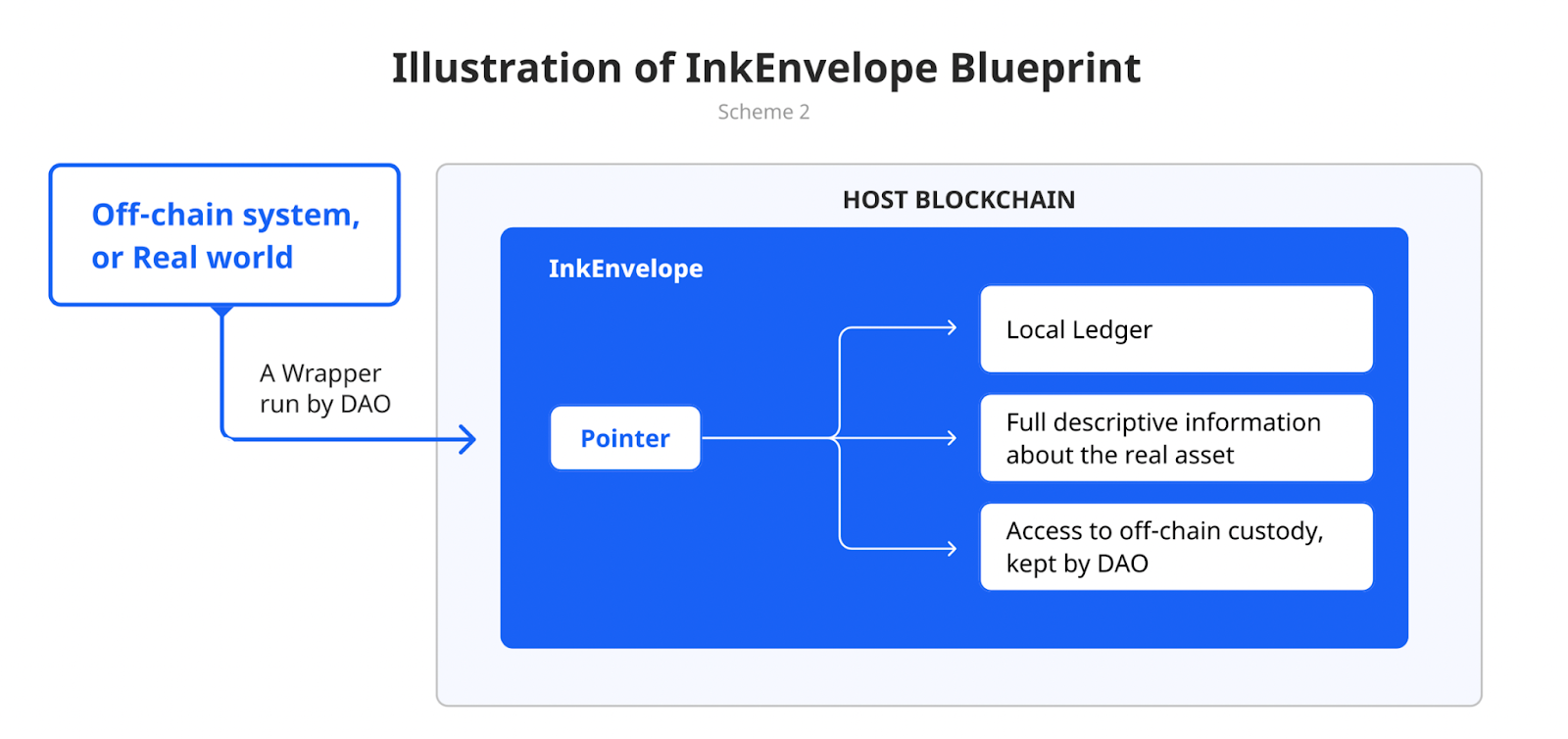
Vital asset information, such as insurance, guarantees, valuation audits, licensing, disposal rights, and clearing authorities can all be incorporated into InkEnvelop’s structure. This comprehensive wrapping of asset details ensures that investors and other stakeholders have transparent and verified information.
A critical innovation of InkEnvelope is its integration of enforceable, transparent governance processes. All steps in the asset tokenization lifecycle, from wrapping critical assets details to approval and publishing, are encoded within the InkEnvelope. This ensures that all parties involved, including risk managers, auditors, and administrators, adhere to clear and community-enforced standards. Governance participants are selected through decentralized voting and must meet stringent criteria, such as pledging governance tokens and verifying legal identities or professional credentials.
InkEnvelope also provides a programmable layer that seamlessly connects to DeFi applications, such that investors can access and trade InkEnvelope-packaged assets through established DeFi protocols.
With all the features, InkEnvelope supports the full lifecycle of asset tokenization and investment, including wrapping asset information, encoding introduction and approval processes, publishing assets, and facilitating investment through DeFi protocols.
Ink Finance’s innovative platform for decentralized fiscal and financial management is built around two core technologies: the Unified Custodian Vault (UCV) and InkEnvelope. These constructs enable decentralized organizations to securely manage, tokenize, and interact with RWA and digital assets.
Unified Custodian Vault (UCV)
UCV is a programmable multi-asset holding construct capable of safekeeping any form of assets with management rules attached. UCVs allow organizations to create multiple vaults within their ecosystem, each designated for unique purposes such as treasury management, investments, or funding operations. Each vault operates independently with clearly defined authorities, ensuring operational isolation.
The UCV can support a variety of financial activities, including periodic payments, on-off transfers, or DAO-to-DAO vaults. All transactions are securely executed by contract-based setup and multi-signing processes. Various income or revenue categorization, as well as audit, is also supported.
Governance over UCVs is managed through two programmable constructs:
With these capabilities, UCVs provide robust infrastructure for decentralized financial operations, enabling organizations to efficiently manage their assets while adhering to strict governance standards.
InkEnvelope: A Wrapper for tokenizing Heterogeneous Assets
InkEnvelope is the second pillar of Ink Finance’s technology for decentralized finance. It enables tokenization of diverse assets while ensuring transparency, flexibility, and compatibility with DeFi.
In addition to the basic features about InkEnvelope introduced in the previou section about RWA underwriting, tokens wrapped with InkEnvelope can be non-fungible (NFT) or fungible (FT), compatible with any mainstream wallet and DeFi. It can be used as a DAO’s treasury asset, collateral for borrowing, or component of investment portfolios.
InkEnvelope also supports the creation of bespoke financial products, such as loans or investment funds, backed by collateralized assets. These bespoke financial products can then be made available to investors through “fund launch” or “product launch”, which can support use cases such as regulated security token offer, crowdfunding, or other asset management operations.
QUILL is the native token of Ink Finance and serves as the cornerstone in its ecosystem. At its core, QUILL functions as an invested capital of the facility.
Most of Ink Finance’s functions are designed to be used completely for free, including the core governance functions that allow decentralized organizations to deploy a set of on-chain contracts through total customization. However, for those who need to use advanced financial tools, they need to purchase QUILL token as invested capital. Unlike traditional Web2 SaaS models, which rely on recurring subscription fees, organizations acquire and stake QUILL token to access advanced governance and financial tools. This approach eliminates the risk of wasted expenditure on subscription expenses, as QUILL remains owned by organizations, and they can not only use Ink’s service for free but also participate in its governance through the QUILL token they staked, ensuring a direct stake in the platform’s future.
This scheme directly endows QUILL tokens as a form of working capital for organizations, which greatly reduce the risk of a organization’s investment, because no matter whether a organization can eventually achieve its business success, the QUILL token as a invested capital will still have value at exit.
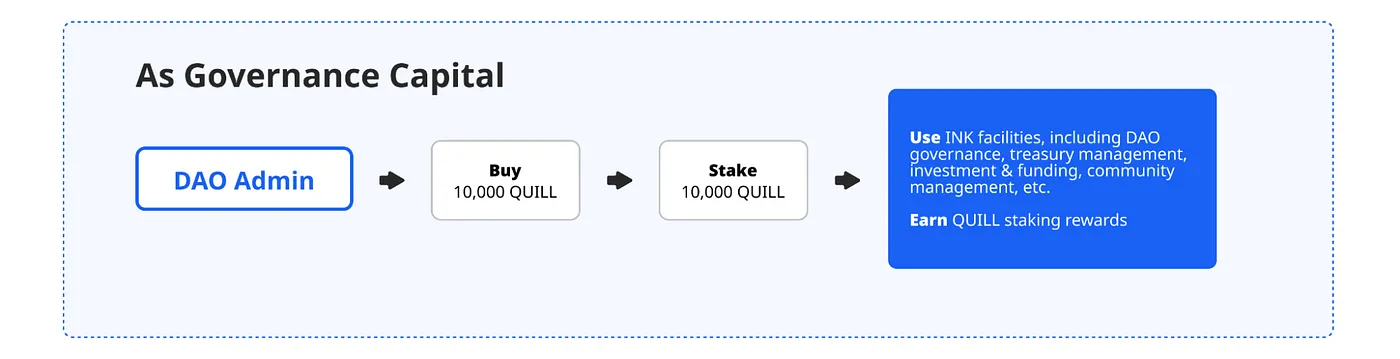
QUILL token also plays a pivotal role in fostering growth through its ecological incubation mechanism. Ink Finance understands that not all organizations may have the capital to purchase QUILL token upfront. To address this, the platform designed a sponsorship mechanism where the Ink DAO community can vote to sponsor these organizations by providing QUILL tokens in exchange for the organization’s native tokens. These tokens are then added to the Ink DAO treasury, creating a diverse portfolio of assets, The Ink DAO can later sell these tokens in secondary markets to repurchase QUILL, which is then placed into the staking emission pool. This process will reduce QUILL’s circulating supply and potentially bring upward price pressure.
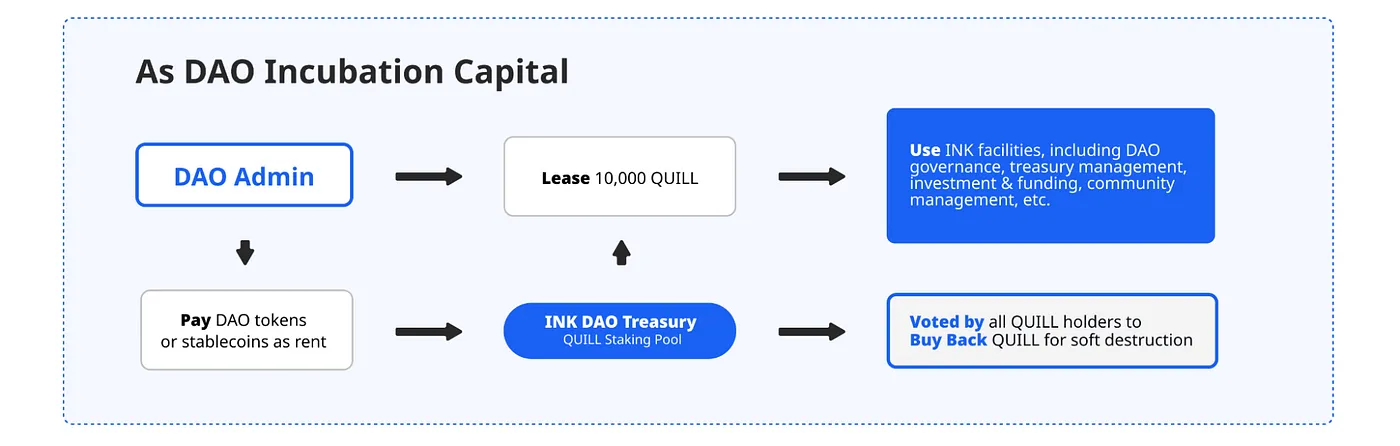
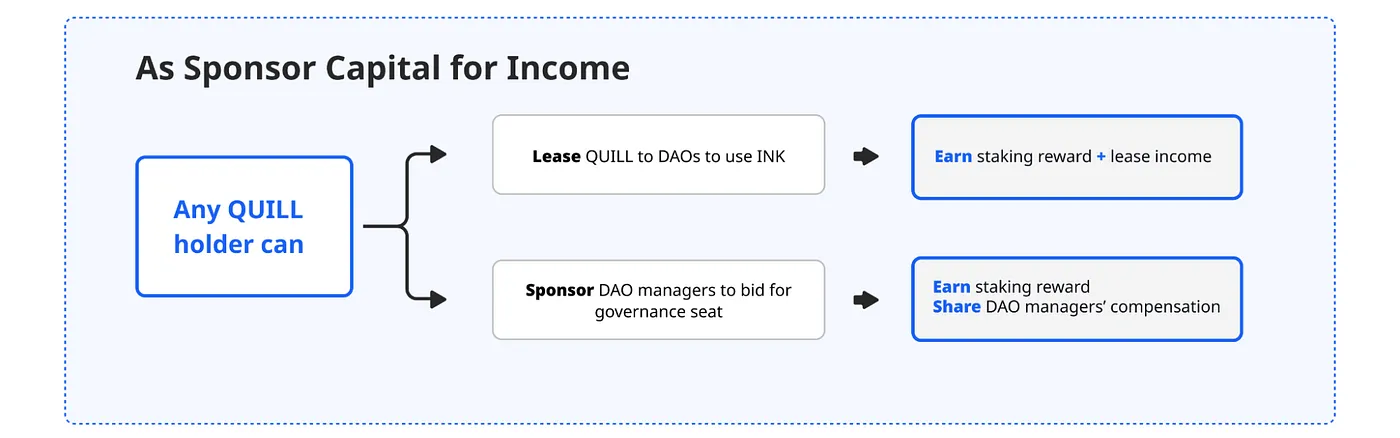
QUILL also empower individual sponsors to directly support organizations. By staking their QUILL to sponsor specific organizations, individuals can earn rewards beyond the standard staking incentives. Sponsors can share the revenue generated from the sponsored organizations and their managers. The sponsored organizations can vote to determine the income sharing ratio and such decisions are executed and enforced on-chain.
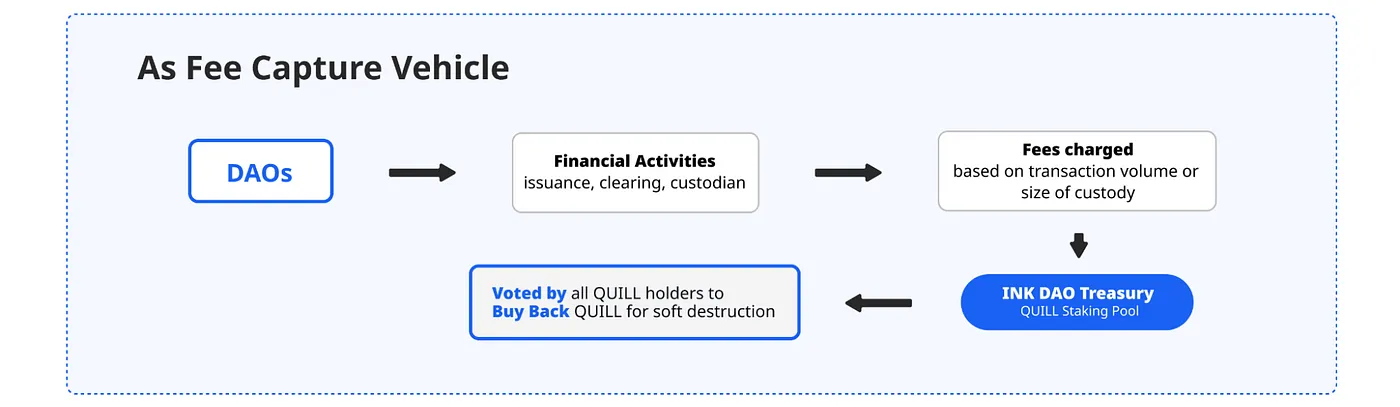
In addition to serving as a capital investment, QUILL token also serves as a tool for capturing financial services fees. Ink Finance charges fees for activities such as asset issuance, settlement, and custody. These fees, collected in crypto assets like ETH or USDC, are used to purchase QUILL in the market. The acquired tokens are deposited into the staking emission pool, ensuring long-term operational sustainability.
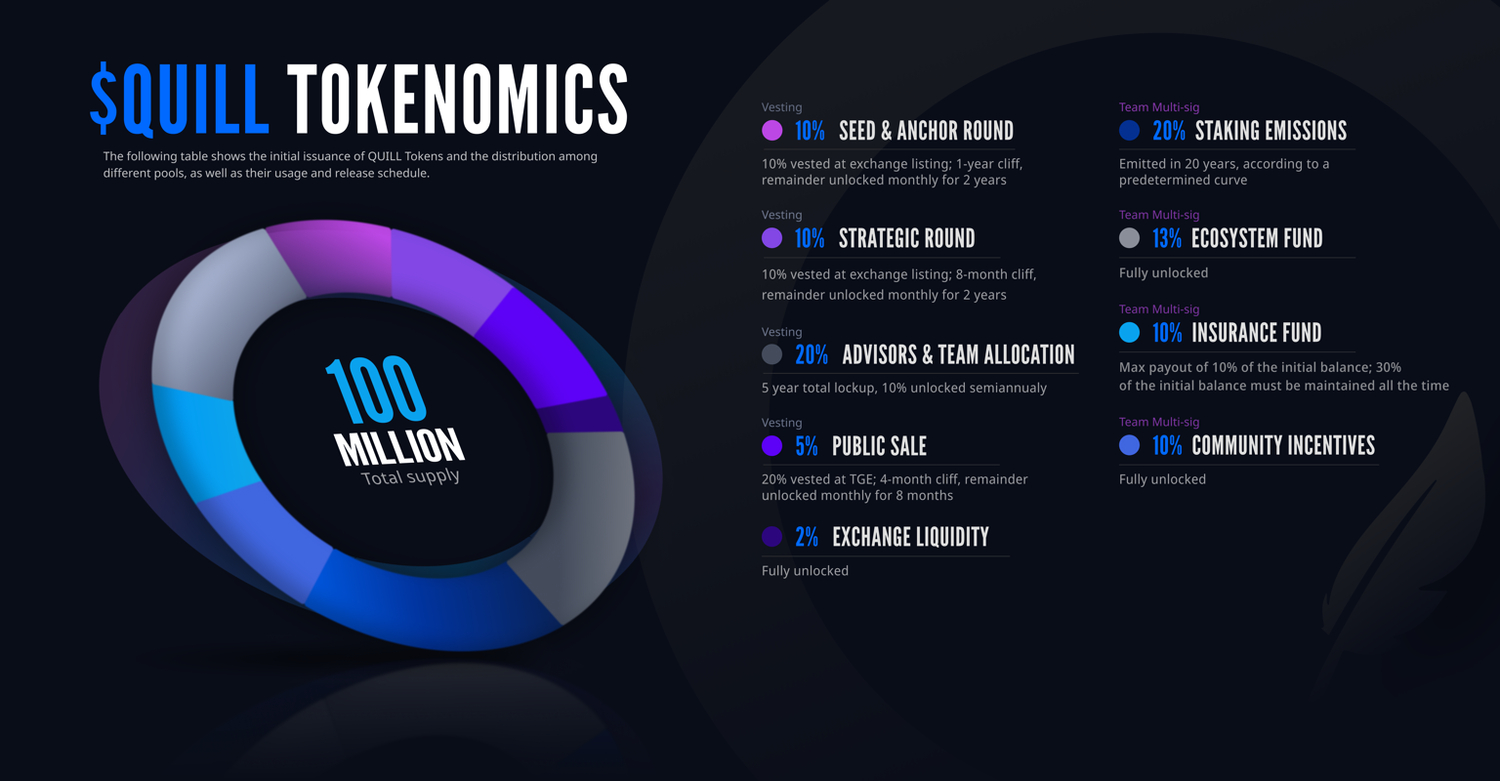
QUILL has a capped total supply of 100 million. The token allocation and vesting plan is illustrated below.

Ink Finance provides an advanced decentralized governance framework to bring real-world economic and finance activities into the on-chain environment, offering a compliant and highly efficient solution. One prominent example is the partnership between Hylobiz, Fluna, and Ink Finance, which transform traditional trade finance with decentralized syndication.
Ink’s collaboration with Fluna and Hylobiz demonstrates how DeFi can address inefficiencies in traditional trade finance.
Fluna is a leading provider of Purchase Order (PO) Financing. The company addresses the liquidity challenges businesses face when fulfilling large orders without sufficient working capital. Traditionally, these loans are secured by physical collateral, such as the goods themselves or other commodities, which significantly limits the ability of borrowers with insufficient collateral to access necessary capital. Ink Finance provides an innovative solution for this problem by enabling decentralized capital allocation through DAOs, reducing collateral requirements while maintaining transparency and legal security.
Hylobiz is a global leader in supply chain finance, it provides sophisticated debt clearing and servicing platform on-chain. With its expertise in supply chain finance, Hylobiz brings a robust pipeline of creditworthy borrowers, complete through KYC and compliance checks. By integrating Hylobiz’s VDP (Vayana Debt Platform) with Ink Finance’s decentralized syndication model, the partnership facilitates seamless origination, syndication, servicing, and tracking of loans.
Ink Finance’s decentralized syndication model represents a key innovation. Unlike traditional platforms that rely on centralized intermediaries for risk management and loan approval, Ink Finance empowers DAOs to take control. Lending DAOs, which comprise sophisticated investors like family offices, corporate treasuries, and commodity trading firms, pool capital to fund trade loans. With Ink Finance’s infrastructure, loans can be tokenized as a NFT (non-fungible tokens). Once a loan is approved, both the borrower and the lending DAO co-create and mint a loan token, which represents the loan agreement and the underlying collateral, legal ownership rights, and real-world enforcement mechanism. All parties involved in the transaction, including borrowers, lenders, risk managers, have verifiable, enforceable rights over the loan’s collateral in the event of default.
Fluna’s clients can access trade loans with reduced collateralization requirements, and Fluna acts as an intermediary, advancing payments to clients, while pledging these loans, backed by physical goods and commodities, as collateral to the lending DAO. This structure allows the DAOs to inherit the legal ownership of the loan and its collateral. Hylobiz enhances this structure with its real-time loan servicing platform, ensuring borrowers can efficiently access capital while adhering to stringent regulatory standards.
INK Finance has supported a Hong Kong-listed company specializing in YouTube IP cross-verification and advertising revenue distribution to streamline and enhance the revenue-sharing process between YouTubers and their communities. This initiative demonstrates how decentralized platforms can bridge traditional content ecosystems with Web3 capabilities.
In this use case, a YouTuber established a DAO (Decentralized Autonomous Organization) to enable benefit-sharing with their fanbase. When the YouTuber uploads videos to YouTube, a third-party company tracks fan engagement, such as likes, comments, and subscriptions, tied to the videos. This engagement data is anonymized and sent to the YouTuber in a CSV file, along with details on the advertising revenue generated for that video.
Using INK Finance, the YouTuber can directly distribute a portion of their advertising revenue to fans. Fans bind their YouTube accounts and cryptocurrency wallets to the system, with plans to incorporate features that enable wallet creation without user intervention for a seamless experience. Through the DAO, the YouTuber can initiate and pass proposals to define revenue-sharing parameters. Once approved, fans receive their share of the earnings in cryptocurrency, such as USDT, directly into their wallets.
This approach benefits multiple stakeholders. Smaller YouTubers who might not meet traditional advertising revenue thresholds can leverage their communities to secure ad deals and share earnings transparently. Fans are rewarded for supporting their favorite creators, fostering stronger engagement. Additionally, the Hong Kong-based distribution company diversifies its service offerings and adds new clients to its portfolio.
This use case illustrates how INK Finance facilitates the integration of Web2 platforms with Web3 tools, providing creators and their communities with transparent, efficient, and decentralized mechanisms for revenue sharing.
INK Finance provides a comprehensive platform for Decentralized Science (DeSci) initiatives, enabling communities and institutions to advance research in a transparent, efficient, and participatory manner.
Through its decentralized governance framework, INK Finance allows research groups to create DAOs (Decentralized Autonomous Organizations) dedicated to particular scientific goals. These DAOs can propose and approve funding initiatives democratically, ensuring that resource allocation aligns with the collective priorities of the community.
Once funds are raised, INK Finance’s treasury management tools provide robust mechanisms for oversight and allocation. Scientific DAOs can manage treasuries, set budgets, and monitor expenditures in real time.
INK Finance enables the tokenization of intellectual property (IP), transforming research outputs into tradable assets. Through tokenization, research findings, patents, or other scientific IP can be fractionalized and distributed as tokens. This model allows contributors and stakeholders to share in the financial benefits of successful projects. Moreover, tokenized IPs can attract broader participation from investors and institutions, creating a decentralized marketplace for scientific innovation.
INK Finance stands out as a transformative platform, offering innovative solutions in on-chain organizational and financial management and real-world asset (RWA) tokenization. Its core advantages lie in its plug-and-play framework, which empowers decentralized organization with advanced tools for treasury management, decision-making, and fundraising. Simultaneously, its cutting-edge approach to RWA tokenization bridges the gap between traditional finance and decentralized ecosystems, unlocking new opportunities for diverse industries, including trade finance, Youtuber, DeSci, and beyond.
Looking ahead, INK Finance is well-positioned to play a leading role in shaping the future of decentralized finance. Its commitment to empowering decentralized organizations fosters a more participatory and equitable economic system, enabling communities to govern themselves with autonomy and trust. In the field of RWA tokenization, INK Finance is set to expand the scope of blockchain applications, offering scalable solutions that connect global capital markets with decentralized platforms.
 APP
APP