

암호화폐 거래에서 P&L을 계산하는 방법은 무엇입니까?

 기업 회계에서 손익 계산서(Profit and Loss, P&L)는 일정 기간 동안 벌어들인 돈과 쓴 돈의 금액을 보여주는 금융 보고서 유형입니다. 손익 계산서 작업은 손익 계산서 회계라고 합니다. 그러나 암호화폐/디지털 자산 시장에서의 손익 계산서 회계는 일반적으로 전통 시장과 유사하지만 추가 복잡성이 있습니다. 본 문서에서 1Token은 암호화폐 거래에서의 손익 계산의 계산에 대한 통찰을 공유하겠습니다.

P&L이란 무엇인가요?
회계 분야에서, 손익 계산서(P&L)는 특정 기간 동안 벌어들인 돈과 쓴 돈을 보여주는 재무제표의 한 종류입니다. P&L 계산 활동을 P&L 회계라고 합니다.
금융 시장 참여자들, 예를 들어 펀드, 자산 관리자들에게 손익은 거래 활동으로부터 벌어들인 돈(또는 손해)을 나타냅니다. P&L은 매수 및 매도, 보유 포지션, 파생상품 만기/인도, 이자 지급 등에서 발생할 수 있으며 실현 손익 / 미실현 손익으로 분류될 수 있습니다.
전통적인 금융에서, 대부분의 기업은 거래 계좌의 P&L을 다음 2가지 관점에서 계산합니다:
- 실시간 P&L, OEMS에서의 일일 거래를 바탕으로 바텀업 접근 방식으로 계산됨
- 일마감 P&L, 중개사의 실제 정산 결과를 상위다운 접근 방식으로 계산함, 동시에 OEMS에서 실행된 거래로 재조정 필요
암호화폐 거래에서 P&L 회계가 어떻게 이루어지는지 자세히 살펴봅시다.
방법론
암호화폐 / 디지털 자산 시장에서, P&L 회계는 일반적으로 전통 시장과 유사하지만 추가 복잡성이 있습니다.
마찬가지로, P&L은 상위다운 (일마감 P&L) 및 바텀업 (실시간) 접근 방식으로 계산될 수 있습니다.
암호화폐 거래소가 7*24로 거래되는 반면, 암호화폐 거래소는 '일마감' 개념 없이 즉시 청산 및 정산하는 OEMS 및 중개사의 역할을 수행하므로 정산된 잔액은 실시간으로 거래소에서 무료로 검색할 수 있습니다. 거래자들은 상위다운 및 바텀업 방식을 통해 실시간 및 일마감 P&L을 추적할 수 있으므로 암호화폐 P&L 회계에서 주요 분류는 상위다운 및 바텀업일 것입니다.
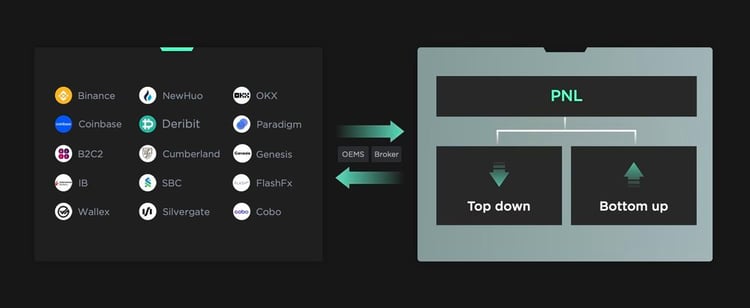
상위다운
총 손익은 자산(자본 및 현금) 잔액의 차이를 비교하여 나타냅니다.
잔액(t1) - 잔액(t0) - 순 자산 이체(t0와 t1 사이) = 거래 P&L(t0와 t1 사이)
다음 예제로 설명해봅시다:

가정: t1에서 BTC 시장 가격이 $30,000, ETH가 $2,000, USDT가 $1일 때
P&L (t0-t1) = 0.6 * 30,000 + 1 * 2,000 - 13,000 = 7,000 미국 달러
P&L은 총 자산(자본) 잔액의 변동을 계산하여 측정되며, 처음 취득 비용이 $30,000이든 $40,000이든 상관없습니다.
이 계산에는 거래 세부 정보가 없기 때문에 간단하며, 잘못된 점이 없기 때문에 정확합니다.
바텀업
위 예제를 계속해봅시다.
기본
예시: t0에서 시작하여 잔액이 50,000 USDT이며, 이 경우 USDT는 USD와 같다고 가정합니다(실제로는 다릅니다)
t0에서 t1까지 아래 거래가 실행됩니다 (ta…
왕교환 수수료를 간소화하기 위해)- 18,000달러에 0.5 BTC 구매
- 25,000달러에 0.4 BTC 판매
- 3,000달러에 1 ETH 구매
- 22,000달러에 0.5 BTC 구매
t1에서 BTC의 시장 가격이 30,000달러, ETH는 2,000달러, USDT는 1달러라고 가정합시다
하향식 계산으로, 7천 달러의 총이익은 아래와 같이 나눌 수 있습니다:
FIFO
- BTC에 대한 실현 손익 = 2.8천 달러 (첫 번째 BTC 거래를 실현으로 간주)
- BTC에 대한 미실현 손익 = 5.2천 달러
- ETH에 대한 미실현 손익 = -1천
LIFO
- BTC에 대한 실현 손익 = 1.2천 달러 (두 번째 BTC 거래를 실현으로 간주)
- BTC에 대한 미실현 손익 = 6.8천 달러
- ETH에 대한 미실현 손익 = -1천
위는 간단한 버전으로, 암호화폐 거래 수익에는 더 복잡한 부분이 있을 수 있습니다.
먼저 전통적인 주식 시장과 암호화폐 시장 사이의 주요 차이점을 설명해보겠습니다.
전통적인 주식 시장에서 주식은 화폐(예: NASDAQ: TSLA / USD)에 대해만 거래될 수 있고, 다른 주식(예: NASDAQ: TSLA / NASDAQ: AAPL)에 대해 거래될 수 없으며, 주식은 다른 계정/브로커로 이체될 수 없습니다.
그러나 암호화폐 시장에서는 안정화폐와 코인 둘 다 존재합니다. USDT 및 USDC와 같은 안정화폐는 안정된 가치가 있으며(그리고 가치를 고정시키는 메커니즘이 있음), BTC 및 ETH와 같은 코인은 화폐에 대한 가격을 가집니다. 그러나 코인과 주식의 차이점은 코인 거래가 반드시 화폐나 안정화폐를 거치지 않아도 된다는 것입니다. 암호화폐 현물 시장에서 거래는 코인 대 코인으로 진행될 수 있습니다(예: ETH/BTC). 암호화폐 파생 시장에서 마진 화폐는 코인이 될 수도 있습니다(예: BTC/USD 영구 스왑을 BTC로 결제). 또한, 코인은 한 계정이나 장소에서 다른 곳으로 직접 이체될 수 있습니다. 이러한 차이로 인해 암호 화폐 거래에서 손익 계산이 복잡해집니다.
코인-코인 크로스 페어
예를 들어, 이전 예에서
- 18,000달러에 0.5 BTC 구매
- 25,000달러에 0.4 BTC 판매
- 3,000달러에 1 ETH 구매
- 22,000달러에 0.5 BTC 구매
거래 #2와 #3을 약간 바꿔보면
- 18,000달러에 0.5 BTC 구매
- 0.4 BTC로 0.333 ETH 구매
- 3,000달러에 0.667 ETH 구매
- 22,000달러에 0.5 BTC 구매
BTC와 ETH에서 실현/미실현 가치를 어떻게 계산할까요? 표준 방법은 거래를 3가지 가상 거래로 나누는 것입니다(BTC에서 USD로, USD에서 ETH로, 거래 수수료의 가상 거래도 포함)
거래 수수료와 할인
전통적인 금융과 달리, 거래 수수료는 화폐(예: USD)로 청구됩니다. 암호화폐 거래에서 거래 수수료는 일반적으로 '출력' 코인에서 청구되며, 즉 CoinA(BTC)를 판매하여 CoinB(ETH)를 구매하는 거래의 경우 수수료는 주로 CoinB(ETH)로 청구됩니다.
일부 거래소는 거래자가 거래 수수료에 거래소 고유 토큰을 사용하도록 장려합니다
i.e. a trade to sell CoinA (BTC) to buy CoinB (ETH), fee is usually in CoinB (ETH), but can also be in CoinC (BNB)
Extra complexity would be rebates. Some exchange rebate fees in batch hourly/daily or even weekly / monthly, which is not settled in real-time with the trade.
Coin-Margined Futures
In crypto, there are USD(S)-margined futures, which are easier to calculate P&L because the mechanism is close to margin trading.
However, there are Coin-margined futures, e.g., BTCUSD futures settled in BTC.
Extra complexity would be a multi-collateral margin model, e.g., trading BTCUSD futures settled in BTC, but with collateral in ETH. If there’s a loss in BTC, there will be an interest.
Advantages and Applications
Top-down and bottom-up should result in the same total P&L (there should be a reconciliation process to make sure the results match), while there are different advantages, and hence applications.
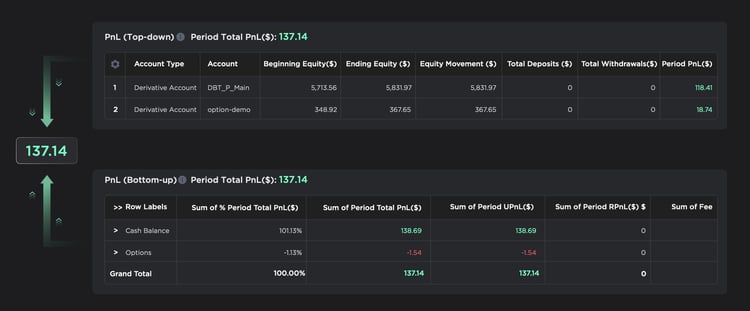
Top-down
Top-down P&L has its advantage in low latency, accuracy, and efficiency.
Low latency – Exchanges support frequent queries and return the whole info
Accuracy - there’s very little chance of mistaking, and the data is very easy to be verified.
Efficiency - the calculation is simple and quick.
While top-down P&L is accurate and efficient, it has limitations in granularity.
- Realized and unrealized P&L on the spot. (derivatives unrealized P&L info is usually provided by exchanges)
- P&L attributions from instruments if there are multiple instruments trading mixed in one account (e.g., trading BTC/USDT and ETH/USDT spot in the same account).
- Accounting strategies like FIFO/LIFO
So the main application is in front office (trading team), where low latency is the most important consideration, and also in middle office (operations team) to reconcile NAV with fund admin results because of its accuracy.
Bottom-up
Bottom-up P&L has its advantage in granularity, because P&L by position, realized/ unrealized P&L… must come from bottom-up trading analysis.
Bottom-up P&L calculation provides the full audit trial history, so auditors can verify if transactions are complete, and build their own calculations with all the transactions they collected.
While bottom-up P&L has limitations on accuracy and efficiency, especially for high-frequency trading, because missing any trade record will cause incorrect P&L results.
So the main application is in the middle/back office (operations team, fund admin), where accuracy and audit trial are the most important considerations.
상하로 결과 조정하기
In traditional finance, hedge funds need to reconcile between brokers and OEMS results every day.
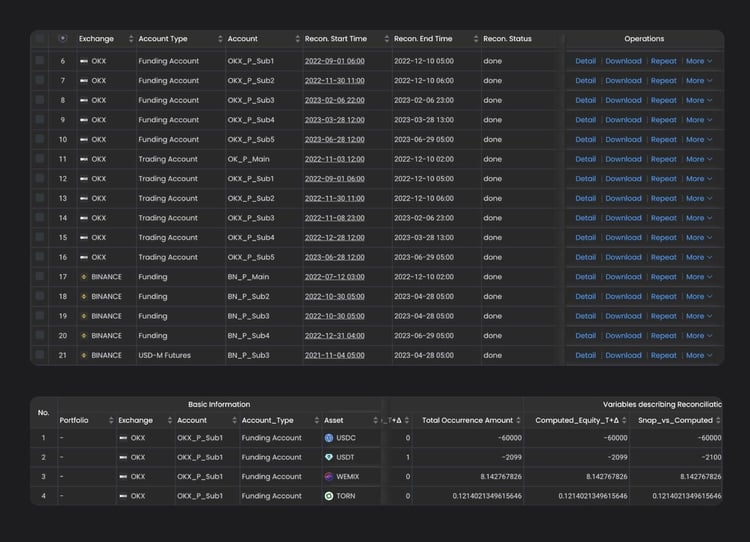
Similarly, crypto hedge funds, depending on their trading frequency, need to reconcile regularly between exchange transactions (execution log) and settlement results (balance and position info).
This is a huge task due to various challenges of exchange infra, e.g., fast developing business, incomplete API endpoints, and different logic and data from each exchange...
Besides reconciliation on centralized exchanges, more and more funds are using DeFi and the data on DeFi can be more non-standardized compared to centralized exchanges.
1Token의 서비스
Rooted in crypto quant trading, 1Token has the unique trading know-how and technology capabilities to build:
- Up-to-date and high-confidence connection to all crypto trading venues, across DeFi and CeFi
- Top-down, Bottom-up P&L calculations, and reconciliation of top-down and bottom-up results
- Real-time trading metrics calculation, monitoring and alerts
- T+0 shadow NAV accounting system with subscription, redemption, dividend, cost accruals...
1Token has been serving global digital asset managers, fund platforms, fund admins, and auditors, to enable them to conduct crypto-related business without any concern for technology.
1Token is undertaking SOC2 audits and provides on-premise deployment to regulated clients.
Tools
면책조항



Use TokenInsight App All Crypto Insights Are In Your Hands
Open