Chainlink is one of the most important projects in the Crypto industry, providing a foundational service, the Oracle, for the Web3 economy. Its oracle services help secure billions of dollars across hundreds of projects in tens of different blockchains. In addition to the price feed services, it has other products including Proof of Reserve, VRF, Keepers, and CCIP, which are not well-known. What are those services? Is $LINK token a treasure in this bear market?
This is the most important service provided by Chainlink, to provide off-chain price data feeds to on-chain smart contracts. Price data includes data from centralized exchanges or price feed from one blockchain to another.
Chainlink uses a multiple layers data aggregating process to ensure the reliability and decentralization of price feed data.
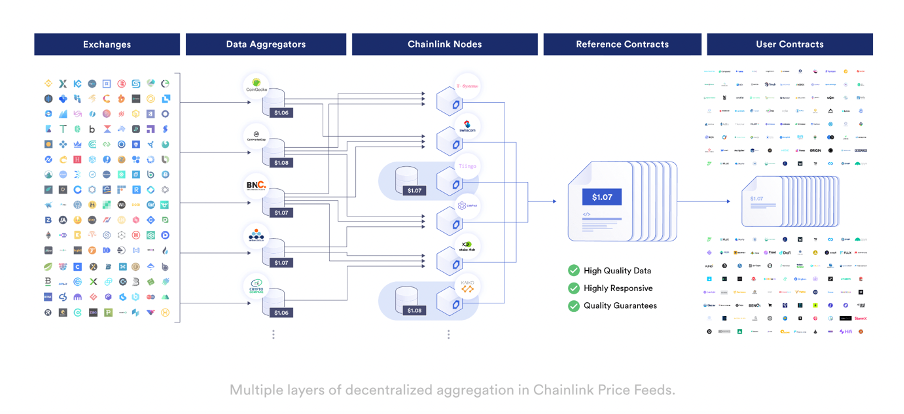
Node operators are the core of Chainlink data aggregation process. There are generally 4 types of node operators.
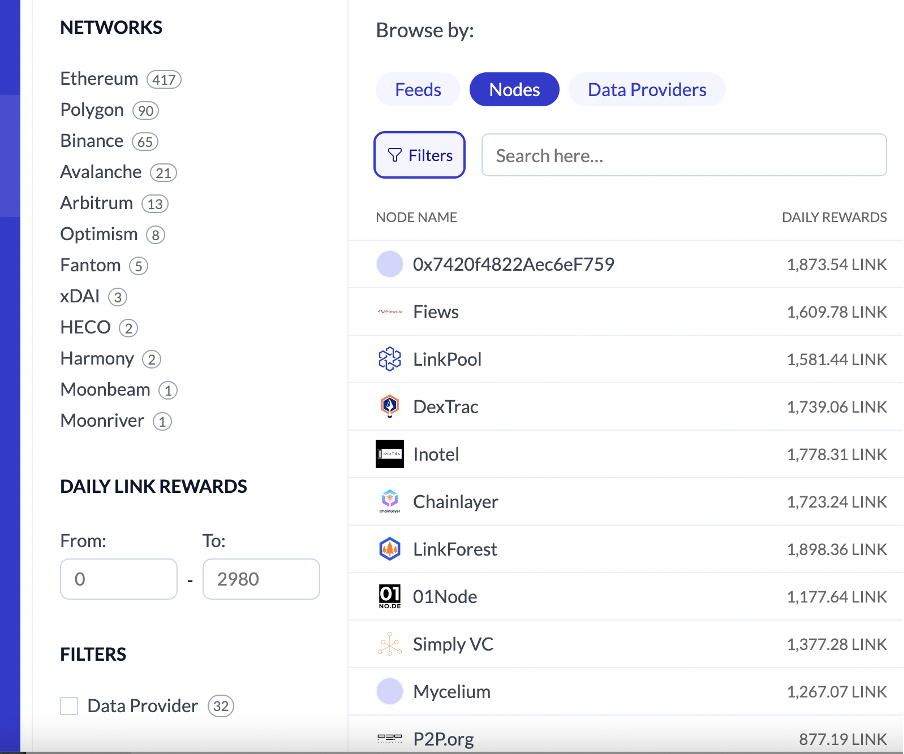
Nodes operating for Chainlink could be a profitable business. Below you can find the daily revenue in $LINK a node can earn.
Proof of Reserve traditionally refers to a business that holds cryptocurrency creating public attestations regarding their reserves to prove their solvency. The most obvious example is centralized stablecoin issuers such as $USDT, $BUSD, and $USDC, all of which issue periodic attestation reports regarding their USD dollar fiat reserves. (Related reading: How Stable are USDT, USDC, and BUSD?)
PoR provides smart contracts with the data needed to calculate the collateralization of any on-chain asset-backed by off-chain or cross-chain reserves. For example, Chainlink PoR fetches $TUSD reserve data from Armanion, an independent accounting firm that reviews the $TUSD's escrowed bank account to ensure a backed reserve. Armanio separately initiates a call for data from $TUSD's escrowed bank accounts.
Through this method, the transparency of fiat-backed stablecoin can be greatly improved compared to the current periodic attestation, which is normally conducted monthly, or for $USDT only conducted quarterly.
Chainlink VRF is a random number generator for blockchain. This is a function that looks trivial but is actually very important. There are many use cases, such as NFT projects that need to assign randomized attributes to NFTs, and blockchain gaming applications to generate random maps.
Keepers are Chainlink nodes responsible for running off-chain computation to verify conditions that were satisfied before triggering the on-chain function. For example, Chainlink keepers monitor AAVE borrowers' health off-chain by consistently computing the collateralization and checking if the collateralization ratio has dropped below the predefined liquidation threshold. If found to be under collateralized, Chainlink Keeper will call the AAVE liquidation function.
CCIP refers to Cross-Chain Interoperability Protocol. This is a cross-chain bridge for messages. What is corss-chain for messages? Originally, a cross-chain bridge can only bridge assets from one chain to another, such as bridging $ETH on Ethereum to Solona. Recently, with the popularity of Stargate developed by Layerzero, it is possible for messages to flow cross-chain, which means a smart contract on one chain can directly call a smart contract on another chain. (Related Reading: Stargate - the Prosperous Future of Blockchain Interoperability)
The cross-chain messaging protocol market is becoming very competitive, in addition to Layerzero, other established cross-chain bridge also roll out their cross-chain messaging protocol, such as Wormhole. CCIP's advantage lies in that it is not only a cross-chain protocol but can also act as a bridge for off-chain information onto the different blockchains.
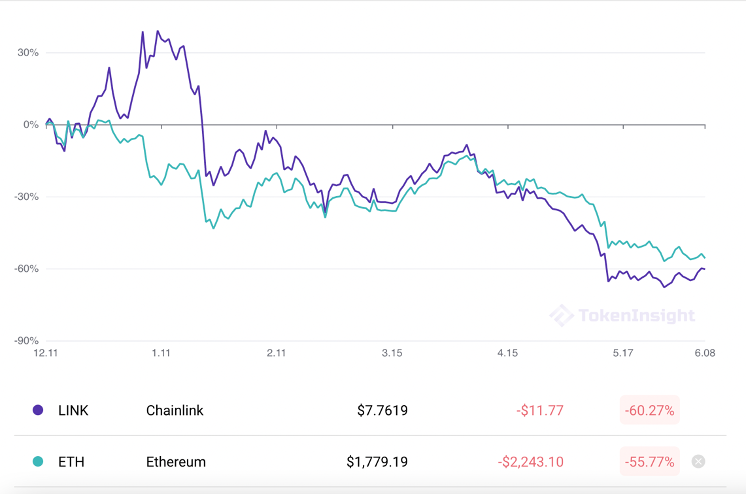
Chainlink provides one of the most fundamental services for the entire Crypto/web3 industry. Does this importance translate into a strong token price? Clearly no. $LINK roughly follows the market, and experienced a significant drawdown in the past few months.
The total supply of Chainlink native token, $LINK is 1 billion, and the distribution is as follows:
$LINK is a payment token, it is used to pay Chainlink node operators for providing oracles services. The services fee is variable and set by the different node operators and paid by the data feed requester (e.g. DeFi protocols).
Chainlink is building the $LINK staking function. It recently updated the roadmap for rolling out the staking function. Two staking functions are expected to go live within this year, which are the staking for reputation and staking for alert.
Nodes operators could put up $LINK as collateral (a guarantee) to signal the commitment for accurate, honest, and timely performance when providing data feed to smart contracts. (slashing mechanism will be developed for those node that fail to meet the service standard)
$LINK holders can stake the token and gain the ability to raise alerts if they believe an oracle has not met performance standards, and earn rewards for timely and valid alerts.
Without the staking function, $LINK is a payment token, there is no incentive for holding the token for the long term. The introduction of staking will likely remove a proportional of $LINK out of circulation into the staking contract, creating supportive factors for the token price in the future.
There are many discussions regarding what could drive the next bull market, and one idea has been repeatedly mentioned - the externality of blockchain. The externality refers to the benefits that crypto could bring to unrelated industries and the external world. If this thesis comes true, Chainlink would be the core element between blockchain and information from the external world. While I don't know what is the fair price for $LINK, but I do believe it is one of the treasure in this bear market.
 APP
APP