This article introduces how MicroStrategy utilizes its NAV Premium to increase Bitcoin per share, and continues to increase its shareholders' value.
MicroStrategy, founded in 1989 by Michael J. Saylor, started as a business intelligence (BI) and analytics software company. Initially, the company focused on providing enterprise solutions to help businesses leverage their data through advanced analytics, reporting, and decision-support tools. Its core product offerings helped organizations gain insights into their operations and performance, allowing for more data-driven decisions.
Michael Saylor has been a significant figure in the technology and business intelligence field. He led MicroStrategy through multiple phases of growth and innovation in the BI industry, making it one of the leading firms in the space for decades. However, the most pivotal moment in MicroStrategy’s history came in 2020 when it shifted its focus toward Bitcoin.
MicroStrategy began purchasing Bitcoin in August 2020, when it announced its first acquisition of 21,454 BTC for $250 million as a strategic investment. Saylor and the company's leadership viewed Bitcoin as a superior store of value compared to cash, especially in light of concerns about inflation and the devaluation of fiat currencies. As a result, MicroStrategy pivoted from being solely a software company to becoming a corporate leader in Bitcoin adoption as a treasury asset. MicroStrategy's Bitcoin strategy is to borrow funds through diverse capital market instruments, and use those funds to invest in Bitcoin. Due to this strategy, MicroStrategy's stock has been one of the best-performing stocks in the market.
As of October 2024, MicroStrategy holds approximately 244,800 bitcoins. The average cost basis for these holdings is around $38,585 per bitcoin, resulting in a total investment of about $9.45 billion. The market value of its BTC holding is now over $16 billion, which means it has acheved a return of over 1.6x.
While MicroStrategy holds over $16 billion worth of Bitcoin (BTC) on its balance sheet, the company's stock valuation is significantly higher. As of October 2024, MicroStrategy’s stock, listed on the U.S. stock exchange, has a market capitalization of over $44 billion, which is approximately 2.75 times the value of its Bitcoin holdings.

MicroStrategy's Net Asset Value (NAV) premium refers to the ratio of the company's market capitalization to the value of its Bitcoin holdings. This premium indicates how much investors are willing to pay for MicroStrategy's stock relative to the intrinsic value of its Bitcoin assets.
As of late October 2024, MicroStrategy's NAV premium has reached approximately 2.7 times its Bitcoin holdings, marking the highest level since February 2021. This means that investors are valuing MicroStrategy's stock significantly higher than just its Bitcoin assets alone.
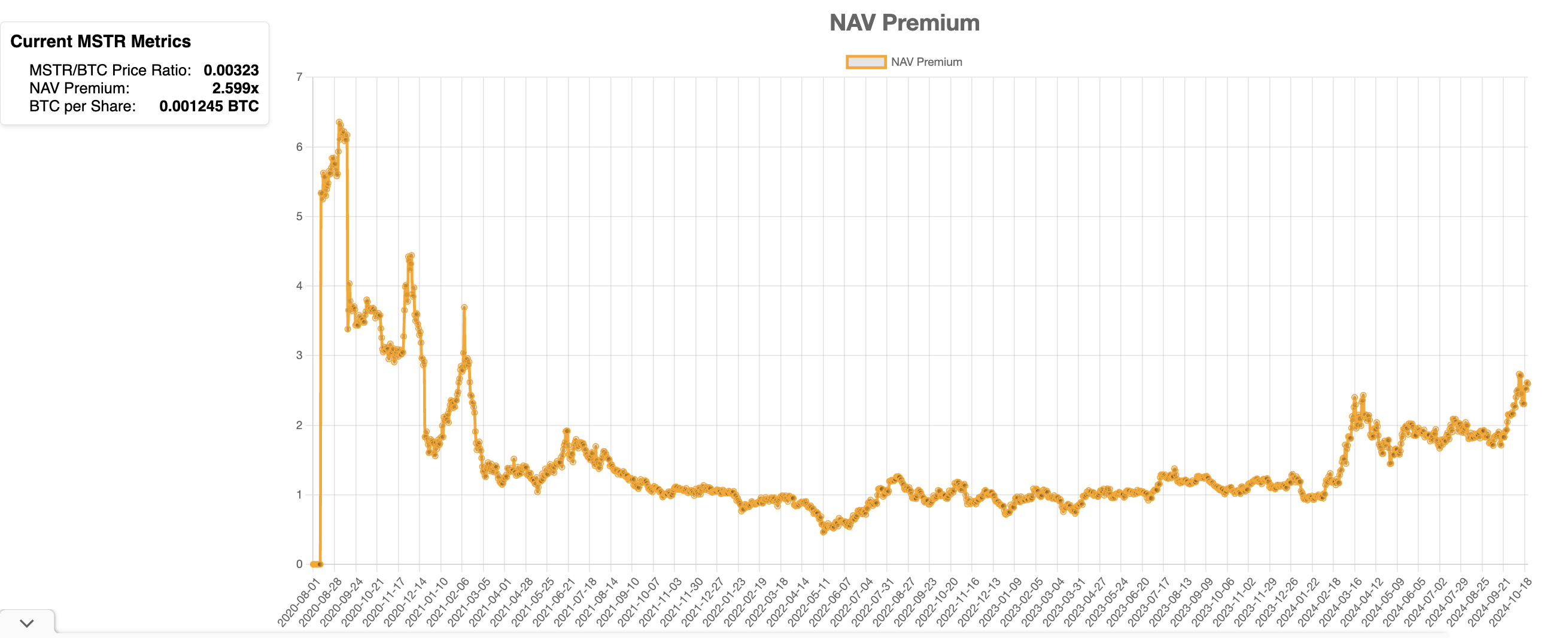
There are two possible reasons to explain the net asset value premium. Firstly, MicroStrategy remains a business software company that generates positive operating cash flow in addition to its Bitcoin investment. However, the cash flow generated—around $12 million in 2023—is relatively small compared to its significant BTC investment. As such, the value from its software business alone cannot justify the large net asset value premium. The second plausible reason is investor optimism about Bitcoin price appreciation. Investors may be pricing in a potential over 100% increase in Bitcoin’s value, which would result in the 2.75x stock price premium relative to the value of its Bitcoin holdings.
Securitization is a financial engineering process where an asset or a pool of assets is transformed into tradable securities. In traditional finance, this is often done with mortgages and loans. The asset's future cash flow are "securitized" into bonds, shares, or other financial products, which are then sold to investors. Investors in these products receive returns based on the performance of the underlying assets.
In the context of Bitcoin, securitization means using Bitcoin holdings as the underlying asset. The company issues securities (such as bonds, stocks, or convertible debt) that are backed by their Bitcoin holding. Investors in these securities are indirectly exposed to Bitcoin's performance.
MicroStrategy holds billions of dollars worth of Bitcoin on its balance sheet. These Bitcoin holdings are considered "permanent captial" by the company, which means MicroStrategy is not intended to sell any of its Bitcoin holdings.
MicroStrategy uses its Bitcoin holdings as collateral to issue convertible bonds to investors. A convertible bond is a type of debt that can be converted into equity (stock shares of the company) under certain conditions. The company then uses the proceeds from these bonds to buy more Bitcoin, further increasing its holding.
Besides debt instruments, MicroStrategy also issues stock equity. The company takes advantage of the market NAV premium (the difference between the market value of its stock and the value of its Bitcoin holdings) to raise capital.
MicroStrategy's stock trades at a 2.7x premium relative to the value of its Bitcoin holding. This means when MicroStrategy issues new shares, investors are willing to buy these shares at a 2.7x value compared to the worth of Bitcoin holdings. For example, if one share is backed by 1 BTC, and the market is pricing the one share at the worth of 2.7 BTC. When the company issue one more share, it can raise the amount of cash that worth 2.7 BTC, and then use the cash to actually purchase 2.7 more BTC. As a result, there will be a total of 3.7 BTC backing a total of 2 shares. The BTC/share increased from 1 BTC/share to 1.85 BTC per share.
A detailed step-by-step process is illustrated below:
1. Current Situation:
2. Issuing New Shares:
3. Purchasing More Bitcoin:
4. Post-Issuance Share Count:
5. Calculating BTC per Share:
By issuing new shares at a price that reflects the premium (2.7x the actual Bitcoin value per share), MicroStrategy can effectively acquire more Bitcoin per share than before. This strategy leverages investor optimism and the premium valuation to enhance the company's Bitcoin holdings on a per-share basis. It results in an increased Bitcoin asset backing for each share, benefiting existing shareholders by boosting the intrinsic value of their shares in terms of Bitcoin holdings.
The most astonishing part of this strategy is , while issuing more shares typically dilutes shareholders' equity, in this case, the Bitcoin (BTC) per share actually increases due to the premium at which the new shares are issued.
The key is that the new shares are sold at a price above the net asset value (NAV) per share. The funds raised exceed the dilution effect because they're used to purchasing more Bitcoin than the dilution proportionally reduces.
MicroStrategy's plan is to maximize Bitcoin per share using a combination of financial strategies that leverage its Bitcoin holdings to issue more capital, which is then reinvested into acquiring additional Bitcoin. The company also introduced the concept of "BTC Yield" to describe the return it generates for shareholders through its Bitcoin strategy. While called "BTC Yield," it is not a traditional yield like interest or dividends. Instead, it refers to the result of financial maneuvers that leverage the company's Bitcoin holdings to raise capital, purchase more Bitcoin, and increase the value of its stock relative to its Bitcoin reserves, which boosts the stock value over time.
The BTC yield is tied to the growth in MicroStrategy's Bitcoin holdings. As the company continues to issue equity or debt at favorable terms and use capital to buy more Bitcoin, the yield increases. Shareholders see their value grow as the company accumulates more Bitcoins and the stock price reflects this increased exposure.
BTC Yield measures the growth in Bitcoin holdings per share, reflecting the percentage change in the ratio of the company's Bitcoin holdings to its assumed diluted share outstanding, effectively indicating how much Bitcoin each share represents over time.
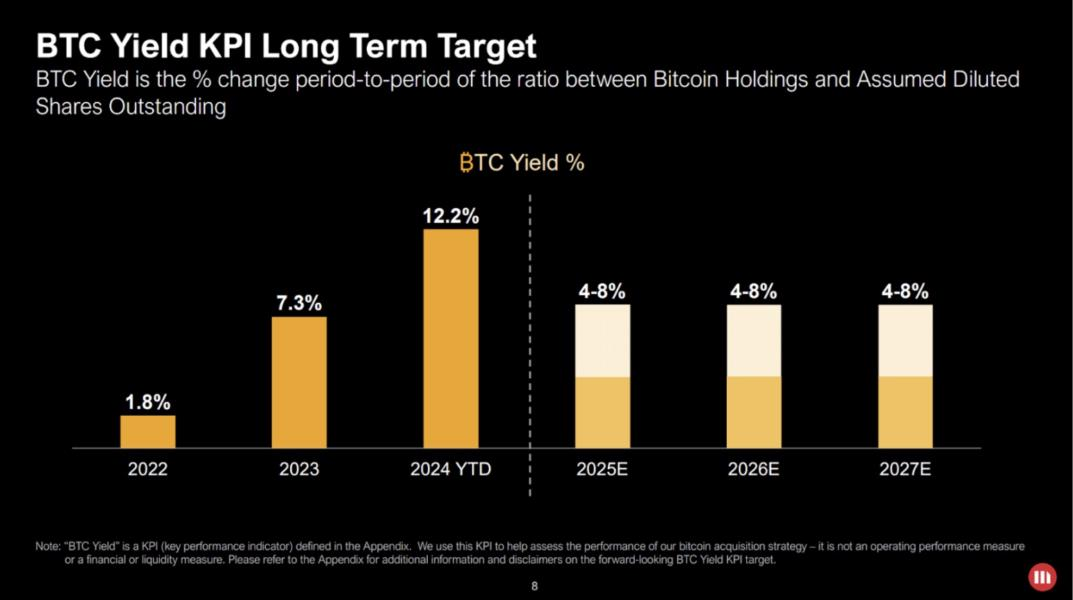
As of recent reports, MicroStrategy has achieved a BTC Yield of 12% in 2024 (17% YTD according to the most recent interview by Michael Saylor). This figure shows that the company has increased its Bitcoin holdings per share, enhancing shareholders' value. The company is guiding for the future BTC yield between 4% and 8% over the next three years. This suggests that shareholders could see their effective Bitcoin ownership grow continuously.
MicroStrategy’s plan to maximize Bitcoin per share is centered on financial engineering, leveraging its Bitcoin holdings through bond and equity issuances at a premium, and continually reinvesting the proceeds into more Bitcoin.
The success of this strategy hinges on Bitcoin continuing to appreciate over the long term. If Bitcoin experiences consistent growth, MicroStrategy can continue issuing capital at a premium and reinvesting in Bitcoin, enhancing its Bitcoin per share.
If Bitcoin’s price stagnates or declines significantly, the value of MicroStrategy’s holdings will drop, and the market may lose confidence in the company’s ability to generate returns from Bitcoin investments. This could cause the stock price to fall, reducing the equity premium and making it more difficult to issue new capital at favorable terms.
 APP
APP