MicroStrategy’s bold financing approach via $9.25 billion in outstanding convertible debt, which, while risk-free in the near term, hinges on Bitcoin’s performance post-2028 halving to avoid long-term repayment pressures
MicroStrategy, founded in 1989 by Michael J. Saylor, started as a business intelligence (BI) and analytics software company. Initially, the company focused on providing enterprise solutions to help businesses leverage their data through advanced analytics, reporting, and decision-support tools. Its core product offerings helped organizations gain insights into their operations and performance, allowing for more data-driven decisions.
Michael Saylor has been a significant figure in the technology and business intelligence field. He led MicroStrategy through multiple phases of growth and innovation in the BI industry, making it one of the leading firms in the space for decades. However, the most pivotal moment in MicroStrategy’s history came in 2020 when it shifted its focus toward Bitcoin.
MicroStrategy began purchasing Bitcoin in August 2020, when it announced its first acquisition of 21,454 BTC for $250 million as a strategic investment. Saylor and the company's leadership viewed Bitcoin as a superior store of value compared to cash, especially in light of concerns about inflation and the devaluation of fiat currencies. As a result, MicroStrategy pivoted from being solely a software company to becoming a corporate leader in Bitcoin adoption as a treasury asset.
As of March 2025, MicroStrategy acquired a total of 528,185 Bitcoin, which is more than 2.5% of the 21 million bitcoin total supply. Only Bitcoin spot ETFs surpass this, which collectively hold around 5.33% of the total supply.
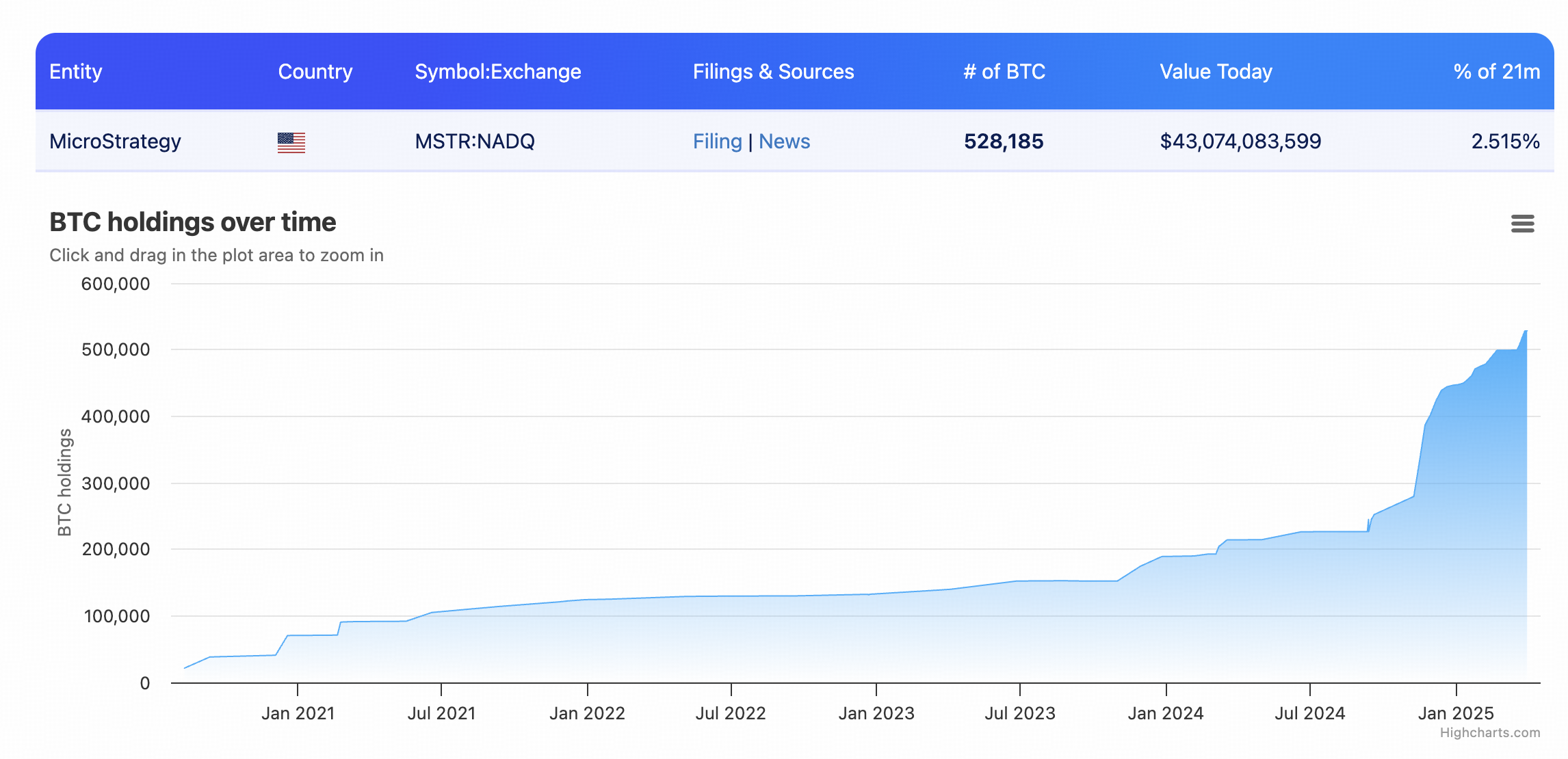
Source: https://treasuries.bitbo.io/microstrategy/
MicroStrategy's ownership is composed of a mix of institutional and individual shareholders. While Michael J. Saylor holds only approximately 9.9% of the total outstanding A shares, he controls a large percentage of the voting rights due to his ownership of Class B shares. This gives him significant influence over the company's strategic direction, particularly its development as a Bitcoin-focused entity.
Michael J. Saylor (Founder and Executive Chairman):
Institutional Investors: Institutional investors represent a significant portion of MicroStrategy's shareholding, including large asset management firms. Some notable ones include Vanguard, BlockRock, and Fidelity.

Source: https://www.tipranks.com/stocks/mstr/ownership
Voting Structure:
MicroStrategy operates under a dual-class share structure designed to concentrate voting power. The company’s Class A shares are publicly traded and carry one vote per share, allowing broad investor participation. In contrast, Class B shares, which are primarily held by Michael Saylor, grant 10 votes per share. This arrangement gives Saylor significant influence over the company’s strategic direction, enabling him to maintain outsized control despite holding a relatively smaller percentage of the total outstanding shares.
MicroStrategy's aggressive bitcoin acquisition strategy is supported by two main financing methods, through issuance of convertible notes and selling Class A shares.
Convertible notes have been a cornerstone of MicroStrategy’s Bitcoin financing strategy. This type of financing instrument is hybrid debt instruments that allow a company to raise capital without immediate equity dilution while giving investors the right to convert debt into equity under favorable conditions.
In simple terms, a convertible note is a debt that allows lenders to convert into shares of the issuing company's common stock.
MicroStrategy issues convertible senior notes at competitive interest rates, with maturity dates typically spanning several years. These notes are attractive to investors because of the potential upside from equity conversion.
Outstanding Covertible Notes

Key terms associated with convertible notes include principal amount, which is the amount a company borrowed; Interest rate, the rate of interest paid on the principle amount, Maturity date, which is the date on which the principle amount is due to be repaid, and Conversion price, the price per share at which the note can be converted into shares of the company's common stock. If the note is converted into company shares, the company will no longer have any debt obligation to pay.
Investors are drawn to convertible notes due to their unique blend of debt and equity features, offering several potential advantages:
In the case of MicroStrategy, the company's value is closesly tied to the Bitcoin price. If Bitcoin price continue to rise, the value of the company's stock will also rise, leading to a significant gain for convertible notes investors who can convert their notes into shares at a discounted price. As notes are debt instruments, they also provide some downside protection. If Bitcoin prices drop, investors can still receive their principal investment back upon maturity. (subject to the company's financial health)
MicroStrategy also leverages its Class A shares through an at-the-market (ATM) offering program to raise capital. This approach allows the company to sell shares directly into the market at prevailing prices, providing liquidity for Bitcoin acquisitions.
MicroStrategy has been enjoying a Net Asset Value Premium on its stock price. This Net Asset Value (NAV) premium refers to the ratio of the company's market capitalization to the value of its Bitcoin holdings. This premium indicates how much investors are willing to pay for MicroStrategy's stock relative to the intrinsic value of its Bitcoin assets.
As of March 2024, MicroStrategy's NAV premium has reached approximately 1.83 times its Bitcoin holdings. This means that investors are valuing MicroStrategy's stock higher than just its Bitcoin assets alone. This means when MicroStrategy issues new shares, investors are willing to buy these shares at a 1.83x value compared to the worth of Bitcoin holdings.

Source: https://strategytracker.com/mstr?chart=performance-comparison&timeRange=year
By issuing new shares at a price that reflects the premium, MicroStrategy can effectively acquire more Bitcoin per share than before. This strategy leverages investor optimism and the premium valuation to enhance the company's Bitcoin holdings on a per-share basis.
To Learn More about the NAV Premium, Please refer to MicroStrategy's NAV Premium and BTC Yield
MicroStrategy faces two kind of payment obligations arising from its convertible notes, it must pay the interest on the notes and repay the principles if bondholders choose not to convert the note into stocks. Of the seven outstanding notes, four require interest payments. However, the interest rates are relatively low, with the highest one only at 2.25%. Consequently, the interest payments alone are unlikely to create any financial strain for MicroStrategy.
The real financial stress could come from the obligation to repay the principal if investors choose not to convert these notes into stocks. Investors typically exercise their conversion right only when the prevailing MSTR stock price is higher than the conversion price, so that they can acquire the stocks at a discount. Currently, MSTR is trading at $272, which is above the conversion prices for five of the seven notes. However, investors can not exercise the conversion right immediately because specific bond covenants must be met.
During the initial period of the bond's life, the conversion right can only be exercised if the bond trades at a 2% discount or more to the implied conversion value based on MSTR's share price. Toward the end of the bond's term, this 2% rule no longer applies, and bondholders can convert to stock without restriction.
This means that the critical factor is what MSTR's share price will be toward the end of each of the note maturity. Since MSTR's share price is now highly correlated with Bitcoin's price, the key determinant will ultimately be Bitcoin's price before the maturity of each convertible note.
MicroStrategy has strategically aligned the maturity date of its convertible notes with the beginning of the next Bitcoin cycle. The next Bitcoin halving is expected to happen in early 2028, and historically, Bitcoin prices tend to recover from bear markets during the halving year and perform exceptionally well the following year. Notably, the three largest convertible notes mature in 2028, 2029 and 2030, coinciding with the halving year and the years after.
If Bitcoin price follows the trend of the previous cycles in the 2028 cycle, it is expected to be significantly higher than its current level. Bitcoin price would likely drive up MSTR share price, making it highly probably that convertible notes holders will exercise their rights to convert the debt into stock. This reflects the company is highly reliant on Bitcoin's price appreciation to maintain financial stability.
While this approach is immune from short-term price volatility, it hinges on the assumption that Bitcoin will appreciate substantially in the long run. If Bitcoin were to face a prolonged bear market or the 2028 cycle deviates from historical trends, the company would be facing huge debt obligations and potentially lower Bitcoin price, it may need to explore alternative strategies to meet its payment obligations.
 APP
APP