

 5m
5m
Helium is a decentralized wireless network that aims to create an affordable and accessible infrastructure for the Internet of Things (IoT). Founded in 2013 by Amir Haleem, Shawn Fanning, and Sean Carey, Helium launched its first product, the Helium Hotspot, in 2019. This innovative device allows users to provide wireless coverage for IoT devices and earn cryptocurrency (HNT tokens) in return. The network has rapidly expanded, boasting over 1 million Hotspots deployed globally by 2024, making it one of the largest decentralized wireless networks in existence.
The mission of Helium is to empower individuals and businesses to build and operate their own wireless networks, promoting a more decentralized and community-driven approach to connectivity. By leveraging blockchain technology, Helium enables users to earn rewards for contributing to the network, effectively democratizing access to wireless infrastructure. This model not only reduces reliance on traditional telecom providers but also enhances connectivity in underserved areas.
The Helium Hotspot is a pivotal component of the Helium Network, designed to facilitate decentralized wireless connectivity for Internet of Things (IoT) devices. Launched in 2019, these devices allow users to contribute to the network by providing wireless coverage while earning Helium tokens (HNT) as rewards. The Hotspot operates on a unique consensus mechanism known as Proof-of-Coverage, which verifies that Hotspots are genuinely providing network coverage.
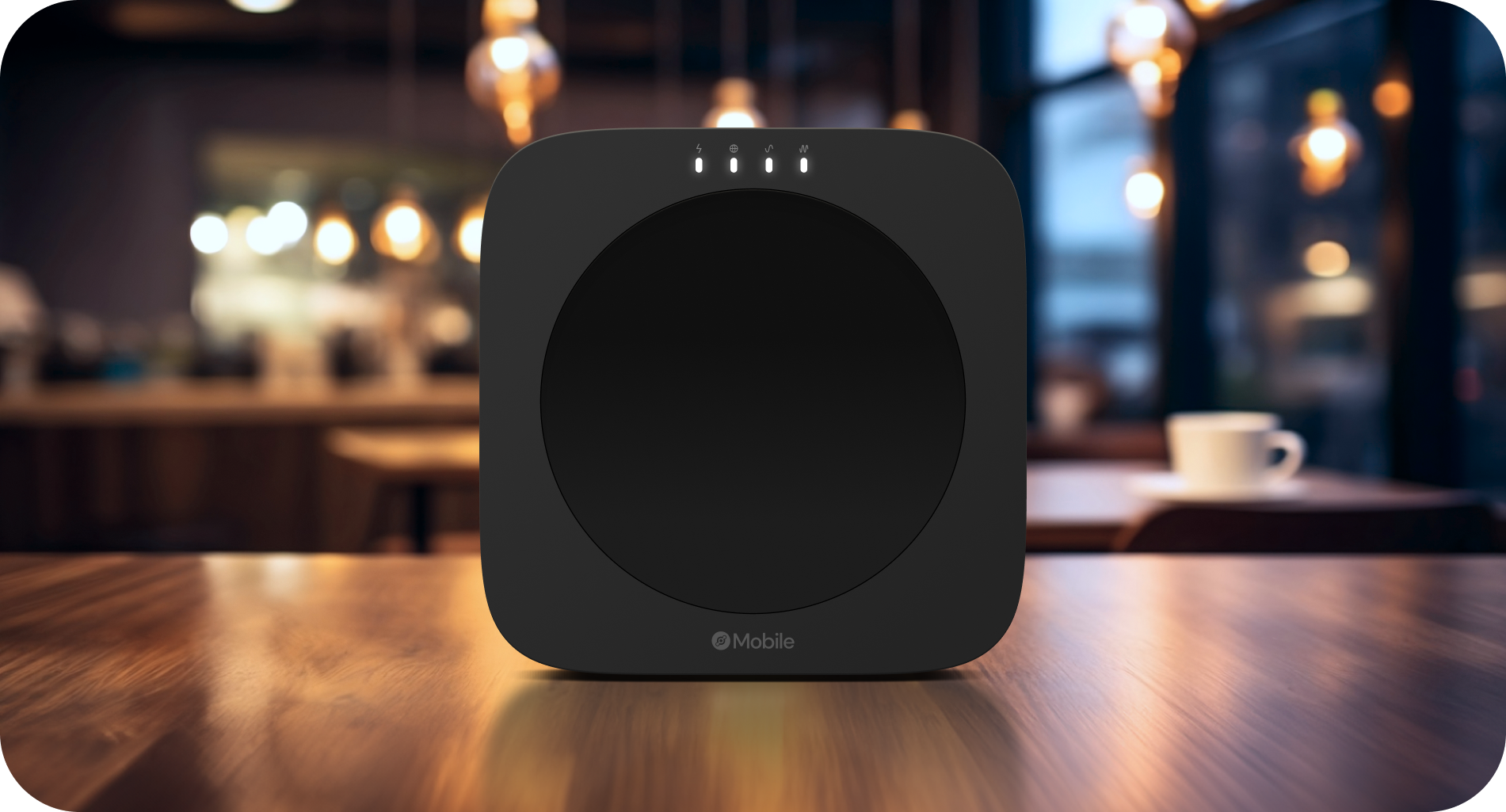
Helium Hotspots utilize LoRaWAN (Long Range Wide Area Network) technology to provide wireless connectivity for Internet of Things (IoT) devices.
LoRaWAN is a low-power, wide-area networking protocol designed specifically for IoT applications. It enables long-range communication between devices while consuming minimal power, making it ideal for battery-operated sensors and devices that require long-term deployment without frequent maintenance. Helium Hotspots act as gateways that connect these devices to the internet, facilitating data transmission over large distances—up to 200 times farther than traditional Wi-Fi.
Helium offers both indoor and outdoor Hotspot models to suit different deployment environments. Indoor Hotspots typically cover up to 150 feet indoors and 3,305 square feet outdoors, while outdoor Hotspots are designed for broader coverage suitable for installation on poles in parks, beaches, and rooftops.
By deploying Hotspots in homes, offices, and public spaces, users can collectively build a decentralized wireless network that provides affordable and accessible connectivity for IoT devices. As more Hotspots are deployed, the network expands, enhancing application coverage and reliability.
Helium has rapidly expanded its network of Hotspots globally, with coverage spanning multiple countries. Here's a look at the current Helium Hotspot coverage map:
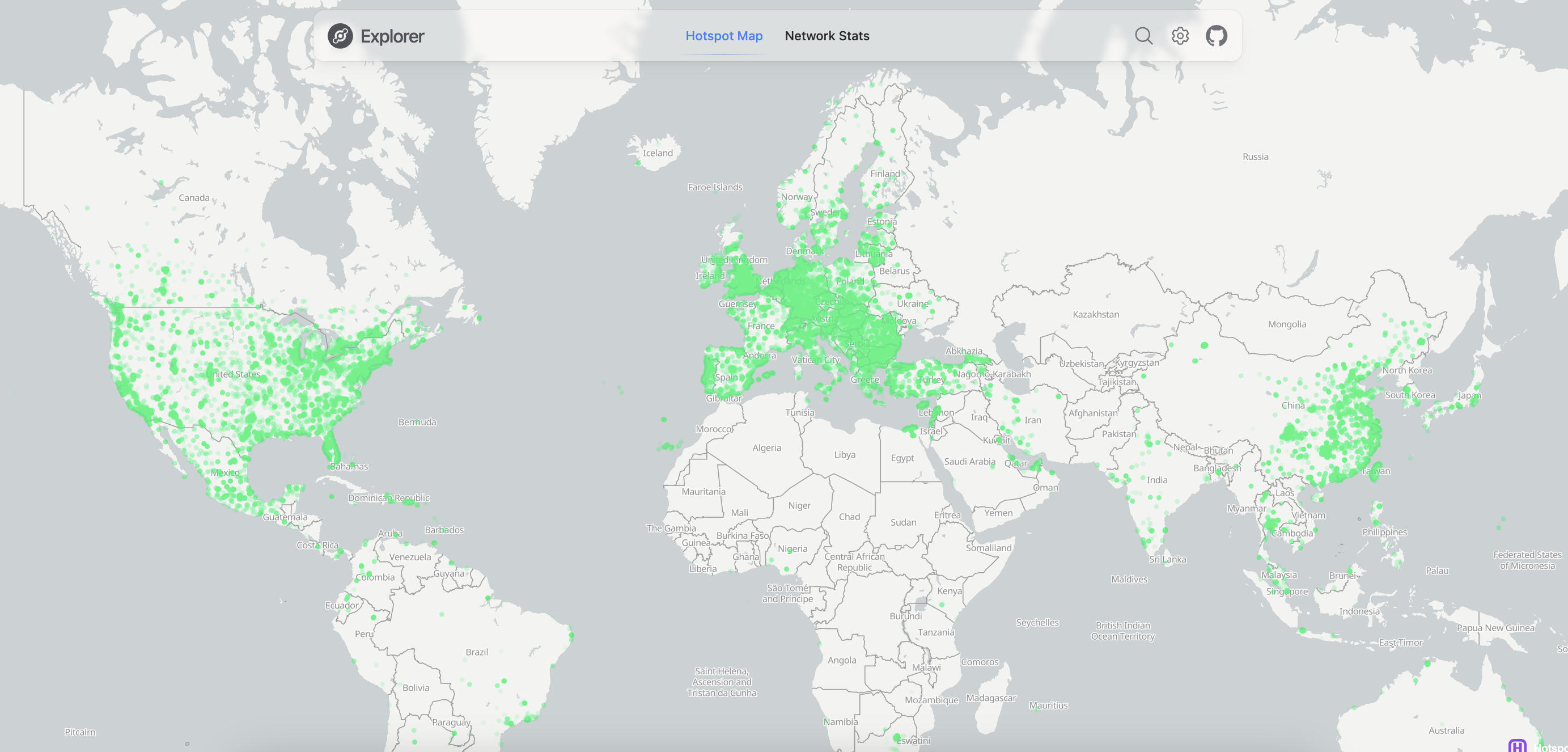
Source: https://explorer.helium.com/
Helium Hotspots can be likened to Wi-Fi routers in some respects, but they operate on different principles and technologies.
Similarities to Wi-Fi Routers
Differences from Wi-Fi Routers
Helium Mobile is a decentralized wireless carrier that leverages the Helium Network to provide affordable, transparent, and privacy-focused mobile connectivity. It is the world's first "cryptocarrier", empowering people to build and power the network through crypto incentives.
Helium Mobile operates on a unique decentralized model that combines the Helium Network with traditional mobile services to provide affordable and accessible connectivity.
Hybrid Coverage
Helium Mobile leverages a combination of the Helium Network and T-Mobile's nationwide 5G network to offer seamless coverage across U.S.. This hybrid approach allows Helium Mobile to keep costs low while ensuring reliable service for subscribers.
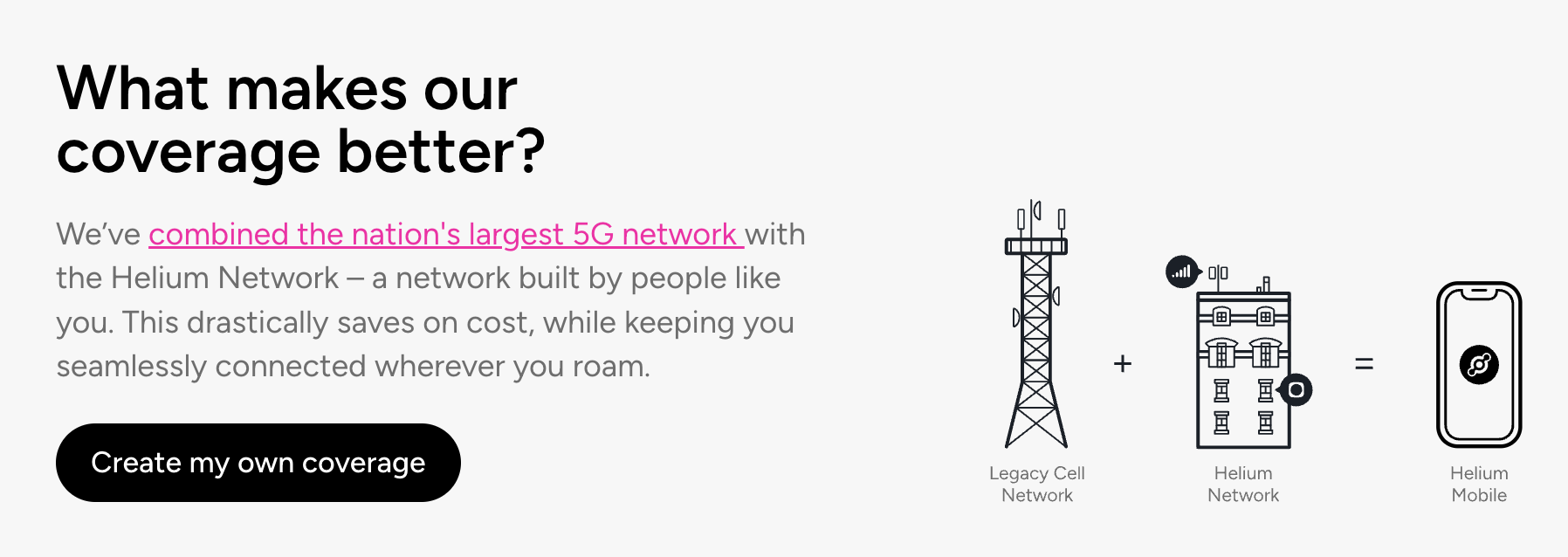
Helium Mobile incentivizes people to deploy 5G-CBRS and WiFi Hotspots through the Helium Network. These Hotspots mine MOBILE tokens by providing data transfer and Proof of Coverage. The more Hotspots are deployed, the faster the network grows and the more affordable the service becomes for subscribers.
Subscribers can exchange their earned MOBILE tokens for HNT (Helium Network Token) and use the Helium Wallet App to redeem HNT for fiat currency. This unique model allows Helium Mobile to offer competitive pricing while creating a truly decentralized and community-driven wireless network.
Helium Mobile offers unlimited talk, text, and data plans starting at just $20 per month, making it one of the most affordable options in the market. The more people participate in building the network, the lower the prices can be.
The Helium Network employs a unique Proof-of-Coverage consensus algorithm to reward participants for providing network coverage. This algorithm ensures that Hotspots are actually providing coverage and not just claiming to do so.
The PoC mechanism operates through a series of challenges and responses among Hotspots. This process not only confirms that Hotspots are operational in their claimed locations but also verifies that they are providing the expected coverage. The algorithm leverages the physical properties of radio frequency (RF) propagation, which include limited range and signal strength that diminishes with distance, to ensure accurate coverage verification.
Hotspot operators are incentivized to maintain accurate coverage reports through a reward system based on their participation in PoC activities.
The Helium Network Token (HNT) is the native cryptocurrency of the Helium network. It is used to power operations and reward Helium miners who provide wireless coverage by running Helium hardware. The Helium network has also introduced subnetwork tokens called MOBILE and IOT to support the expansion of its ecosystem.
The Helium Network Token (HNT) is the primary cryptocurrency of the Helium network, designed to facilitate decentralized wireless infrastructure primarily for Internet of Things (IoT) devices. HNT plays a crucial role in the Helium ecosystem by allowing users to earn rewards for providing wireless coverage through hotspots.
Utility of HNT
Tokenomics:
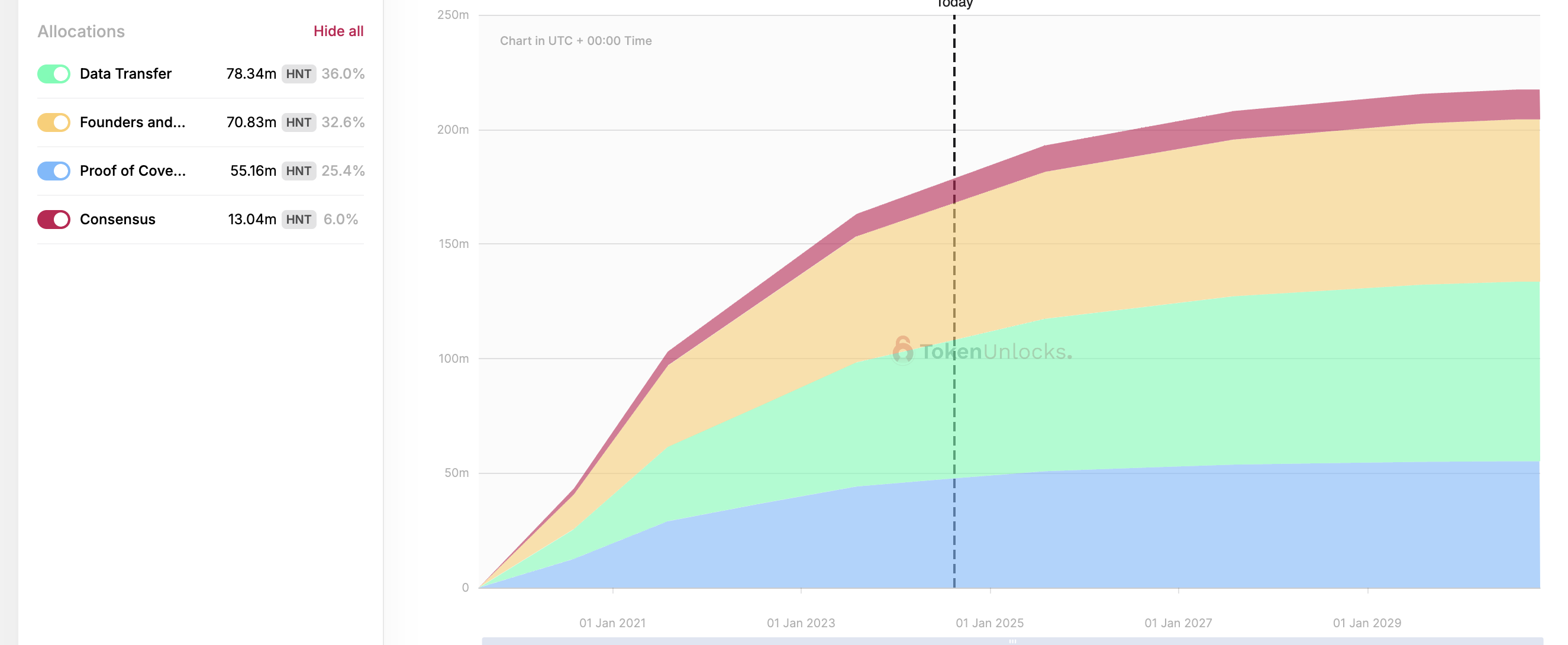
There is no pre-mine of HNT, and the maximum supply is capped at 223 million tokens. The distribution model includes rewards for hotspot operators and data transfer activities, promoting a sustainable economic model for the network.
The distribution of HNT is structured to incentivize various stakeholders within the Helium ecosystem, including hotspot hosts, network operators, and investors. The initial distribution plan was set to release 5 million HNT per month, which is subject to halving events every two years. The halving events reduce the issuance rate, thereby controlling inflation and aligning with the network's growth.
MOBILE Token
The MOBILE token supports the Helium Mobile Network. The token is mined through the PoC mechanism, which verifies that hotspots are providing legitimate coverage and facilitating data transfers. This ensures that only hotspots contributing to the network's utility earn MOBILE tokens.
IOT Token
The IOT token is used in the IoT subDAO, which manages the Helium IoT network. The token rewards are tied to the Proof-of-Coverage (PoC) mechanism, which verifies that hotspots are accurately representing their coverage areas.
Helium has recently experienced significant growth and advancements, particularly with the expansion of its Helium Mobile service and the integration of decentralized physical infrastructure networks (DePIN).
Helium's HNT token saw a remarkable surge in recent weeks. This increase is largely attributed to the rapid growth of Helium Mobile, which has now surpassed 100,000 subscribers. The surge reflects a 300-fold increase in subscribers over the past year, showcasing the service's increasing adoption and popularity. Additionally, Helium Mobile has initiated a pilot program in collaboration with major U.S. telecommunications companies, further enhancing its market presence and service capabilities.
The Helium Foundation is broadening its focus to include decentralized physical infrastructure networks (DePIN). This strategic move aims to bolster Helium's Internet of Things (IoT) network and facilitate collaboration on various innovative projects. A notable application of the DePIN model is exemplified by WeatherXM, which has installed decentralized weather tracking stations at the Paris Olympics.
 APP
APP

 24210
24210