

 5m
5m
Staking in cryptocurrency is the process of locking up a certain amount of coins to help secure and operate a blockchain network, and earning rewards for doing so. Blockchains that allow staking use a system called Proof-of-Stake (PoS) (as opposed to Proof-of-Work used by Bitcoin’s “mining”). In a PoS network, validators are chosen to verify transactions and create new blocks based on the coins they have staked, rather than based on who has the most computing power. This method is far more energy-efficient than mining because it doesn’t require heavy computatio– instead, it relies on participants having a financial stake in the network’s success.
When you stake your crypto, you typically lock it into a wallet or staking platform for a period of time. While staked, your coins help to validate transactions and secure the network. In return, the network rewards you with new cryptocurrency (staking rewards). For example, by staking ETH (Ethereum’s coin), you earn more ETH over time as a reward for helping validate the Ethereum blockchain. Many popular blockchains use staking, including Ethereum, Cardano, Solana, Polkadot, Cosmos and others.
Staking is crucial because it aligns the incentives of coin holders with the health of the network. By having something “at stake” (your locked coins), you’re motivated to follow the rules and keep the network secure. If a malicious actor tried to attack or cheat the system, they would risk losing their staked coins. In fact, many PoS blockchains have penalties (called slashing) for validators who misbehave – this means a portion of their staked coins can be destroyed if they try to cheat or even if they go offline negligently. This threat of losing money encourages honest behavior and makes it extremely expensive to attack a well-staked network. On the flip side, the more people stake their coins, the more secure and decentralized the network becomes, because an attacker would need to control a huge amount of the staked coins to take over.
In summary, staking serves two main purposes: (1) it allows crypto holders to earn passive income in the form of additional coins, and (2) it helps secure the blockchain by incentivizing good behavior\. Next, let’s explore the different types of staking and how they work.
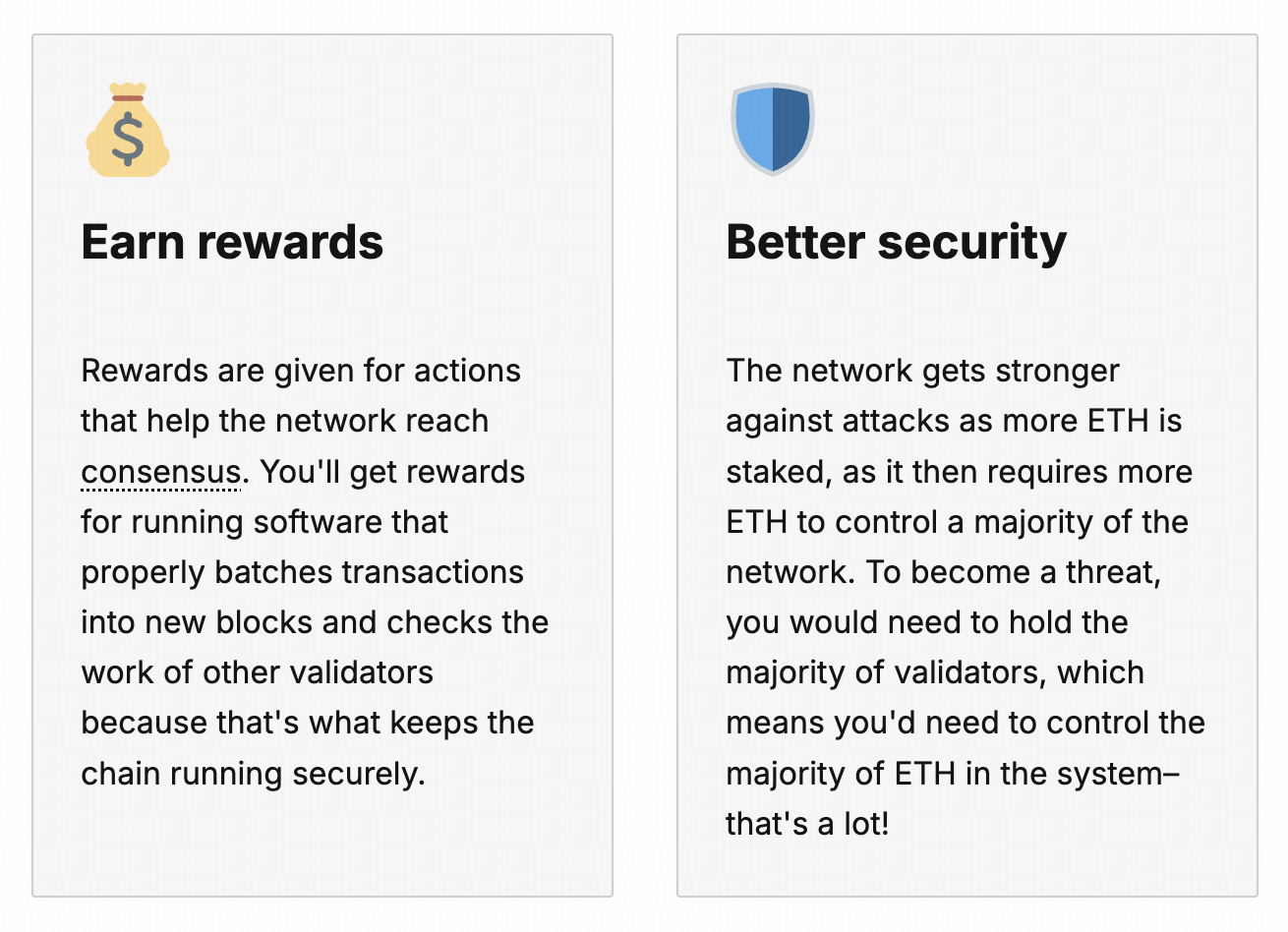
Proof-of-Stake staking is the most common form of staking and is part of the blockchain’s core operation. In a PoS network, anyone with the minimum required coins can become a validator by staking those coins. A validator’s job is to verify new transactions and bundle them into a “block.” The blockchain selects validators to create new blocks based on a combination of factors like how many coins are staked (more stake can increase your chances), how long they’ve been staked, and sometimes random luck. When a validator is chosen and successfully adds a block to the chain, they receive a block reward (newly minted coins or transaction fees) as a staking reward.
Source: https://ethereum.org/en/staking/
For example, Ethereum now uses PoS for block validation. To become a full validator on Ethereum, you must stake 32 ETH (the required minimum). Your staked ETH activates a validator node – a piece of software that runs 24/7 to process transactions and secure the network. As a validator, you can currently earn roughly 4-5% annual yield in ETH rewards (the rate varies) for doing your duty. However, running a validator comes with responsibilities – if your node goes offline or you try to cheat, you could be slashed, losing some of your 32 ETH as a penalty. Not everyone has the technical ability or the large amount of ETH to stake solo. Fortunately, it’s possible to stake less than 32 ETH by joining pools or using staking services\. Many regular users stake via exchanges or staking pools that gather many people’s ETH and run validators on their behalf, splitting the rewards.
Outside of core blockchain consensus, the term “staking” is also commonly used in the context of Decentralized Finance (DeFi). In DeFi, staking usually means locking your cryptocurrency into a smart contract to earn yield, but here you are supporting a DeFi protocol rather than securing an entire blockchain. This can take a few forms:
While staking is generally considered safer than highly speculative trading, it is not without risks. It’s important to understand the potential risks before you stake:
 APP
APP

 9732
9732