Currently, most centralized exchanges offer two types of perpetual contract products: USD-margined contracts and COIN-margined contracts.
As the names imply, USD-margined contracts are contracts priced in stablecoins such as USDT, USDC, and BUSD, while COIN-margined contracts are settled in the corresponding tokens (such as BTC, ETH, and XRP).
Due to the different pricing methods, these two types of contracts have advantages and disadvantages, as well as suitable market environments and investment strategies.
Pros and Cons of USD-Margined Contracts
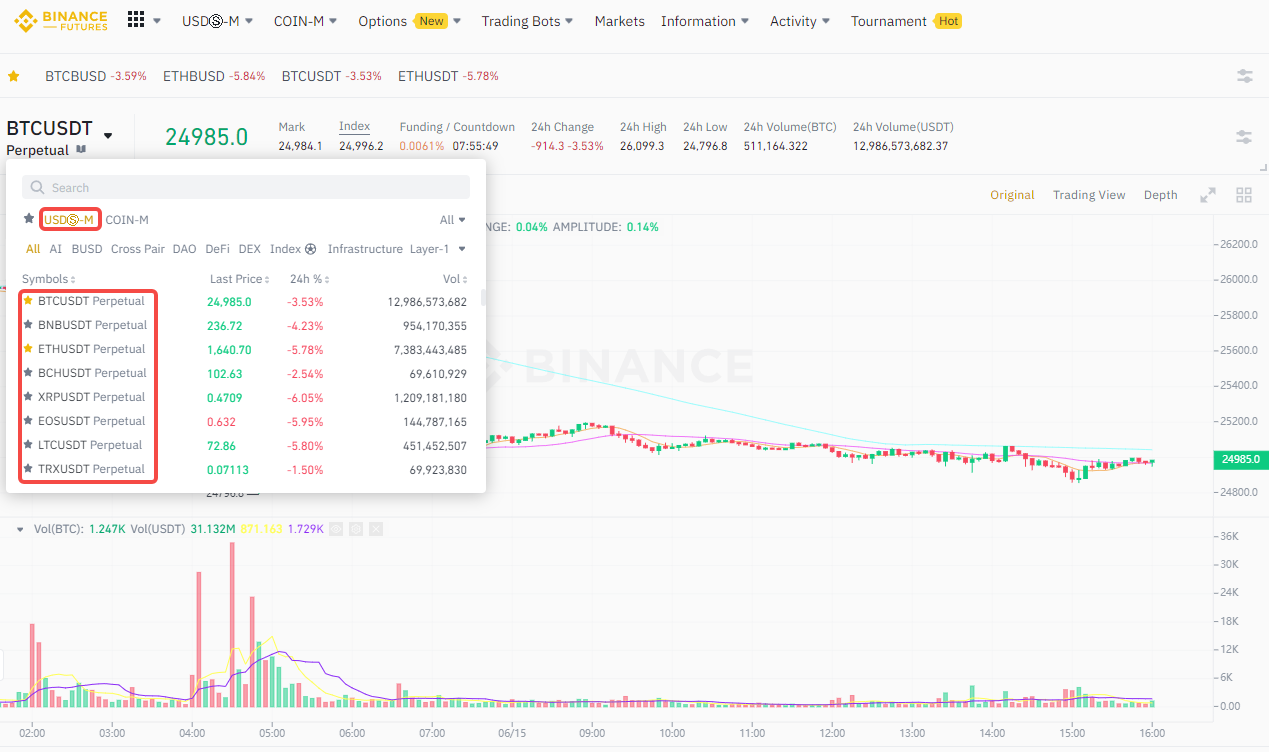
Source: Binance USD-M Perp
Pros:
Easy to understand: Stablecoins are pegged 1:1 to the US Dollar, making them easier to comprehend and calculate. For example, when you earn a profit of 100 USDT, you can easily estimate that the profit is approximately 100 dollars, making the contract settlement more intuitive.
Higher flexibility: You can use stablecoins to open or settle different futures contracts without the need to purchase the corresponding tokens to provide margins for the futures position. This reduces unnecessary time and trading costs.
Greater stability: Compared to regular tokens, stablecoins maintain a relatively constant value. Therefore, during significant market fluctuations, you generally don't need to worry about changes in the value of your positions due to fluctuations in the stablecoin's value. This helps to reduce risks.
Cons:
Limited potential returns: When engaging in perp trading using stablecoins like USDT, you need to allocate a portion of your assets to USDT. This means that compared to holding other tokens with potential appreciation, such as BTC and ETH, the value of USDT is unlikely to change significantly, resulting in minimal potential returns.
Potential value gains: COIN-margined contracts allow you to participate directly in the price changes of the underlying token since they are priced and settled in the base token. This means that during a bull market or when you have high confidence in the future value of the token, you can earn greater profits through the contract.
No need to hold stablecoins: For miners or long-term token holders, COIN-margined contracts enable them to open positions directly without converting their crypto assets into stablecoins. This avoids unnecessary losses that may occur from selling tokens at lower prices. Additionally, you don't need to worry about the risk of stablecoin depegging.
Volatility risk: Since COIN-margined contracts are priced and settled in the base token, traders face the risk of price fluctuations in the base cryptocurrency. If the market experiences significant volatility, traders may incur substantial losses.
Relatively higher barrier to entry: COIN-margined contracts require traders to hold a certain amount of the base token, which may limit participation, especially for those without a significant amount of cryptocurrencies. Additionally, price calculations are more complex, and traders need to have a thorough understanding of contract operations, margin requirements, leverage ratios, and other aspects. This can be unfriendly for newcomers or inexperienced traders.
Summary
In a nutshell, USD-margined and COIN-margined contracts have significant differences in flexibility, potential returns, and risk levels. USD-margined contracts are more suitable for bear markets due to their lower risk. In contrast, COIN-margined contracts are more suitable for bull markets as you can benefit from the potential value appreciation of the underlying tokens. However, the specific choice of contract depends on factors such as your risk tolerance, trading objectives, and contract terms. It is important to consider these factors and make an informed decision.


 4m
4m
 APP
APP

 20562
20562