Strategy (MSTR) has introduced an innovative new capital instrument, STRC, offering a 9% plus annual yield and maintaining price stability like a stablecoin. This article will explore STRC alongside Strategy’s other capital instruments, like STRK and STRF, highlighting their unique appeal to different types of investors.
Strategy (formerly MicroStrategy) has crafted a distinctive capital structure, blending various debt and equity instruments to fund its operations and, most notably, its Bitcoin acquisitions. In simple terms, capital structure refers to the mix of debt and equity a company uses to finance its growth. What makes Strategy’s case particularly interesting is the introduction of multiple innovative financial instruments, including common stock, preferred stocks like STRK and STRF, convertible bonds, and now, the newly launched STRC.
The latest addition, STRC (Stretch), is particularly intriguing. Marketed as a "stable" Bitcoin-backed equity, STRC aims to mimic the stability of a T-bill, offering a low-volatility, cash-like yield layer within Strategy's BTC credit stack.
This article will break down these layers in simple terms, explain what STRK, STRF, and STRC are and how they work.
Think of a company’s finances as a layered cake or pyramid. Each layer represents a different type of capital with its own risk and reward:
In summary, the capital stack is a hierarchy: debt > preferred stock > common stock in terms of claim priority. Each layer has a different risk/return profile suited to different investors. Now, let’s see how Strategy has structured its own capital stack using these ingredients.
Strategy has deliberately engineered a multi-tier capital structure to fund its strategy of accumulating Bitcoin. As of 2025, the company’s captial stack include:
Common equity – the regular shares of Strategy that trade on Nasdaq under MSTR. These are the ordinary stocks for shareholders who want direct participation in the company’s fortunes (and Bitcoin holdings).
Preferred equity – multiple series of perpetual preferred stock with creative nicknames:
Convertible bonds – these are debt instruments that can convert into common shares if Strategy’s stock price reaches certain levels. Strategy has issued several, notably 0% interest convertible notes due in future years (2027, 2028, 2030, etc.) to raise billions to buy Bitcoin.
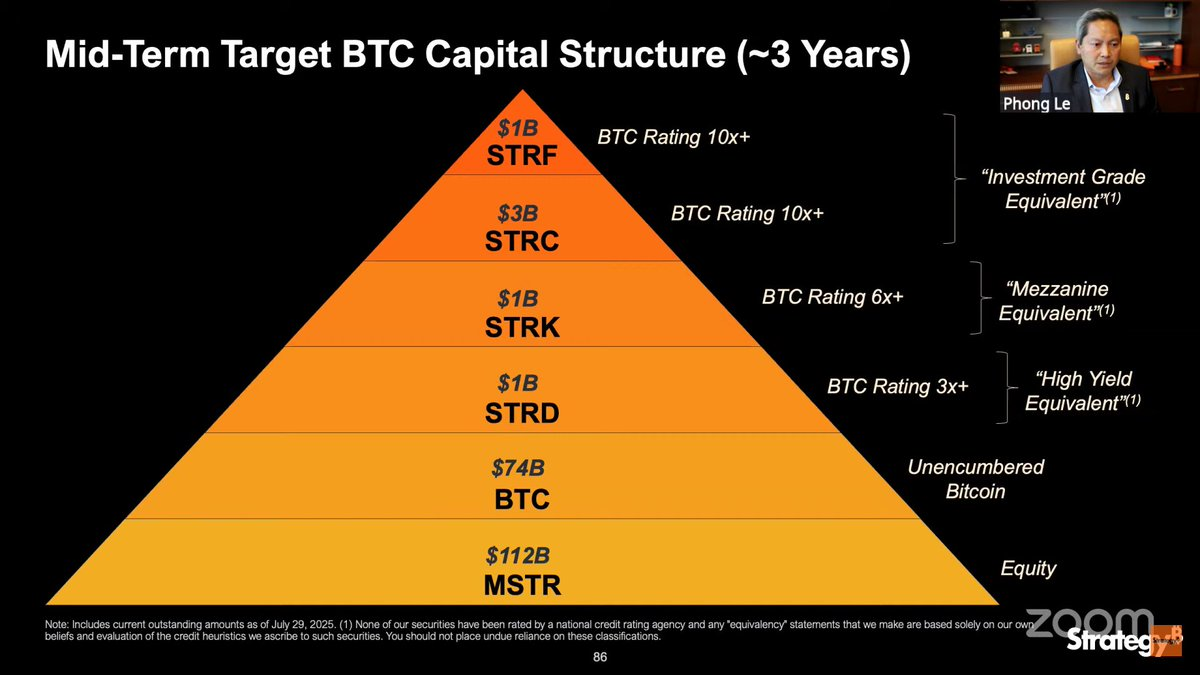
Source: Strategy
Think of each layer as a different way for investors to bet on Bitcoin with a profile that suits them:
STRC, or “Stretch,” is the latest innovation in Strategy’s capital structure. STRC is a variable-rate, perpetual preferred stock that provides investors with a stable, high-yield opportunity backed by Bitcoin. The instrument is designed to function like a cash-equivalent asset, offering low volatility and regular monthly dividends, while still allowing exposure to Bitcoin’s performance.
Preferred stocks are a special class of stock that have a fixed dividend and priority over common stock for receiving dividends or assets, but usually no voting rights. Strategy’s preferreds are “perpetual” – meaning they have no maturity date (the company isn’t obligated to ever pay back a principal amount; it just pays the dividends indefinitely, unless it redeems the shares).
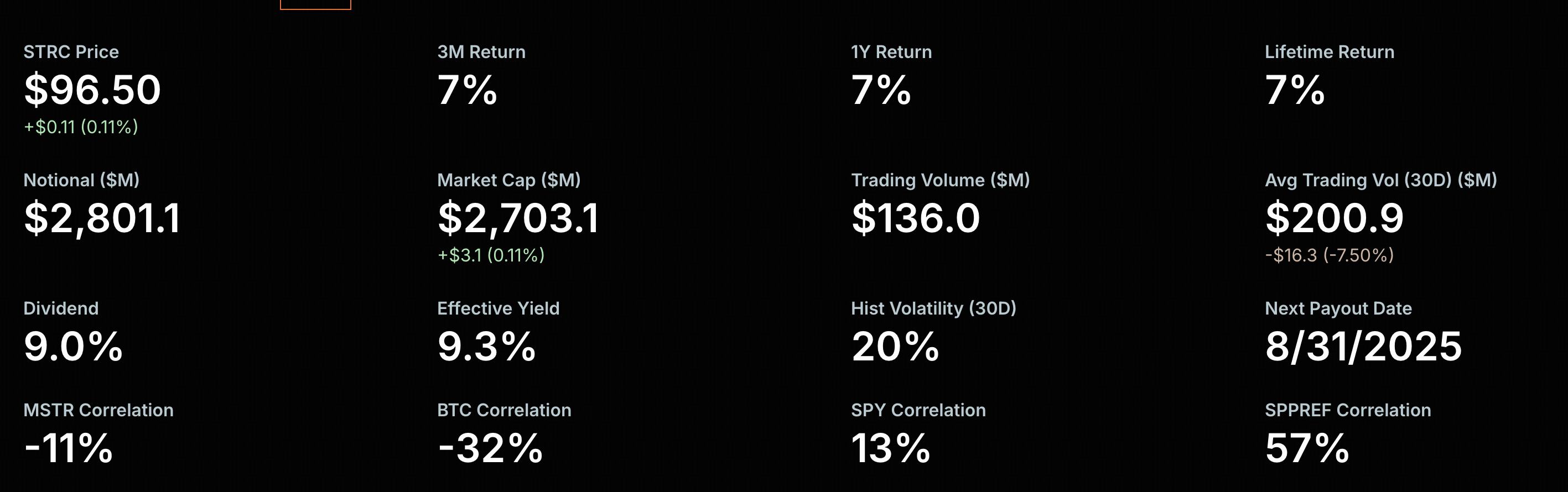
Yield & Dividends: STRC offers an annual dividend rate of approximately 9%, which is payable on a monthly basis. The dividend rate is adjustable each month, with the aim of maintaining the share price near its $100 stated value. This makes it an attractive option for income-focused investors looking for a stable cash flow without the full volatility of holding Bitcoin directly.
Price Stability Mechanisms:
In Strategy’s multi-layered capital structure, STRC occupies a middle tier. It ranks senior to STRD (“Stride”) and STRK (“Strike”), but is junior to STRF (“Strife”) and the company’s debt. This positioning allows it to be a more stable, low-volatility option compared to the higher-risk preferred stocks, while still offering a higher yield than traditional cash-equivalent instruments.
STRC is designed for a variety of investor profiles:
It’s worth reiterating the company’s plan to service its obligations. Strategy openly states it will use a combination of sources to fund its preferred dividends and any debt interest: operating cash flow (from its software business, which provides some millions in income), proceeds from new debt or convertibles, and proceeds from ATM (at-the-market) sales of common stock.
In 2023–2025, the company had an active ATM equity program, selling small amounts of MSTR stock into the market – for example, it sold stock to raise $500 million in 2023 and had authorization to sell up to $3.57 billion more of common stock as of early 2025. That is a sizable war chest: by issuing new common shares gradually (especially when the stock price is high), they can bring in cash to cover dividends.
Additionally, the launch of new preferred series (like STRD “Stride”) was explicitly to raise money partly to pay the dividends on STRF and STRK. This might seem like paying one credit card with another – and in a sense it is a form of refinancing scheme. As long as new investors are willing to come in (and Bitcoin’s narrative stays strong), it can work. If capital markets froze or the stock price collapsed, it would be much harder for Strategy to raise fresh funds, and that’s where the strain would show.
 APP
APP