

 4m
4m
In many cases, the two concepts of yield farming and liquidity mining often need clarification. Indeed, in a broad sense, both concepts refer to the process of obtaining passive income by providing liquidity to DeFi (decentralized finance) protocols. But there are also subtle differences between them, and understanding these differences can help us grasp the two concepts more accurately.
To better understand them, here's a suggestion that we introduce another fundamental concept, "staking," mentioned in the previous chapter, for comparison and understanding. The following are the basic definitions of these three concepts:
It is not difficult to see that the main difference between the three lies in the scenario and motivation: as the core element of many blockchain consensus mechanisms, staking generally exists in various scenarios, and in general, compared to obtaining passive income, stakers are more inclined to want to maintain the security of the network; yield farming occurs in DeFi protocols, and farmers focus on revenue, that is, the pursuit of a higher APY (annual percentage yield); and when this investment strategy is specific to the category of AMM DEXes, it's therefore called liquidity mining.
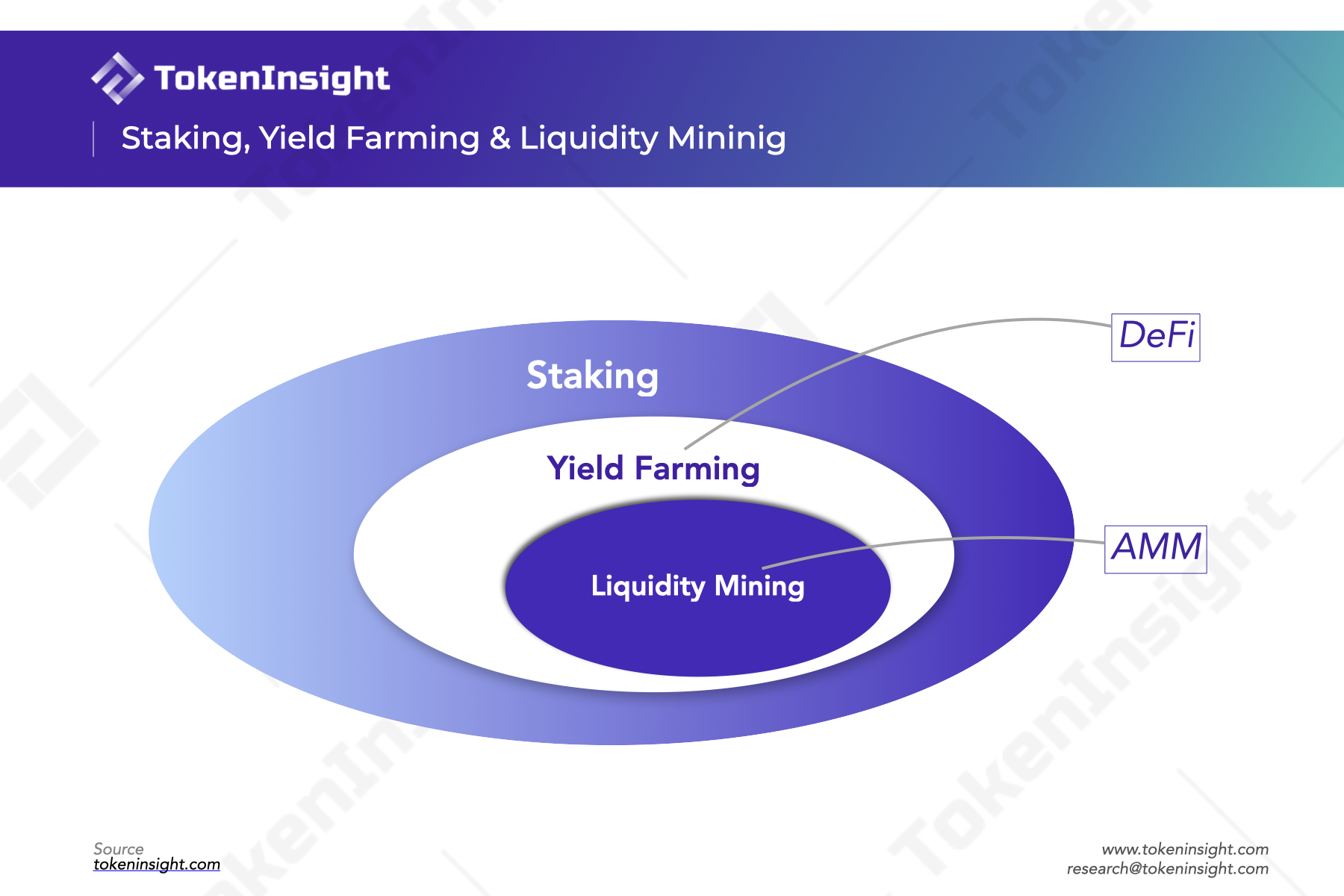
Of course, the relationship between the three is more complex than shown in the chart. The above chart is to provide an intuitive relationship display.
If you want to learn more about yield farming, please check “What is yearn.finance”.
 APP
APP

 4124
4124